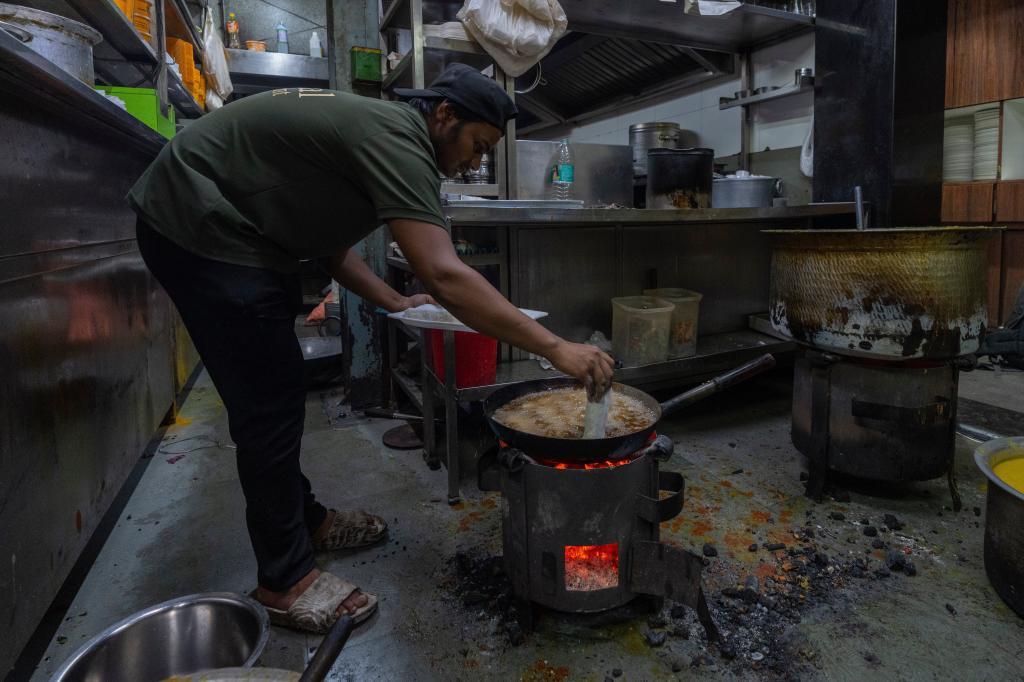
In Noida, a satellite city east of New Delhi, a small café inside a cricket stadium complex has turned off the fryer. Not due to lack of customers, but due to lack of gas. The business is run by several acid attack survivors, women who were shunned by society and have rebuilt their lives through work. Now, the energy crisis threatens to take that away from them as well.
"Before, we could cook all day. Now we don't serve meals anymore", says Mousumi Halder, 33, who was attacked with acid by a group of men in 2015. "We have to wait at least five days to get another cylinder," she adds. With burns all over her face, Halder underwent a dozen surgeries. Shunned by her family, she found refuge in an NGO, the Chhanv Foundation, which shelters victims and provides them with work in three cafés opened in Noida and Agra, near the Taj Mahal. Businesses that are now at risk due to the fuel shortage. "No gas means no income. And without income, many of us have nowhere to go," adds another worker, Sunita, 28.
In Delhi, long queues snake in front of gas distributor offices. Neighbors, restaurateurs, and small traders wait for hours to get a cylinder. Many return empty-handed. "I've been coming for three days," explained Rajesh Kumar, owner of a street food stall, to a local television station. "Without gas, I can't fry. Without frying, I don't sell. And without selling, I don't eat".
The same seemingly endless waits are repeated at government offices that usually subsidize gas supply to the poorest families. Five-kilo cylinders can be obtained on the black market, but the price has doubled to 1,900 rupees, which is around 18 euros, a figure that may seem modest outside India but is prohibitive in a country where millions survive on just a few euros a day.
This situation is being replicated these days throughout South Asia, in developing economies heavily reliant on gas for daily cooking. The interruption of liquefied petroleum gas (LPG) supply, caused by the blockade of the Strait of Hormuz due to a distant war, has plunged the region into its worst energy crisis in decades.
For India, this interruption is a structural shock. So far, only two shipments have managed to cross Hormuz since it was effectively closed, a fraction of the daily demand. The world's most populous country, with over 1.4 billion inhabitants, is the second-largest importer of LPG. Over 60% of its supply comes from Gulf countries like the United Arab Emirates, Kuwait, Qatar, and Saudi Arabia. This dependence is strategic but also social: LPG is the basic cooking fuel in hundreds of millions of households.
Over the past decade, the government promoted access to gas as a cleaner alternative to wood or kerosene, especially among the poorest families. Public programs provided subsidized cylinders that improved domestic life in rural areas and slums. Today, that progress is at risk of being reversed.
Restaurants and street stalls, which are the backbone of the informal economy in cities, are temporarily closing. Demand for electric induction cooktops has surged, although very few can afford their cost and have stable electricity supply. In the industrial sector, the impact is more noticeable. In Morbi, in the state of Gujarat, one of the world's largest ceramic hubs, nearly 500 out of 670 factories have closed. Another 430 have suspended operations for at least three weeks. "Without gas, there is no production," said a local businessman. "And without production, thousands of workers are left without wages."
Even crematoriums have had to adapt. Some have switched to electric ovens to avoid a buildup of bodies. Meanwhile, thefts of LPG trucks have soared, a sign that the shortage is no longer just economic but also a public order issue.
Prime Minister Narendra Modi has tried to contain the alarm. "There is no need to panic," he recently declared. His government has authorized the use of more polluting fuels, such as coal, to alleviate the crisis after many restaurants warned they would close within days if they did not receive new supplies. A measure that highlights the seriousness of the situation. Refineries have also been ordered to maximize LPG production for domestic use, prioritizing hospitals and educational centers. But experts warn that domestic capacity is not enough to compensate for the drop in imports.
This energy crisis is not limited to India. In neighboring Pakistan, schools have temporarily closed, and the public sector has adopted four-day workweeks. Sri Lanka is following a similar path. In Bangladesh, universities are closed, and exams are canceled. In Southeast Asia, facing very limited oil reserves, countries like Vietnam, the Philippines, or Thailand are promoting telecommuting to reduce transportation and save energy.