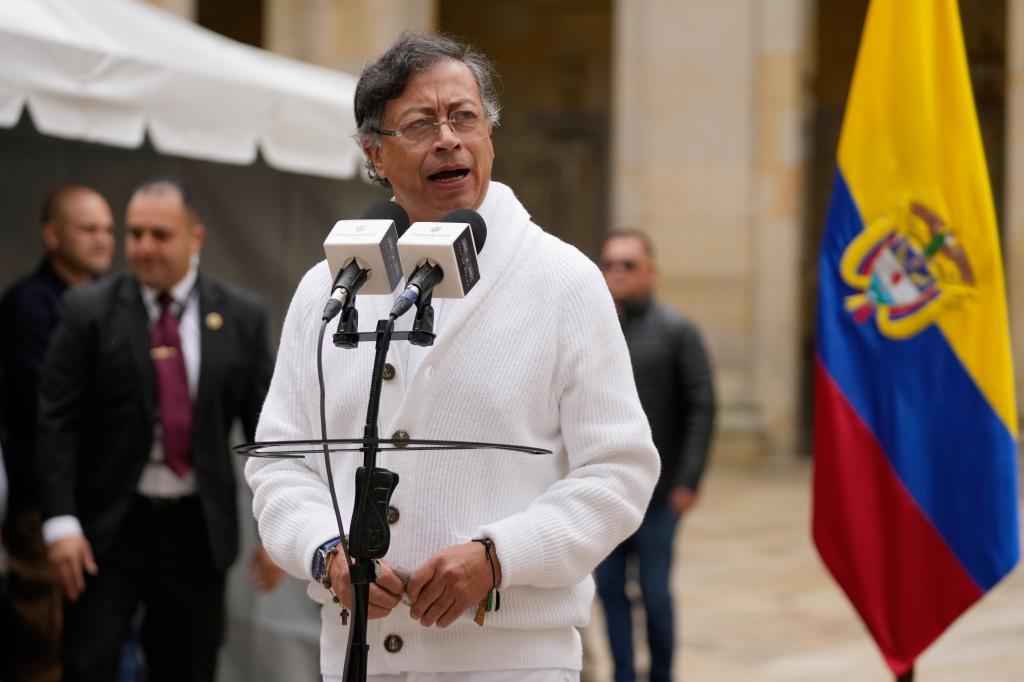
Two U.S. federal prosecutors are officially investigating the President of Colombia,Gustavo Petro, to determine if his presidential campaign requested or accepted donations from criminal organizations. The accusation, reported by The New York Times, is similar to what many of his predecessors faced, from Juan Manuel Santos to Iván Duque and Álvaro Uribe, but they did not face the US criminal justice system.
Relations between Bogotá and Washington, especially between their leaders, are particularly delicate at the moment, as seen in the case of Nicolás Maduro, a case of this nature is now a matter of great concern on the continent. Especially if Donald Trump has pointed at you saying you will be "next," as was the case with Petro in January.
The New York newspaper reports today, citing three people with knowledge of the investigations, that the investigation has mobilized "specialized prosecutors in international drug trafficking, as well as agents from the Drug Enforcement Administration (DEA) and Homeland Security Investigations (HSI)," but it is in its early stages "and it is not clear if any of them will result in criminal charges."
The news published today specifies that there is no evidence that these investigations were ordered or suggested from the White House, despite Trump's past remarks or the US administration's clear interest in the outcome of the May elections that will decide who succeeds Petro. But there is clearly a new pattern in the authorities' modus operandi.
A few months ago, Trump's Treasury Secretary, Scott Bessent, sanctioned Petro, his family, and collaborators stating that the Colombian president "has allowed drug cartels to thrive and has refused to stop this activity."
The justification for the military operation that led to the capture of Nicolás Maduro and his wife, detained in a prison in New York right now, was the formal accusation by the Department of Justice against the former Venezuelan president for his possible ties to drug trafficking networks. As also reported by the Times, the top federal prosecutor in southern Florida, a Trump ally, has ordered an investigation against the leaders of Cuba "for crimes related to drug trafficking, immigration, the economy, and violence," almost in parallel with Trump's escalating rhetoric, talking about a "friendly takeover" of the islands and insisting that he "can do whatever he wants with it."
Ironically, all this while the president pardoned former Honduran president Juan Orlando Hernández, who had been extradited to the US in 2022, tried, found guilty, and sentenced to 45 years in prison precisely for drug trafficking.
Specifically, the New York prosecutors are focused on determining if Petro personally met with drug traffickers and if his presidential campaign requested funds from them. The Colombian press has extensively reported on these possible links and the role of Petro's son, who has admitted that there was dirty money in the 2022 campaign.
Since Trump's return to power, relations with Colombia have always been tense. It started with Bogotá's refusal to accept US military flights with deportees, leading to a rhetorical escalation on social media and the imposition (briefly) of mutual tariffs.
Coordination in operations against drug traffickers was the next point of contention, especially since Washington began sinking boats in the Caribbean, killing dozens of people in international waters. Later, Petro, from New York during the UN General Assembly, participated in a pro-Palestinian march and encouraged American soldiers not to follow illegal orders, leading to the mentioned sanctions.
At the end of last year, the Colombian visited the White House. There were no live images of the conversation, but it seemed that the worst moments were behind. In January, after Maduro's capture, Trump pointed at Bogotá, and Petro himself, who is now finishing his term, confessed that he was afraid of being next and of a similar intervention in his country.