The walls of the Rivoli cinema are still decorated with posters of the movies it used to show. Mostly titles from Bollywood or movies like Ninja: American Warrior. Qassem Istanbouli also wanted the venue to become a repository of the "memory" of the southern region. That's why there are showcases with old coffee makers and vintage glasses, mixed with film reels hanging on the walls.
The Rivoli is part of that history of a Lebanon defined by glamour, when it was one of the five cinemas in the southern city of Tyre and hosted artists like Brigitte Bardot, who attended the screenings of their films. The artistic scene in Tyre was just a small-scale reflection of what was happening in Beirut, which had nearly 50 cinemas in the 1960s and early 1970s, and a street - Hamra Street - that earned the nickname "the Champs-Élysées" of the Lebanese capital due to the accumulation of theaters and artistic exhibition halls it had.
Like everything in this country, the era remembered with nostalgia was replaced by the horror imposed by the civil war starting in 1975 and the multiple Israeli invasions in the subsequent decades. The Rivoli barely survived the ravages caused by the Israeli occupation of Tyre in 1978 and the one it endured later between 1982 and 1985. Exhausted, like the entire country, it closed its doors at the end of that last decade. Istanbouli, grandson of a hakawati (traditional storyteller), was determined to rehabilitate the venue and reopened it in 2018.
But the Arab nation cannot escape a destiny associated with violence. In early March, when Lebanon joined the regional war, Rivoli opened its two floors, as it had done in 2024, to accommodate the displaced who were fleeing once again, within that grim ritual that repeats itself over and over in the country.
"People came without us saying anything. War is nothing new [in Lebanon]. Here we have about fifty people," says Qassem Istanbouli, who also lives in the building with his family.
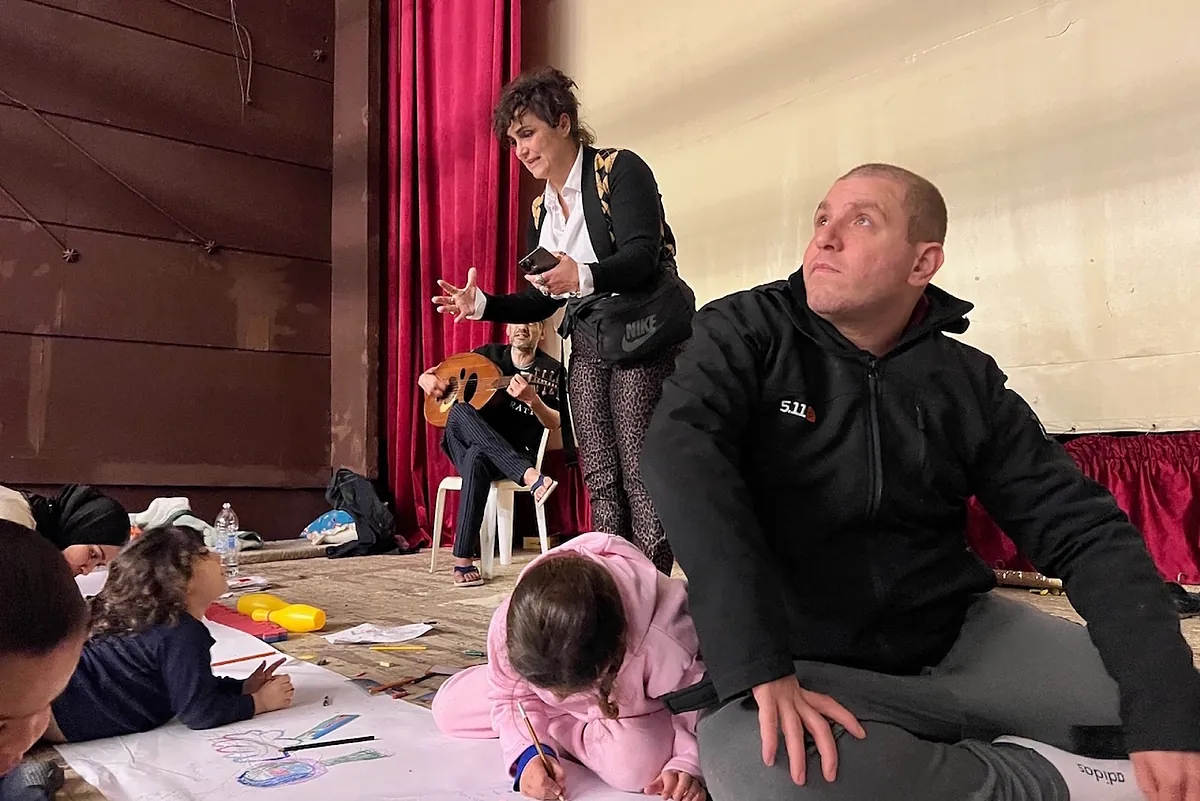
In the morning, the interior of the venue is a mix of mattresses on the floor where some still sleep next to the stage, pots of food stacked on one side of the same platform, or clothes spread over the chairs that were once occupied by spectators. The balcony stores dozens of spotlights, along with cardboard boxes - which sometimes define the spaces where the displaced live - and more mats.
The relative tranquility inside the Rivoli contrasts with the psychosis that has taken over Tyre - the main Lebanese city near Israel - for several days. The villages in the surrounding area and most of the streets in the city appear almost deserted due to the intensification of Israeli bombardments.
It's six in the evening. The time when Portuguese actress Ana Palma, 50, gathers the children living in the Rivoli for the daily workshop she organizes to distract them from the conflict. Today, it's drawing, although Faisal - another displaced person - entertains the activity with his lute. Notes that recall melodies like those of the singer Fairuz, turned into anthems for the Lebanese who heard them a thousand times during the civil war that shook the country between 1975 and 1990.
The southern population has had a "quiet" day according to the references of this community of refugees. Only a distant explosion was perceived. "A few days ago, we could hear the whistles of the missiles," Khalil Qawar points out, who has settled in the Rivoli with his wife and son Ali. "There is nothing safe in Tyre," Qassem adds.
Among the fifty residents, there are "veterans" who had already sought refuge in this place as an improvised home during the 2024 conflict. Fatima Hakim, 52, is among them. On that occasion, she spent 66 days living in the cinema's balcony. This time she has moved to the main stage.
The family home was destroyed in the last conflagration. "We were left with only the kitchen and a small room," recounts the Lebanese woman. It was there that miraculously her mother and two brothers were trapped - but alive - just a few days ago when a new airstrike caused the upper floors of the building to collapse onto the house. Fatima spent two hours crying. She thought the three had died. "It was a miracle. They were protected by a gap that formed with the kitchen walls," she explains.
As she herself mentions, leaving the Rivoli and moving around the city is an act of faith. A kind of Russian roulette. Fatima says she has narrowly escaped death three times. The day she was going to meet her mother and brothers at home and was bombed. Another day when she went out to charge her phone and the store she went to was hit by two rockets. And when she was sitting in a local garden and the explosion of another projectile shattered a window that fell right next to her.
That's why Ana and Qassem strive for the Rivoli to be a kind of oasis of peace amidst the war. "A sanctuary of hope. A bubble in the midst of violence," in the words of the former.
The displaced living in the Rivoli are part of the tens of thousands of southern residents who fled to this town after the start of the war and are now trapped by the intensification of Israeli bombardments. Leaving or arriving in Tyre is a journey that, in the words of the Israeli army spokesperson, Avichai Adrai, "can endanger your lives." An expression whose meaning is not lost on the Lebanese.
This Sunday, the Israeli air force destroyed one of the main bridges connecting the southern town to the north of the country. Tel Aviv has announced its intention to bomb all access routes to the south, and the Defense Minister, Israel Katz, declared on that day that they intend to "accelerate the destruction" in the villages closest to the dividing line following "the model" - the minister's expression - applied during the Gaza genocide.
Tel Aviv has reacted furiously to the fierce resistance of Hezbollah militants on the border, increasing the action of its air force. On the same Sunday, a Hezbollah commando unit took advantage of the weather conditions to overcome Israeli army outposts already inside Lebanese territory to infiltrate near the town of Misgav Ams and attack that population with anti-tank missiles, according to the account of the Israeli newspaper Maariv. The operation resulted in one Israeli killed, burned alive in his car.
According to Israeli media, their troops have managed to establish 10 positions inside Lebanon, but just at the border, unable to reach the ten-kilometer security zone they intended to capture. "Hezbollah is taking the initiative and firing at the [Israeli] populations along the confrontation line to force them to evacuate their homes. Israel has not presented a strategy or specific tactics to determine what it intends to do in Lebanon," opined Avi Ashkenazi, the military correspondent for that newspaper.
Accustomed to decades of conflict and to distinguishing between rhetoric and reality, Dr. Abdul Nasser Farran—one of the surgeons still based in Tyre—believes that the actions of the neighboring country's aircraft are still far from the devastation they inflicted in the 2006 war, even in terms of the number of wounded. "We've received about 350 wounded since the start of the war. About 90 had to undergo surgery," he explains at the medical center where he has resided since the beginning of the latest conflict. "The border area is devastated, but the attacks in Tyre are targeted. It was much bloodier in 2006 and in 2004. The real war hasn't started yet," he estimates.
For Qassem Istanbouli, a native of Tyre, the Rivoli—beyond its use as a shelter during the war—is part of a much broader project aimed at rescuing local culture. The Lebanese man founded the Shooting for Art Association in 2014 with the aim of rehabilitating old Lebanese cinemas. He managed to restore four. One of them, the Nabatiyeh cinema, has now been damaged again during the conflict.
The other three, located in Beirut, Tripoli, and the Rivoli district, have gone from being cultural centers to shelters for refugees. The same situation as two years ago. "This is what I understand by cultural resistance. Cinemas cannot be empty. They have to be a space of freedom. It's a phrase Fernando Arrabal told me in Córdoba in 2016. And that's what we intend, for people here to be free, even though there's a war out there," Istanbouli explains.