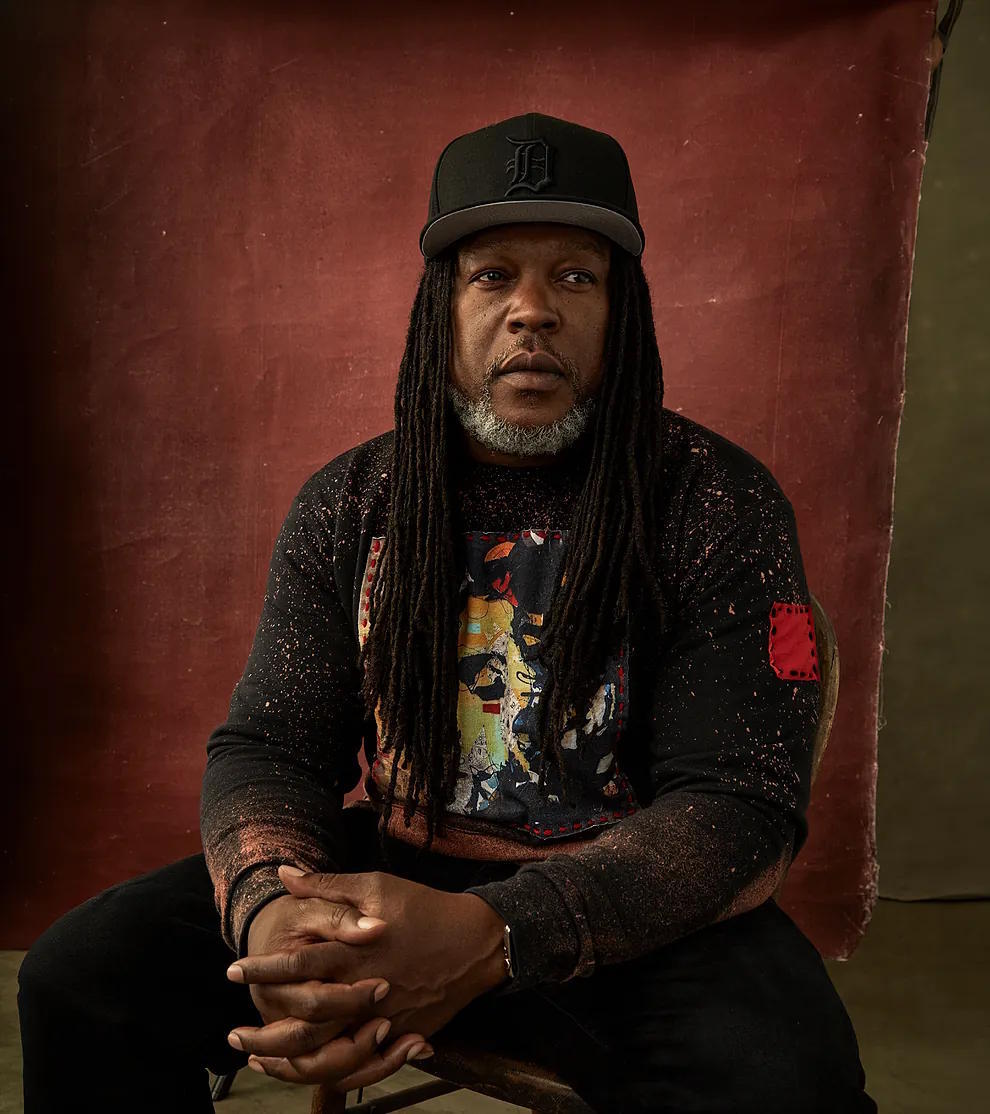
Shaka Senghor is 53 years old, a writer, a bestselling author according to The New York Times, a speaker, and lecturer. His TED talks have millions of views online, and his name appears on the list of the most spiritually inspiring and influential figures compiled each year in the US by American journalist Oprah Winfrey. He is also an expert in resilience, an occasional professor at the University, a coach, and an activist.
All this is on his resume... It also states that Shaka Senghor is a murderer. Or at least, he was.
In the summer of 1991, when he was not yet 20, he shot and killed another man during a drug deal in the tough streets of Detroit. He pleaded guilty and was sentenced to between 17 and 40 years in prison. His final sentence was 19 years, seven of which he spent in solitary confinement due to his dangerous behavior in prison.
When he was released, 7,000 days later, inmate 219,184 was determined to escape the 67.8% of ex-convicts who end up back in prison before three years have passed and became a self-help star, an influencer capable of giving talks at Harvard and turning his hell behind bars into motivational speeches for companies like Google, Apple, or Meta. "My most important message is that everyone has a hidden prison," he now evangelizes. "But also that every prison has a door."
And he says this, having spent his youth behind bars. "I lived locked in a cell 23 hours a day, five days a week. The other two days, I didn't go out for a minute," he explains. "Isolation is an inhumane experience for anyone, really tough. Often it was all chaos and noise, a lot of noise. Other times there was only silence...".
Shaka Senghor now responds on the other side of the screen from the recording studio in his Los Angeles home. He wears a Detroit Tigers baseball cap covering his distinctive dreadlocks and holds the Spanish edition of his latest book, the first of the three he has written that is being published in our country. It is called How to Be Free and is presented as a guide to escape life's invisible prisons.
Senghor speaks with the calm of a Buddhist monk who, when he entered prison, was an "angry and broken" kid. His childhood was marked by crack cocaine, kung fu movies, an attempted sexual assault when he was just a kid, abuse, and his mother's abandonment. At 14, Shaka ran away from home, at 16 he imagined his suicide with a shotgun and a bottle of pills in the basement of his house, and at 17 he was almost shot. At 19, he shot someone.
"On the first day in prison, I felt anger and shame. I was angry because I thought my life was over," he explains.
During his early years in prison, he accumulated 36 disciplinary sanctions. "I didn't believe there was another possibility for me," he insists. Until something started to change in his mind...
He writes in his book: "I realized that I had already entered prison long before I was arrested."
Books, writing, and meditation gave him freedom long before the court granted him parole. "I believe that freedom comes from within," he says. "Sometimes you can move, but anger, shame, disappointment, or insecurity trap you in your mind, and that is worse than being physically imprisoned. When you free yourself mentally and spiritually, the body eventually follows."
Senghor left prison in 2010 as a different person, entering a changed world. "When I entered prison, there was no internet. And suddenly, I came back home, and there were many different ways for people to connect and communicate. I didn't know any of them, and I had to learn everything at once," he recalls. "The hardest part was realizing that a big part of me was still that 19-year-old who had entered prison and having to learn again how to navigate society, feel comfortable, and move freely in the world."
Each chapter of his book, written as if Mr. Wonderful himself had spent half his life in Alcatraz, is titled with a feeling. All the emotions that Senghor went through in prison. From pain to anger. From joy to success. Forgiveness, vulnerability, hope... Each section has its set of practical exercises and a string of quotes, like Master Yoda, that have made him a sought-after guru.
He says that pain helped him understand the importance of gratitude. "It taught me that we are resilient and taught me to be grateful for the things I have in my life, even when it's hard. If I can overcome the pain of the moment, I can move forward in any situation."
He also says that it is easier to punish oneself than to forgive. "One of the hardest things as human beings is to forgive ourselves when we have done something that has harmed others," he philosophizes. "And if you can't forgive yourself, it's hard to accept forgiveness from others. It took me a while to realize that I was worthy of forgiveness."
And he also says that he is no longer afraid to be happy. "No, the truth is, I'm not anymore," he celebrates. "I really strive to live my life with joy, love, laughter, and all those things that make up a very happy life."
Q. What can someone who was convicted of murder teach us about life?
A. I believe that people who have been convicted of any crime can teach us a lot about life. Mine has been an example of what happens when you fail, when you are marginalized by society. Learning to rise after such an experience is a lesson that applies in any context. How do you recover when you lose your job? How do you redeem yourself when you are not a good father? I learned a lot, and that's why I wrote this book, which is not so much about prison but about the hidden prisons that exist in our minds. I think people can learn from my journey: not only how I took responsibility and be held accountable for my crime, but also everything I did afterwards. How I decided to reshape my life, how I embraced education on my own, and how I now dedicate myself to serving others.
Senghor exudes the calmness of a Buddhist monk who, when he entered prison, was an "angry and broken kid." Behind him was a childhood marked by crack cocaine and kung fu movies, by an attempted sexual abuse when he was just a boy, by abuse and abandonment by his mother. At 14, Shaka ran away from home, at 16 he imagined his suicide with a shotgun and a bottle of pills in the basement of his house, and at 17 he was almost killed by a gunshot. At 19, he shot someone.
"On the first day in prison, I felt anger and shame. I was angry because I thought my life was over," he explains.
During his initial years in prison, he accumulated 36 disciplinary sanctions. "I didn't believe there was another possibility for me," he insists. Until something began to change in his mind...
Q. You write in your book: "I realized that I had already entered prison long before I was arrested."
A. Books, writing, and meditation also gave him freedom long before the court granted him parole. "I believe that freedom comes from within," he says. "Sometimes you can move, but anger, shame, disappointment, or insecurity trap you in your mind and that is worse than being physically imprisoned. When you free yourself mentally and spiritually, the body eventually follows."
Q. What was the darkest moment for you in prison?
A. The darkest moment was when, after three years in solitary confinement, I realized I had a talent as a writer, but at the same time, I was trapped in a place where I couldn't do anything with what I wrote. That was the toughest part of my sentence: discovering that I had a dream in an environment meant to be a nightmare.
Q. "Prison is designed to break you," you say on the first page of your book. "The walls, the rules, the routine; everything is planned to strip you of everything you have until you forget who you are." How does one rebuild their identity when they have been defined by a crime for years?
A. First, you have to build your identity from within. And the story you tell yourself has to matter more than the story the system tells about you. In my case, it was a matter of accumulating small achievements that, although they didn't define me, were part of who I am. Keeping a journal, for example, helped me realize that I was more than my crime. I was more than my worst moment. I believed that if I remained present in the world, I could contribute value to society. And that was more important than something I did when I was a 19-year-old kid.
Senghor left prison in 2010 as a different person and found the world transformed. "When I entered prison, there was no internet. And suddenly, I came back home, and there were many different ways for people to connect and communicate. I didn't know any of them and had to learn everything at once," he recalls. "The hardest part was realizing that a big part of me was still that 19-year-old who had entered prison and having to relearn how to navigate society, to feel comfortable and move freely in the world."
Q. What part of you still lives in that prison?
A. I would say the only part is the love I feel for the friends I left behind and my desire to help people in that environment. I never thought I would go back, but now I visit prisons around the world and feel love for the people trying to find meaning in their lives while they are inside.
Q. What did you learn from other inmates that you would have never learned on the outside?
A. It's hard to imagine how my life would have been if I had never entered prison. But I learned to be responsible. I learned to be diligent in my studies, to face my difficulties head-on. Inside, I met some incredible thinkers: lawyers, philosophers, educators... There were amazing men. Some of my best mentors were serving sentences.
Q. You are now a staunch activist for criminal justice reform and inmate rehabilitation. Is prison just a punishment or an opportunity for transformation?
A. Prison itself is a punishment. And I believe that transformation depends on each person. Prison can help people turn their lives around, but for many years, it hasn't been the case. I was lucky, but it wasn't prison that changed me, I changed myself.
Each chapter of his book, written as if Mr. Wonderful himself had spent half his life in Alcatraz, is titled with a feeling. All the emotions Senghor went through in prison. From pain to anger. From joy to success. Forgiveness, vulnerability, hope... Each section has its set of practical exercises and a string of quotes, like Master Yoda, that have turned him into a sought-after guru.
He says that pain helped him understand the importance of gratitude. "It taught me that we are resilient and taught me to be grateful for the things I have in my life, even when it's difficult. If I can overcome the pain of the moment, I can move forward in any situation."
He also says that it's easier to punish oneself than to forgive. "One of the hardest things as human beings is to forgive ourselves when we have done something that has harmed others," he philosophizes. "And if you can't forgive yourself, it's hard to accept forgiveness from others. It took me a while to realize that I was worthy of forgiveness."
And he also says that he is no longer afraid to be happy. "No, the truth is, I'm not anymore," he celebrates. "I truly strive to live my life with joy, love, laughter, and all those things that make up a very happy life."
Q. When you think today of the young man you were at 19, what do you see?
A. I see a boy who had experienced many traumas and who, in turn, traumatized others. I only see a complex human being who had not yet finished his journey. There are still parts of me in that kid. My sense of humor, my curiosity, my intellect...
Q. And if you could speak to him now, what would you say?
A. I would tell him that I am proud of the man he has become, and I am proud that he did not let the circumstances defeat him.