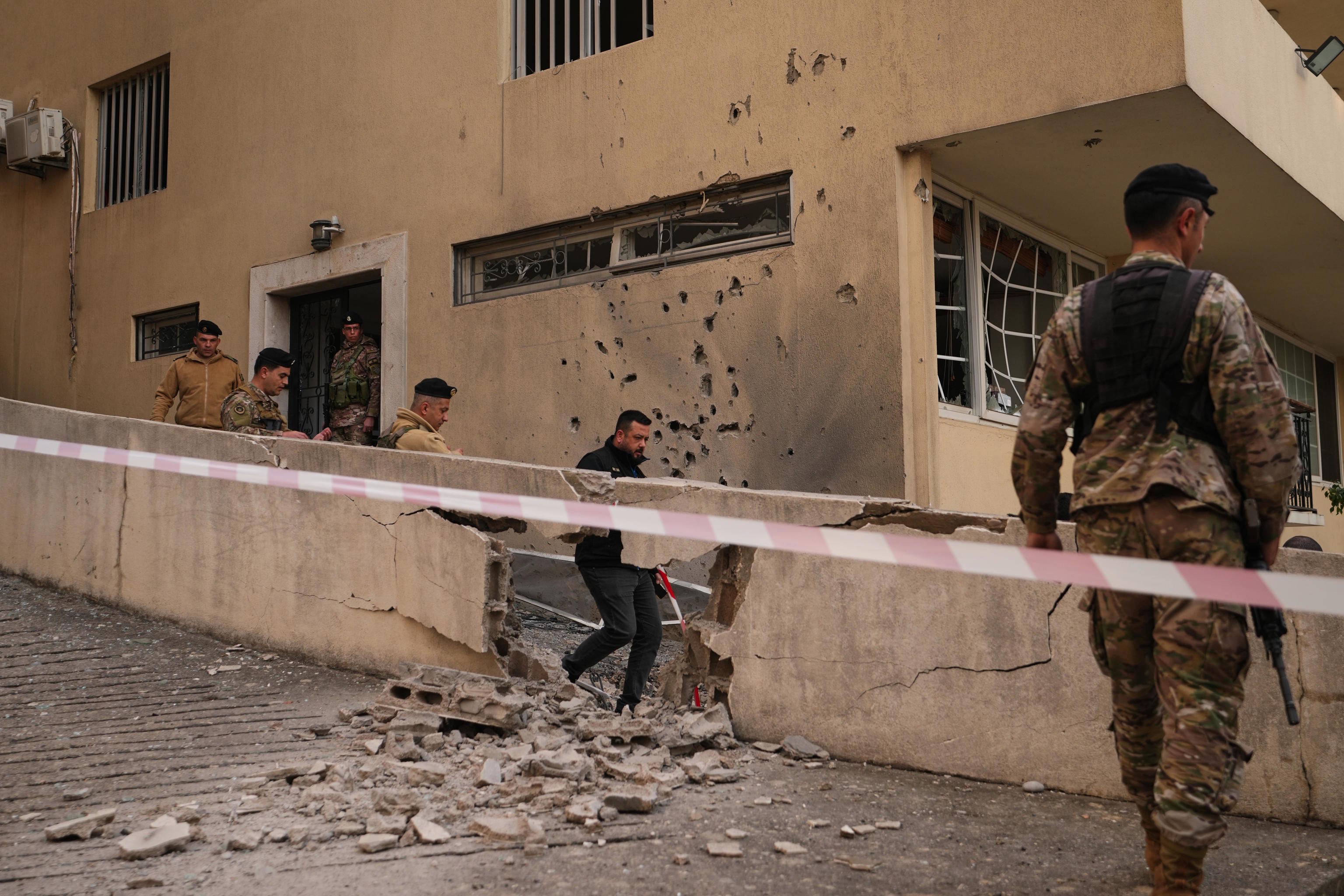
When Mohamed al Guta, 45, arrived at his home - adjacent to the one that had been destroyed - he found a huge hole in the kitchen wall. The explosion had pierced several walls, ripping doors and windows off.
"I found human remains in the kitchen. There was a tiny amputated hand. A child's hand. And two fingers, also small," he recounts amidst the ruins of the Hussein clan's residence.
The missile literally crushed half of the three-story house. Among the rubble, a small toy truck and a child's chair can be seen. Around the debris and wires emerging from the broken cement, several pages of what appears to be a children's educational book are scattered.
"What does the polar bear do? What does the monkey do?" reads the pages, written in Arabic. A few meters away, a basic French book for children is visible. "A racing car," reads the French text next to a Formula 1 drawing. Perhaps these were the textbooks of Ghadi, who was only three years old. Or of his neighbor, Gita Nabil Shams, who was six.
Ali Bueri, Alia's brother, was among the first to arrive at the scene on the 18th. The plane had bombed the dwelling shortly after nine in the evening. The attack claimed the lives of Alia and her husband, Mahdi. Also of their son, the young Ghadi, and of Gita. Only the couple's other daughter, Karina, survived. "She is recovering in the hospital from her injuries," Ali recounts, struggling to express himself.
He can barely contain his emotions. When asked what he saw upon arrival, he cannot explain. "I can't tell you what I saw," he admits. Mohamed al Guta had explained that the bodies were unrecognizable, in pieces.
The tragic fate of the Hussein family has been repeated in the Bekaa Valley, where Israeli aviation has surpassed a hundred bombings in the last week, a region of origin of Hezbollah.
The four victims of the incident on the 18th are part of a toll that now exceeds 100 deaths, including two dozen children, according to the estimation of the local newspaper Annahar. A fraction of the 1,039 deceased in Lebanon during the current regional conflict, among which 118 children are already included, according to figures provided by the local Ministry of Health this Tuesday.
The Bekaa has always been the heart of activism linked to Hezbollah. Here, the first cadres of the movement were trained under the guidance of the Revolutionary Guards in the early 1980s.
The roads throughout the area are filled with portraits of fallen militants in recent confrontations, of missing leaders like Hasan Nasrallah - whose huge portrait adorns the entrance of Baalbeck - but also of leaders from Iran, reflecting the religious and political dependence of the group on Tehran.
"[Ayatollah Ali] Khamenei was our red line. They were killing us for months, and we remained silent. That's over. The resistance was born here, and here we will all die if necessary," proclaims one of the guards of Baalbeck, Hasan Abbas.
Local media warn that the Israeli Air Force seems to be emulating in the Bekaa, albeit on a smaller scale, the tactic they used during their offensive against Gaza, where their planes eliminated entire families in brutal attacks that were labeled as genocide by an independent commission of investigation from the United Nations.
In Baalbeck, no one can explain the reason for the attack on Mahdi Hussein. Just over 10 kilometers away, in Younine, neither can they. On the same day, the 18th, the Tel Aviv air force razed another home in this small town, killing six people, including four children. In this case, Israel told the BBC that they had targeted "a Hezbollah headquarters while its members were inside." "Our operations are against Hezbollah, not against the civilians of Lebanon," added the soldiers.
For Ahmad Nammar, 72, his cousin Hussein Nammar was a "simple farmer," who, according to his account, was resting at home after "iftar," the meal that ends the fast during the month of Ramadan. "This is a neighborhood of civilians, there are no weapons here," he asserts.
Ahmad lives a few dozen meters from what was Hussein Nammar's residence. It took him less than a minute to reach what remained of the structure. His account is pure horror, like Mohamed Al Guta's in Baalbeck.
"There were decapitated heads. All the bodies were in pieces. One of the children, Mohamed, who was a year and a half old, was missing a leg. He had a piece of metal that went through his head and came out through his face," he recalls.
Local residents have placed a sign on the few remaining pillars with images of the six deceased. There, the young Mohamed and his sister, Falak, aged three, can be seen. Also their father, Hussein, and mother, Asma, and Hussein's siblings, Muhammad and Sara.
"They bomb us because we support the Party [of God, Hezbollah]. There are people here, spies, who work for them," Ahmad mentions.
The attack on the Nammars occurred a few hundred meters from the one suffered by the Tahan family on the 11th. Here, bombs or rockets ended the lives of eight people from this lineage, including three children. Abbas Tahan lists their names and ages. Several days have passed, but when he does so, his eyes still well up. "My two sons, Ali and Ahmed, died. Ahmed's entire family disappeared. His wife and their three children: Yahia, 14; Haura, nine; and Riskaiya, five years old," he states.
The Younine area was systematically targeted by the Israeli air force during the 2024 war. "We endured 47 attacks," says Ali Attar. "We had 110 martyrs," adds Abbas Tahan.
The Lebanese cannot specify if that tragic toll included the 23 Syrian workers who were torn apart by another Israeli bombing in September of that year, in one of the bloodiest incidents of that conflict, which sparked significant controversy about the intentionality of the actions of the neighboring country's air force.
The father of the missing lives a few meters from the impact site, which features a large hole caused by the missile that reduced the home to a pile of cement and metal debris. Hezbollah supporters - accompanying the group of journalists - have placed a party flag on the remains.
According to his account, the incident occurred - like the others described - just after Muslims break their fast, when families gather to eat as night falls. "Everything filled with smoke. Nothing could be seen. My eyes were burning. We started to rescue the bodies. One of the children, Ali's son, Hussein, was alive but completely burned. He is in the hospital," he clarifies.
Twelve-year-old Mohamed Baqqar also belongs to the same lineage. He used to play, he recalls, with Yahia. "We rode bicycles. He was my cousin, but he was much more. He was my best friend. We knew each other since we were little." The boy managed to retrieve a basketball that belonged to Yahia: "I have kept it as a memento."