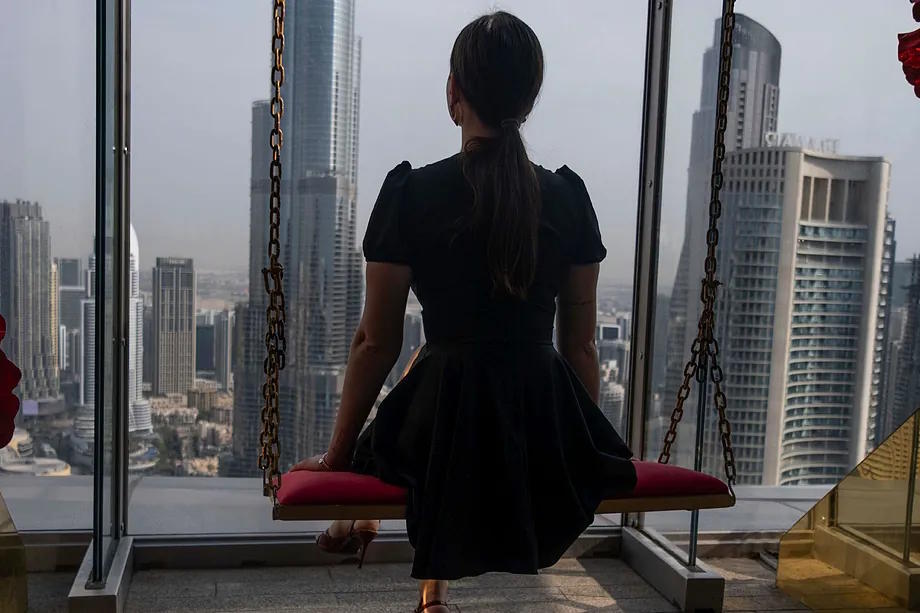
Galina, a Ukrainian woman from Zaporiyia, enjoys a cappuccino in one of Dubai's futuristic towers. Here, she is involved in buying and selling properties, one of the emirate's major businesses, now in crisis due to the war.
- I came here fleeing a war and now I find myself in another one.
- Why have you decided to stay?
- Where could I go? I don't want to go back to Ukraine in any way, and Europe has become very difficult for us due to its high prices. Dubai is the ideal place, and I will only leave if work forces me to.
Since the large-scale invasion of Ukraine in 2022, Dubai has become a refuge for Ukrainian women and families, but also for Russian citizens. Its ease of setting up businesses, finding work, and not paying taxes facilitated the arrival of tens of thousands of people fleeing the war. Here, they joined others who had already formed a community. Among them are thousands of Belarusians who had also fled the repression of President Alexander Lukashenko.
As a curiosity, all these Russian-speaking communities have in many cases merged into one, where Ukrainians and Russians can do business together, live in the same neighborhoods, and even go out partying together, especially the younger ones. Maryna, a Ukrainian working in an international data analysis company, admits to having Russian friends: "I don't judge anyone by their passport. Obviously, if I'm at a dinner and someone starts praising President Putin in front of me, I tell them off, get up from the table, and leave, but the Russian friends I have here are not exactly pro-Putin."
So we decided to talk to the other side of the conflict: Svetlana is Russian from the Siberian region: "Last night I was bowling with three Ukrainian girls. None of them mentioned the war. We had a great time. This conflict is the result of political poison, but among us, there are no issues, only those created by them." Oksana on the exclusive terrace of The Lana hotel: "I have no problem with any Ukrainian. That's Putin's thing. I haven't declared war on anyone, and no one has declared war on me."
Adriana is from the outskirts of Moscow. She left the country when the invasion began, seeing how her country was sinking into totalitarianism and social control. Now she is happy in Dubai: "My mother is Russian, and my father is Ukrainian, as is the case in many mixed families in our countries. I despise everything my government does, and I don't want Ukrainians to see me as hostile towards them," she says. Since 2022, Russians have invested at least $6.3 billion in real estate in Dubai, fleeing from economic conditions that have hardened in Russia. Although this flow existed before the invasion of Ukraine, it increased more than 10 times from 2022 onwards.
Money from Russia is concentrated in enclaves like Palm Jumeirah or Downtown, where oligarchs, tech entrepreneurs, and intermediary networks coexist between sanctions and opportunities. But the phenomenon goes beyond housing: Dubai has become a platform from which Russian companies reshape their global businesses, taking advantage of its position between continents and its regulatory flexibility, fleeing from the new conditions imposed by the war.
Galina admits that in the early days of the conflict in Iran, she was about to pack up her life and emigrate. "To hear the sound of the same drones that attacked us in Ukraine again triggered my fear. I spent three days locked in without going out and unable to sleep. My mother lives alone in Zaporiyia and asked me to return with her, but things are much worse there, and besides, I wouldn't have a job there!" The martial law in Ukraine means that the vast majority of Ukrainian citizens living and working in Dubai are women, as adult men cannot leave the country in the current war conditions.
Oksana in downtown Dubai.ALBERTO ROJAS
While 50 Ukrainian instructors train Emirati soldiers on how to shoot down drones using their much cheaper technologies, every day the air force and anti-aircraft defenses shoot down Shahed 136 drones like the ones bombing Ukrainian cities every night, suddenly uniting the two conflicts.
There have been isolated cases of violence in private settings such as parties or restaurants, like the case of a Ukrainian model assaulted by individuals linked to Russian circles, but in general, not only is tolerance mutual, but both communities coexist without issues. Additionally, the Emirati policy of zero tolerance for foreign political or security activities on its territory has nipped any scenario of exporting the conflict here in the bud.
Estimates of resident Russians vary widely depending on the source, as the official figure is not published, but since the start of the war in Ukraine, the numbers could exceed 100,000 Russian residents in the Emirates (most in the Marina district in Dubai). In the case of Ukrainians, many are women and can reach up to 30,000 residents. Dubai has around four million inhabitants, with over 90% being expatriates. Within this mosaic, Russians and Ukrainians are minorities in absolute terms but overrepresented in visibility, capital, and international networks.
Dubai has become a kind of neutral ground for contemporary wars, a place where irreconcilable enemies share space without openly confronting each other, and sometimes even preparing barbecues together. In its hotels, restaurants, and financial districts, Russian entrepreneurs fleeing sanctions, Ukrainians displaced by the war, and intermediary networks operating in the shadows coincide, all under the strict surveillance of a state that does not allow the conflict to spill over into its territory. It is not a battlefield, but a reflection of the conflict: here there are no trenches, but bank accounts, visas, and intertwined businesses. Dubai does not fight the war, but absorbs it, transforms it, and contains it within the limits of a city that has made neutrality its greatest asset. The same goes for Iranians and Americans, Turks and Greeks, Arabs and Israelis.