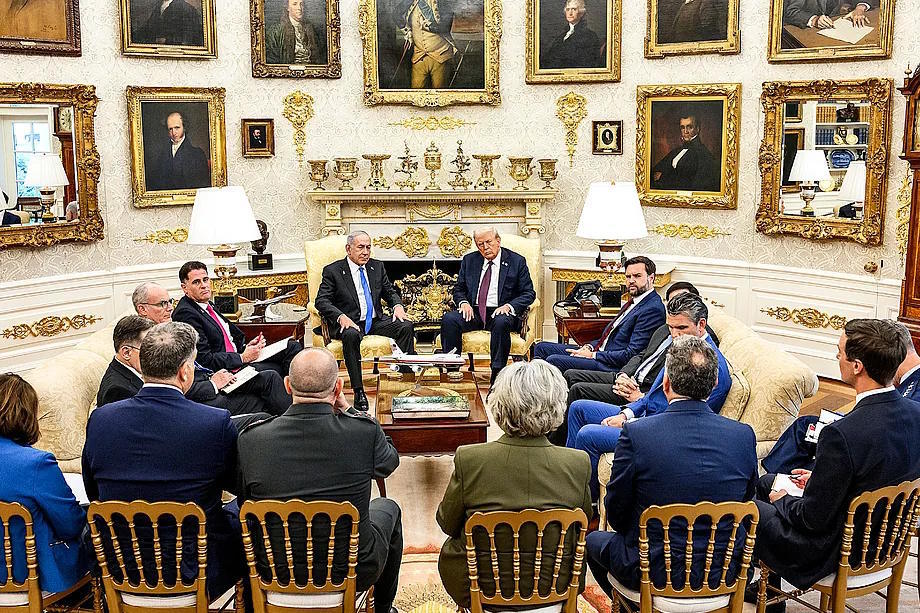
In a recent and tense interview with The Economist director, the influencer and conservative activist Tucker Carlson, who fell out with his friend Donald Trump over the war in Iran and the US government's unconditional support for Israel, explained that Benjamin Netanyahu's urgency to convince the White House of the need to destroy the ayatollahs' regime was driven by two logics. The first, a historical one, as Bibi had been trying for a quarter of a century to persuade Washington of the need to eliminate the main existential threat to his country. The second, however, was not looking forward, but backward. Israel, Carlson implied, was in a hurry because it is aware that this total, unconditional support is in question, and the current political generation, with figures like Donald Trump, Marco Rubio, or senators like Lindsey Graham, Ted Cruz, or the Democrat/independent John Fetterman, may be the last with such ideas.
In recent weeks, the MAGA movement has begun to feel this division. It is not just a feeling of betrayal because Trump promised there would be no more distant wars or regime change attempts. It is specifically about Israel and the "exceptional relationship" of the last six decades. In addition to Carlson, figures like Steve Bannon, the conspiratorial Candance Owens, and numerous podcasters, influencers, have warned of what they consider a mistake in an election year. "Everyone under 30 is against Israel," commentator Megyn Kelly often says, another fallen out with Trump. "What is happening in Gaza is genocide," said former MAGA congresswoman Marjorie Taylor Greene in 2025, now nicknamed Marjorie Traitor Greene by the president. She was the first to use the taboo word among her ranks.
This month, Joe Kent, head of the US counterterrorism center and right-hand man to the Director of National Intelligence, Tulsi Gabbard, resigned saying that his conscience could not bear a war started against an enemy that was not a threat "due to pressure from Israel and its powerful US lobby." Blaming Jerusalem for dragging Americans into the wars in Iraq or Syria as well.
According to Gallup, three years ago, 54% of Americans sympathized with Israelis compared to 31% with Palestinians. Now, support is roughly balanced, with 41% stating their sympathies lean more towards Palestinians, while only 36% say the same about Israelis. The significance of this shift is enormous and although it has come after years of destruction in Gaza and tens of thousands of victims in the war following the brutal Hamas terrorist attacks on October 7, it had started long before.
Nearly two-thirds of Democrats today say they are more concerned about Palestinians, while only about 2 out of every 10 sympathize more with Israelis. In 2016, nearly half of Democrats sympathized more with Israelis and barely a quarter did so with Palestinians. According to the Pew Research Center, 59% of Americans now have an unfavorable opinion of the Israeli government, a significant increase from the 51% at the beginning of 2024. Much of this can be focused on Netanyahu, who has visited Trump seven times in person since returning to power, and the images of the devastated strip. But it is not just him or that.
The change began on the left, throughout the Democratic skeleton, a long time ago, albeit slowly. Joe Biden's and Kamala Harris's stance on Gaza led to a massive loss of support in the last elections. Just as Pennsylvania Governor and potential presidential candidate Josh Shapiro is experiencing now. Not only from the Muslim and Arab or Persian population, especially important in states like Michigan. But among the young, disappointed, furious, with the establishment. "Decades of unconditional US support for Israel have undermined - rather than promoted - peace and stability in the Middle East. The Palestinians have been the main victims of these failures, but the United States and Israel have also paid a price. And until the fundamental problem of the bilateral relationship is resolved, that price will only increase.
The United States and Israel will have to adapt if they want their relationship to endure, transitioning from an exceptional - but self-destructive - cooperation towards a more normal relationship that can still serve as the basis for an alliance," wrote Andrew P. Miller, from the Center for American Progress and one of the officials responsible for Israel and Palestine issues under Obama and Biden.
This rupture is now also evident among neoconservative ranks, even among figures who were pillars in the Bush administration and the Iraq war or in its defense, such as Robert Kagan or William Kristol. In reality, this tension over Israel is not new, but it had disappeared in recent decades. In the 1980s and 1990s, there were deep divisions and fights. The epic quarrel between intellectual William Buckley Jr. and Republican presidential candidate Pat Buchanan is one of the best examples. Buchanan, at the time, said that the US Congress was "occupied territory" by Israel, using the same language as in the West Bank.
Donald Trump himself, last September, said in an interview with the Daily Caller that Israel used to "have total control of Congress, and now they don't have it anymore (...) They are going to have to end that war... They may be winning the war, but they are not winning in the public relations arena; you know, and that is hurting them," he warned.
According to Pew, Democrats are or were more likely than Republicans to express unfavorable opinions about Israel (69% versus 37%), but negative opinions among Republicans are increasing unstoppably. According to Politico, "over the past three years, the proportion of Republicans under 50 with a negative view of Israel jumped from 35% to 50%, adding to the 71% of Democrats under 50 who have an unfavorable view of Israel.
To understand the extent to which this is true, it is worth going back to Tucker Carlson. A few months ago, he decided to feature Nick Fuentes, a 27-year-old streamer, Hitler sympathizer, provocateur, openly supremacist, and antisemitic, on his YouTube show. Fuentes also has an extraordinary appeal among young Republicans and conservatives, with a legion of followers and fans who call themselves groypers. The interview sparked enormous controversy, led to heated debates on the internet, and even caused chain divisions in one of Washington's main conservative think tanks, The Heritage Foundation, after its president defended Carlson and did not criticize the invitation to a deeply antisemitic voice.
There is more. James Fishback is a 31-year-old man running for governor of Florida. He is not going to win, but his positions and enormous appeal among young people, especially men, explain these profound changes at the heart of the system. Fishback is a populist who mixes ultraconservative views on social and immigration issues with a kind of economic socialism. He is against laws restricting gun ownership, immigration (although his mother is Colombian), and abortion. He supports raising teachers' salaries, taxing "vice" on Only Fans. But above all, he is against Israel, its influence in the US, and openly mocks his rivals by saying they are all on the AIPAC payroll, the main pro-Israel lobby in the US. "Soon, all victorious Republican politicians will speak this way," Carlson said about Fishback and his generation a few weeks ago.
In December, the Manhattan Institute conducted a survey with 3,000 voters, including large oversamples of Black and Hispanic Republicans and/or Trump voters in 2024 on "a wide range of political issues, as well as on identity politics, populism, conspiracy theories, antisemitism, and other forms of racial bias." The results are striking. "The vast majority of the current Republican Party rejects racism, antisemitism, and conspiratorial thinking in politics. However, a significant minority - 17% - fits our definition of 'anti-Jewish Republicans.' A respondent falls into this category if they simultaneously self-identify as racist and antisemitic, express Holocaust denial or describe Israel as a colonial state; or if they do not self-identify in that way, but still hold both extreme positions," the survey says.
But almost one in three Republicans under 50 identify their own opinions as racist, and 25% believe their views are antisemitic, according to these categories. Among those over 50, these figures are only 4%. Most under 50 also believe that the Holocaust either did not happen or has been exaggerated.
Compared to 2022, negative opinions about Israel have increased widely, as explained by the Brookings Institution, although at very different rates when broken down by age and party affiliation. "Negative opinions have increased overall from 42% to 53%. Among Republicans, they have risen from 27% to 37%; among Democrats, from 53% to 69%. When analyzed by age, among young Republicans (18 to 49 years old), the percentage of those with an unfavorable opinion of Israel has increased from 35% to 50%, while among Republicans aged 50 and older, such opinions have only marginally increased, from 19% to 23%."