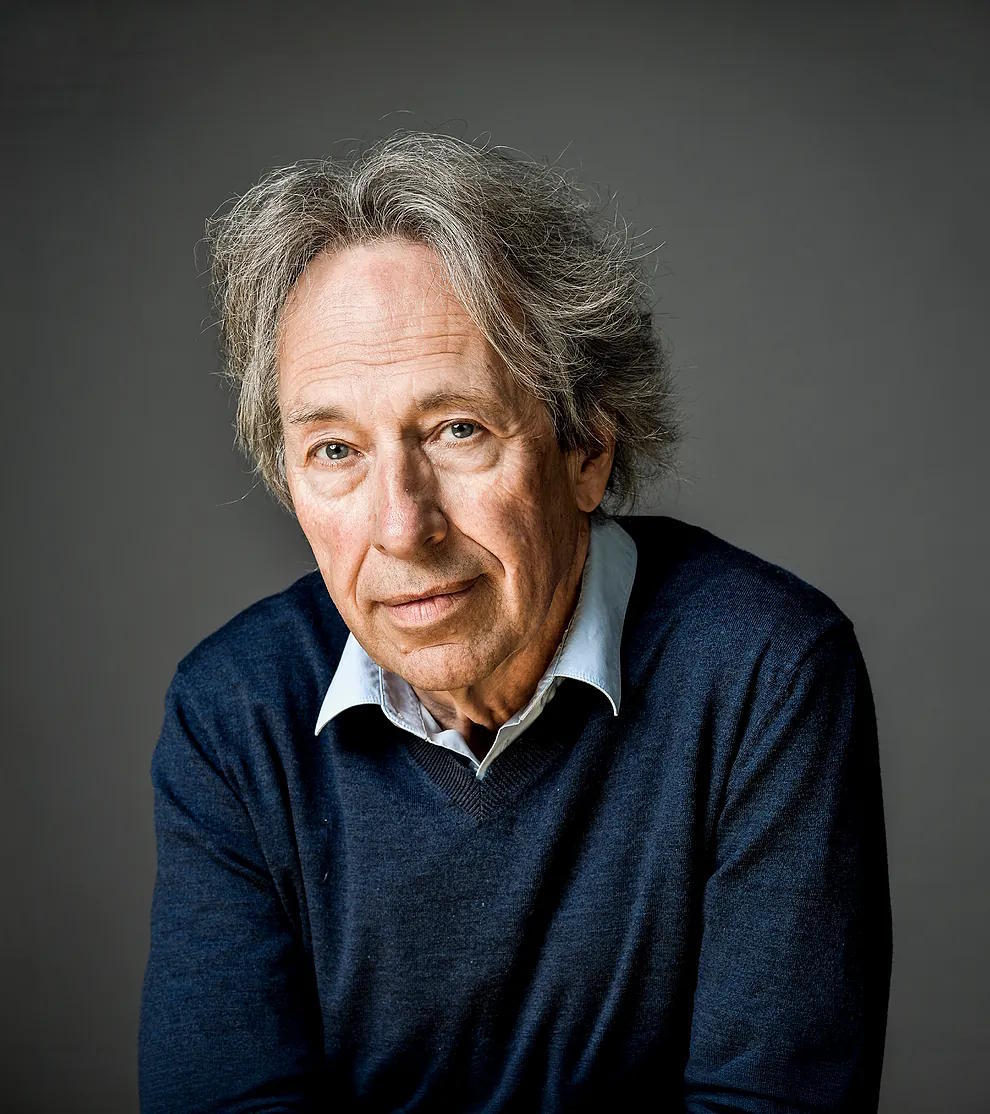
In the midst of the Thirty Years' War, which convulsed 17th-century Europe, René Descartes wrote his famous maxim of I think, therefore I am. A principle that would rise as the beacon of the Enlightenment and that now the philosopher Pascal Bruckner (Paris, 1948) twists with sarcasm to describe our young 21st century: I Suffer Therefore I Am: Portrait of the Victim as. That's the title of his latest essay, published by Siruela, in which he analyzes the victimizing drift of a society that no longer venerates heroes but yearns for 2.0 martyrs, in a whiny, tearful, prudish version. Even blue-blooded princes cry, just read the memoirs of ex-royalHarry, "a chic torrent of tears that has produced a worldwide bestseller," Bruckner points out. According to him, suffering sells more than sex. And that's a lot to sell...
The French philosopher has once again written one of his uncomfortable essays, the kind that hits the nail on the head, that serves as a mirror. Here we go with the reflection: "The citizen of modern democracies is both a king child who has benefited from a rather liberal education and a monarch customer whose desires are sacred in the commercial sphere," he tells us.
Sometimes seen as a controversial author, he is not afraid to go against the current, denounce the excesses of MeToo or take a stand in the Polanski affair in favor of the director (who, by the way, directed Bitter Moon, based on Bruckner's novel of the same name, who also has his novelist side). But the worst attacks in the French media have been directed at him for warning of an "imaginary racism" towards Islam: under the word Islamophobia, all legitimate criticism of Islamism is silenced, considers this disciple of another uncompromising philosopher, the great Roland Barthes, who supervised his doctoral thesis.
Who is your executioner? Bruckner asks provocatively, unfolding a deck of cards to choose from, as if he were reading our tarot: capitalism, family, bourgeoisie, patriarchy, the colonial country of the moment, the system in general...
What is your executioner? Bruckner asks us, somewhat provocatively, unfolding a deck of cards to choose from, as if he were reading tarot cards: capitalism, family, bourgeoisie, patriarchy, the current colonial country, the system in general...
Question. In the chapter 'Suffering produces rights,' you pose a question that sums up the last half-century and, in passing, the thesis and tone of your book: "How have we gone from the heroic figure of Rosa Parks fighting against discrimination in the United States to Greta Thunberg crying for the fate of the planet?" Popular idols have indeed changed...
Answer. Since the end of World War II, the history of the Western world has been one of the end of heroism. It has become a negative value because it is associated with war and virile attitudes, although women can be just as heroic as men. You mentioned Rosa Parks, an African-American woman who refused to give up her seat to a white person and was subsequently arrested... However, today we value victims so much that we are wary of heroes. The intense heroic dream of the 19th and 20th centuries has been replaced by the intense victimhood reverie of the 21st century.
Q. In 1983, you published a book, not translated into Spanish, titled 'Le sanglot de l'homme blanc' (The Sobbing of the White Man) focused on colonial guilt. Did you already anticipate the culture of victimization?
A. In reality, I have been writing the same book for the last 50 years [laughs]. Back then, I criticized Western guilt towards the countries of the South. At that time, the eight imperialist countries in Europe - Spain, Portugal, France, Germany, England, the Netherlands, Belgium, and Italy - were flagellating themselves for having occupied Africa and Asia and promised not to do it again. Indeed, it was during that time that the idolatry of the victim began. In France, it also occurred with the reconsideration of World War II: in the 70s-80s, it was no longer seen just as the resistance against the German occupiers but the focus shifted to the extermination of Jews and Gypsies. It was a change in worldview that profoundly altered our conception of suffering and resistance.
Q. Were our grandparents, those who lived through the post-war period, stronger than us? More stoic?
A. Of course. The great anthropological change was the arrival of the consumer society in Europe between 1950 and 1970. Credit was invented, breaking the frustration of our parents' and grandparents' generations: until then, families saved and waited to buy a car or a house. With credit, everything changed: you want it, it's yours, and you'll pay for it over the next 20 years. The consumer society instilled impatience in the mentality of Europeans. Frustration became a crime, and satisfaction became a human right, practically. We have been educated with the idea that our desires are commands.
Q. More than citizens, it seems like you are describing spoiled children...
A. That's what we are. A society of spoiled children who are disgusted with getting their hands dirty and who need slaves, that is, immigrants to do the considered low tasks, while proclaiming solidarity with the exploited. The famous slogan of May 68, 'Vivre sans temps mort et jouir sans entraves' [Live without dead time and enjoy without obstacles] was believed to be related to love life but, in reality, it was a consumerist message. It wasn't libertarian, it was advertising. Today we live in the climax of consumerism. You can buy online 24 hours a day. Therefore, satisfaction has become a right, and its deprivation makes us potential victims.
Q. Traditionally, the status of a victim was obtained from the historian or justice, as you remind us in your essay. But in digital times, it is enough to write a tweet proclaiming oneself a victim of a comment or microaggression. Being a woman, I have it easier than you, a privileged white man...
A. Currently, women are considered victims from birth. This, by the way, blurs the distinction between those who have actually suffered an assault and the rest. There is a kind of self-celebration as a victim, even in literature. I am a member of the Goncourt Prize jury, and every year we receive several books from people who explain that they have been beaten, that they have suffered immensely, that they have experienced incest... The problem with this literature is that it is interesting when it is a rarity, but when it becomes commonplace, it becomes tiresome. We see many young women, actresses, or commentators trying to say that they have suffered terribly, that they testify to the martyrdom of assaulted women, but the public does not follow them. The public distinguishes very well between the true and the false, between a Gisèle Pelicot and someone who feels offended by a comment or a compliment...
Q. Of course, Pelicot was a victim of an atrocious act. But she has always refused to claim victimhood.
A. Indeed, since the trial, she has rejected describing herself as a victim. Her pride lies in the restart of life; she has just published a book and now has a new partner. Furthermore, she harbors no ideas of revenge against men. In France, many feminists resent her because they thought she would carry her message and lead the war against the male gender. I believe she will mark a stage in the history of victimization and the feminist movement.
Q. What has been the influence of Christianity on the conception we still have today of a victim or martyr? Tell me about that "Christian revolution," as you call it, which involves the sacrifice of Jesus Christ.
A. That sacrifice is the great evangelical revelation, the novelty of Christianity. Until then, it was the strong who were right. With Christianity, the Son of God is crucified like a slave by the Romans, as if he were a dog. It implies a paradigm shift in which the weakest overcomes the strongest. These are the famous phrases of the Gospel: 'The last on Earth will be the first in the kingdom of heaven.' Christianity reverses hierarchies and gives precedence to the defeated over the bullies. Thus, the vilified, the degraded, or the persecuted become our new teachers. Obviously, the Church did not follow the teachings of the Gospels, as throughout its history, it has always aligned itself with the powerful. But the spirit of Christianity has survived very powerfully in Marxism and wokism.
Q. But Marx proclaimed himself very atheist...
What is the working class in Marxism if not the body of Christ constituted as a revolutionary bloc to transform history and establish a perfect society? Ultimately, Marxism is a secularized adaptation of the Gospels. For Karl Marx, the working class or the proletariat is the representative on earth of Jesus, a revolutionary who will lead humanity, where man exploits man, to a paradisiacal classless society. Well, we know it didn't work out exactly as Marx predicted...
Q. And where is the Christian heritage in wokism?
A. Wokism is the American adaptation of the French theories from the University of Vincennes, those of Gilles Deleuze, Jacques Derrida, Michel Foucault... It grants victim status a priori to all minorities: women, homosexuals, disabled, blacks, indigenous peoples, etc. It must be said that Donald Trump, contrary to what he says, is not anti-woke but hyper-woke! He has taken up the victim metaphor, extending it to the entire American people. His great phrase consists of saying: 'The whole planet takes advantage of you, Europe has looted us, as well as India and China. And I will get you out of this victim situation and restore your sovereignty.' In reality, Donald Trump has a very woke approach but has changed the subject: he has expanded the victim to the entire American nation, especially to white supremacists. Coming from the richest and most powerful nation in the world, presenting oneself as a victim of the rest of the planet is an incredible tour de force.
Q. 'Wokism' is one of those anglicisms we have incorporated in recent years. With inclusive language and neologisms, are we creating a new victim-oriented dictionary?
A. Yes, it's true: a new dictionary where everyone will be welcomed without being hurt. In the world of publishing, euphemisms have proliferated: you can no longer say fat or ugly to avoid hurting sensibilities... However, parallel to this extreme caution, there is a great verbal violence developing among individuals and generations. At least, in France.
Q. A verbal violence in which a worrying word has proliferated: fascist. In Spain, the word 'facha' seems to have become fashionable... Have we emptied fascism of its true political meaning?
A. Fascism died in 1945 as a political regime. I'm not saying there are no authoritarian regimes that share many traits of fascism, but today, anyone who disagrees with me is labeled a fascist. This is despite knowing that democracy is built on disagreements among different segments of the population. Democracy is the peaceful resolution of disagreements among citizens. It is the very foundation of social life that we disagree with each other! However, today, a simple disagreement brands the other as a fascist, rendering the word meaningless. Antifascists often exhibit reverse fascism, employing the same methods: violence, brutality, intimidation... Another twisted misuse of words is seen with genocide [sighs]. I believe fascism should be left to historians, and we should find another insult. Calling someone a Stalinist has no effect because no one really knows what it means to be a Stalinist anymore. Totalitarian is too abstract for the youth. But fascism has retained all its semantic virulence, and when labeled a fascist, one obviously has to react and respond. In terms of miserabilism, a similar mimicry affects both right-wing and left-wing extremists in Europe and the United States. However, a more sectarian part of the left sees fascism starting with the right, even with groups that do not align with the dominant party. In the end, there is a somewhat totalitarian view of society: we are right, and all who oppose us are descendants of Francoist, Mussolinian, or Hitlerian hordes, take your pick. All this does not clarify political debate. In France, we often witness many media psychodramas with antifascists...
Q. You know, one of the recent psychodramas in Spain was about the use of the veil and the ban on the burqa and niqab. France was the first to ban them in 2010, along with the law prohibiting headscarves in schools in 2004.
A. It's a shame that Spain hasn't adopted this law. Secularism is a good system to separate religion, which should be a private matter, from the public life of citizens. On the other hand... Not all cultures are respectable. Covering an eight-year-old girl with a niqab goes against all values of decency and humanity in my opinion. This is one of the major contradictions of Western leftists: on one hand, they advocate for women's freedom, and on the other hand, they support oppression when these women are from Muslim culture. In Iran, thousands of young women have been killed or tortured for refusing to wear the veil. Yet here, our feminists consider rejecting the veil in schools or public institutions a serious violation of human rights. This is also the Anglo-Saxon view: when you go to a university in New York or Texas, seeing young women in niqabs doesn't bother anyone. To me, it's horrifying! There is no longer universal solidarity in the fight against a certain form of sexism, and respect for particular cultures has taken precedence over the universality of women's freedom.
Q. You also criticize that the "new oppressed people" are Muslims. What role have certain left-wing intellectuals played in this view of Islam as a victim?
A. A part of the left has betrayed itself, its own teachings: it was universalist and secular, but has become differentialist and devout. The left, notably the French left, has no qualms about attacking the Pope, the Gospels, Jesus, or bishops - and we are right to do so, we have the right to do so - but is hesitant to criticize Islam. When you criticize a dogma or the Quran, they cry racism. A sort of favorable prejudice has emerged where Muslims are seen as the new wretched of the earth, the new proletarians of the global revolution, which is unfounded. This new dogma dates back to the 1979 Iranian revolution and was created by a British Trotskyist group called the SWP, the Socialist Worker's Party. However, it has spread to all European leftists, becoming a form of unconscious racism. When the Arab-Muslim world includes some of the wealthiest states, not to mention the persecution of Christians in those countries...
Q. How do we move away from this global victimhood culture? In your conclusion, you encourage not to succumb to defeatism...
A. In every human life, there is mourning, illness, suffering, betrayal, perhaps poverty... We must prepare the younger generations to face these dilemmas. We must remember the significant challenges Europe must confront: climate change, terrorism, drug traffickers who become a kind of state within a state, and of course, the greatest threat of war. The victim mentality is a dead-end. We must teach our children to resist suffering, above all, not to confine them in a bubble of self-pity. Strength is a blend of lucidity and resilience. Otherwise, we bury our heads in the sand like ostriches and await servitude. But that is inconceivable in a democracy.
Q. Do you know what I did after finishing your book? I played Bonnie Tyler's song 'Holding Out for a Hero.' In the 80s, we still needed heroes...
A. Ah, great. I'll listen to it too!