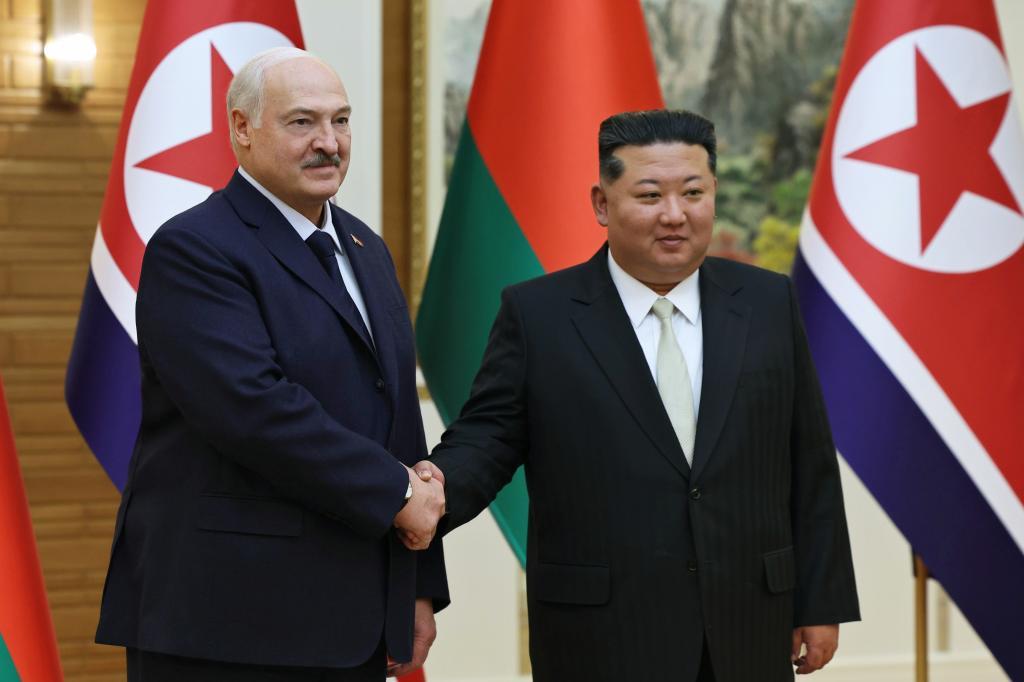
According to the Belarusian president's press service, both leaders have signed a document marking the beginning of an unprecedented collaboration in the modern era.
The treaty signing has been confirmed through official channels in Minsk. "Alexander Lukashenko and Kim Jong-un signed the Friendship and Cooperation Agreement between the Republic of Belarus and the Democratic People's Republic of Korea," the Belarusian press department stated on Telegram. For Lukashenko, this document is not just a formality but a fundamental pillar that "precisely and openly outlines the objectives and principles of our interaction, defining the institutional frameworks of future mutually beneficial processes."
During the bilateral meetings, the Belarusian president spared no praise for the North Korean regime, predicting "a great future" based on the nature of its "hardworking and disciplined people." In a statement highlighting the mutual admiration between both leaders, Lukashenko stated: "You know how to do everything. And you do it like no one else in the world. And what I say is not a sign of respect within the framework of our negotiations. This truly comes from my observations."
Despite the thousands of kilometers separating Minsk from Pyongyang, the Belarusian leader emphasized that "despite the geographical distance, the peoples of Belarus and Korea share common interests in patriotism, preservation of historical memory, and deep respect for older generations." This rapprochement occurs in a context of increasing isolation by the international community towards both countries due to the war in Ukraine. Lukashenko recalled that "the friendly relations between our states, forged even in the times of the Soviet Union, were never interrupted.
Now they enter a completely new stage," adding that both nations "need each other" as they possess complementary economies. Kim Jong-un, in turn, responded with "solidarity and full support" towards Belarus, taking advantage of the summit to condemn "illegal pressures against Belarus by the West." The North Korean leader went further by expressing his "support and identification with the measures taken by the Belarusian Government aimed at ensuring political and social stability, economic development." Lukashenko's official visit, lasting two days, will not be limited to this major friendship agreement. The delegations of both countries are expected to address "the entire spectrum" of their bilateral relations to finalize joint projects. In addition to the main treaty, the signing of another ten agreements is expected to consolidate this reactivation of cooperation at all levels, reinforcing the strategic axis that both countries maintain with Russia.