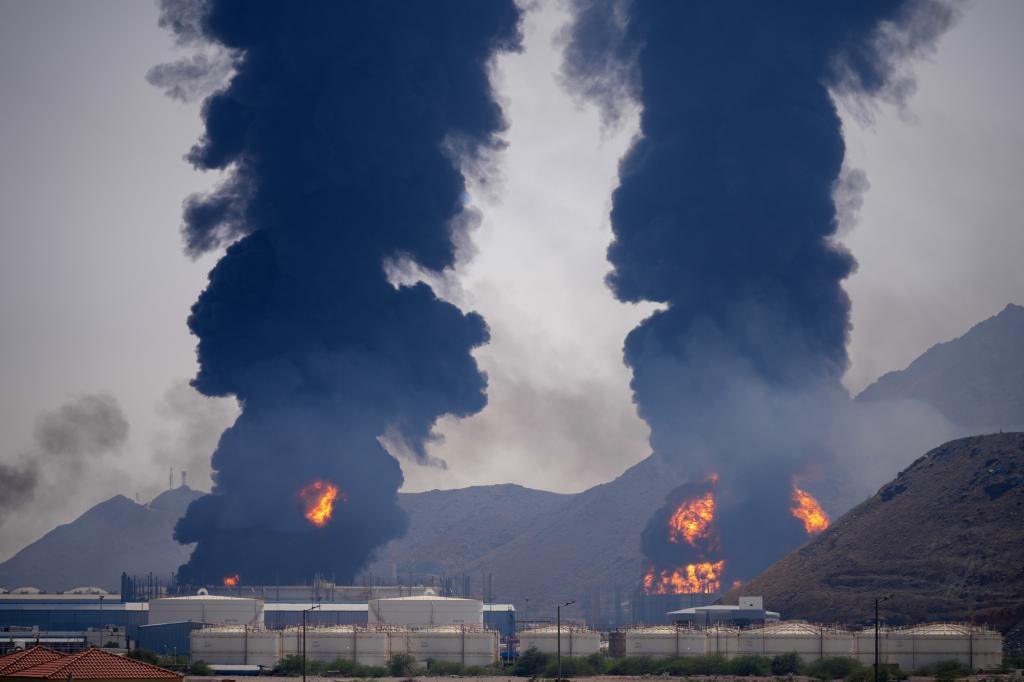
For war video game enthusiasts, they can anticipate real invasion plans and experience a firsthand amphibious assault on Jark Island if they still have Battlefield 3 at hand, released in 2011. In the real world, however, the mission will have nothing to do with the video game. Jark Island is practically the same size as Iwo Jima, the Japanese fortress that, in 1945, witnessed one of the bloodiest battles of World War II. It is a small island on the map but large enough to become a deadly trap if well defended. Iranians are already talking about causing a bloodbath if the US tries to occupy the island. Although it sounds like bravado similar to that of Saddam Hussein.
Iranian Intelligence has detected US military movements suggesting an imminent invasion attempt on the strategic Jark Island. Some sources place the attack during this same weekend, as soon as commodity markets close on Friday night, while other military analysts point to several weeks later, on April 17-18, when there will be a moonless night over the Persian Gulf, an ideal context for such incursions.
The Tehran regime has mined its surroundings to prevent US warships from approaching its coast, while Iranian troops and the Revolutionary Guard are reinforcing positions within their territory to repel any airborne helicopter operation. They have also placed landmines on access points from the sea and in the port, in addition to reinforcing each position, trench, or bunker on the island with more soldiers.
Iranian sources have leaked that their men have a large number of Manpads, those shoulder-launched anti-aircraft missiles that can be lethal if the helicopter flies at low altitude. According to the Iran Observer, Iranian troops have been ordered to "take American soldiers hostage" if they attempt to enter Iran. The Pentagon announced that it is developing military options for a "final blow" in Iran that could include the use of ground forces and a campaign of massive bombings.
Furthermore, if the paratroopers of the 82nd Airborne Division or the Marines manage to land, they will face a type of conflict they are unfamiliar with: surviving in a battlefield full of drones. Iran, thanks to its alliance with Moscow, has taken note of the lessons learned from the Russian invasion in Ukraine and has developed drones and specialists to fill the sky with the fearsome FPVs (First Person View), small drones with four propellers and an explosive payload that are now responsible for 90% of the deaths and injuries in Ukraine. The United States lags far behind in this field.
Jark Island, with American firepower and total air control, may be easy to take but at the same time very difficult to hold. Its short distance to the coast means that US soldiers will be fighting close by.
There are concerning warning signs: Iran's war has succumbed to some of the same ills that plagued Iraq and other conflicts abroad, including unclear or propagandistic objectives that did not match reality, insufficient planning for contingencies, and overly optimistic assumptions.
David Petraeus, a general and former head of the Central Intelligence Agency, stated in a recent interview that "entering a territory is relatively simple; the challenge is sustaining the operation and finding an exit." James Mattis, a four-star general who served as Secretary of Defense in Trump's first term, has been highly critical of this operation against Iran from the beginning: "You don't fight fortified positions from ships at sea: the enemy always has the advantage," he asserts regarding the possible capture of fortified islands. "Before deploying troops on the ground, you need to know how you're going to get them out," comments Stanley McChrystal, who was the commander of the International Security Assistance Force during the war in Afghanistan.
It is noteworthy that the name of Jark Island has been heavily used in recent hours by Pentagon sources, as if they were telegraphing the mission. They either have great confidence in their capabilities or expect to bait the Iranians with that island to attack at another point by surprise, such as in the Strait of Hormuz area.
At the same time, Iran is also holding some cards close. A Houthi leader told Reuters that their Yemeni militia (an ally of Iran) is prepared to attack ships in the Red Sea and in the strategic Bab el-Mandeb strait. "As for other details related to determining the zero hour, they are at the discretion of the leadership, and we... will know when the right time to act is." If even one tanker is bombed (which they have done before), this second major Indian Ocean strait would also be closed, interrupting an additional 10% of global oil transportation. It would open a second front at a time of great tension.
Meanwhile, major shipping companies that had their ships trapped in the Persian Gulf are starting to unload their cargo at the same ports where they loaded their vessels and are transporting their goods by land from Saudi Arabia, Bahrain, Qatar, Kuwait, and the United Arab Emirates. The destination is the port of Fujairah, in the Gulf of Oman, already outside the Iranian blockade and a stone's throw from the Arabian Sea.
Amena Bakr, Head of Middle East Energy and OPEC Analysis, states that even if Jark Island were attacked or its access disrupted, "Iran's oil exports would not be completely cut off, as they would use alternative routes and tankers to transfer the fuel at sea. This reinforces the idea that while Jark is crucial, Iran's true strategic advantage lies in its ability to keep exports running and threaten a broader disruption through the Strait of Hormuz."
The Iranian Parliament is seeking immediate approval of a law to charge tolls to ships transiting the Strait of Hormuz, "to provide security for ships passing through the strait." Additionally, similar to what they are already doing with some tankers, payment would be made in yuan, a symbolic blow to the petrodollar and US supremacy in this business for decades.