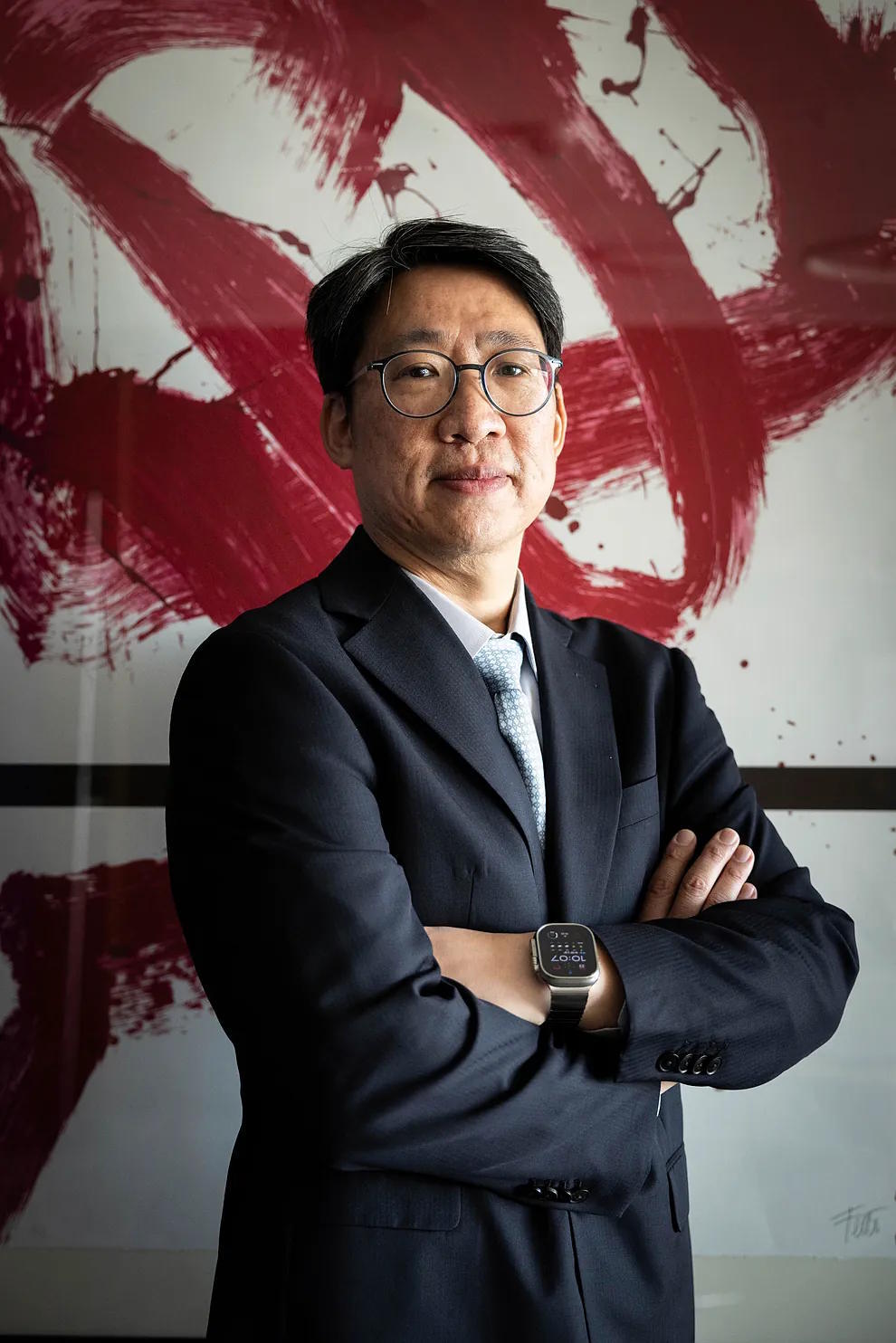
The work of Jeongmin Seong (South Korea, 1977) is to watch over the world for McKinsey, the most powerful consultancy on the planet. He leads the Global Connections area in the firm's think tank, which means his playing field is global geopolitics. A web of relationships that moves the threads of global trade, investment flows, and even migrations. They have just published the latest edition of the report Geopolitics and the geometry of global trade which, year after year, addresses the same question: what is happening in the world.
The answer is becoming increasingly difficult. "This Iranian war was not within the scope of our research, but what we can say is that every 20 or 30 years there is a major leap of era. And when that happens, the rules of the game change completely," he asserts.
Are we now experiencing one of those leaps? Yes. The previous era, of markets or globalization, began around 1990, when the Soviet Union disintegrated, the Berlin Wall fell, and China accelerated its policy of openness. That stage lasted until around 2020. Now we are in a new era, and in terms of the world order, the rules have changed. Previously, they were based on globalization, free trade, and efficiency. Now, it is more about a multipolar world: fair trade in addition to free trade and resilience in addition to efficiency. How does the war in the Middle East fit into this transition? It is part of a series of geopolitical events. Because it is not just Iran, but many others that we have seen in recent months and years, that reinforce our view that we are already in a new era, where countries and companies, not only in Asia but worldwide, will think even more about how to strengthen and diversify their supply chains to manage their dependence on a specific geography or provider.
The war has hit Asia at a time when the world was already embracing protectionism, from Trump's tariffs to Brussels' made in Europe. What was happening in global trade before Iran, and what will happen now? It is a great question. Before the war, there was already much debate about deglobalization, but what is happening now is more of a reconfiguration than a decoupling. We analyze various metrics of global trade. One of them is the geographical distance of trade, which measures the physical distance goods travel. That distance has been steadily increasing, so we can argue that the world is becoming more connected, and globalization continues, despite all the news about reshoring, offshoring, nearshoring... That is not happening on a global scale.
But there is another metric, the geopolitical distance of trade, which measures how aligned countries trading with each other are geopolitically. We quantify the geopolitical position of different economies based on their voting patterns in the UN. That distance has indeed decreased, by around 7% since 2017, meaning that countries are trading more with geopolitically closer partners.
Is the same happening with investment?
Absolutely. In fact, the geopolitical distance of foreign direct investment has fallen even more, by 13%. This is twice as much as in trade because money moves faster than physical networks.
The Spanish government advocates for a closer approach of Europe towards China, do you think it would be favorable for the EU's interests?
Europe faces a double pressure. The first is that its purchases from China are growing, but its sales to this country are not increasing at the same rate. And the second is that European exports to the United States have not increased significantly, partly due to tariffs. Europe exported many pharmaceutical products and gold as a precaution in anticipation of higher tariffs. Excluding that, European exports to the US did not materially grow. That is Europe's double pressure. In the automotive sector, for example, European sales to China and the US have declined, and Germany has imported more cars from China than it exported to China.
And what about Spain?
Spain is an interesting case because China was the fastest-growing trading partner for Spain, both in exports and imports. There was double-digit growth in Spain's sales to China, for example in copper or agricultural products. Spain is providing inputs to China so that it can play its role as the world's factory, and now as a factory of factories. The Chinese middle class is growing and demanding better and different products, and Spain has been exporting products like pork to meet that growing demand.
Spanish factories talk about coopetition, the mix of competition and cooperation with China. Does that model work?
Yes, you can leverage China's strength in any value chain, such as renewables. You can attract foreign direct investment and, at the same time, build a domestic manufacturing ecosystem to then add more value. On one hand, supply and meet domestic demand; on the other, use that capacity to meet external demand. That is the playbook that China and the so-called Asian tigers have been using: inviting foreign investment and using it as seed capital to build their own manufacturing ecosystem.
Who is winning the AI battle?
The history of AI has always been a story of disruption and national competitiveness. But from a trade perspective, we are starting to see its impact. Last year, despite tariffs, trade grew faster than its historical trajectory, and one of the major drivers was AI. It contributed to about a third of global trade growth. In the US, in fact, it drove two-thirds of trade growth because it built 50% of the global capacity of data centers.
Many advanced economies, including Spain, are aging very rapidly. Productivity growth is likely the most critical factor for their economic growth. Our research shows that AI can contribute up to 3.4% annually to productivity growth in a high scenario. Therefore, the ability to develop and deploy AI will be very, very critical for the economic growth of a country like Spain.
Do you think the war in Iran could change the global trade landscape, for example, redirecting investment to safer sectors?
Yes. This was already happening even before this war. Around 75% of foreign direct investment went to what we call future-shaping sectors, compared to 50 or 55% before Covid. Basically, data, AI infrastructure, advanced semiconductor manufacturing. Also, to the resources that power these sectors like critical minerals. Geopolitical reconfiguration towards those sectors is already happening, and given the geopolitical situation, it will likely accelerate even more.
Are critical minerals a bottleneck for the growth of countries that do not possess them?
If you look at global trade, around 10% corresponds to what we call highly concentrated trade, meaning products whose supply chain depends on more than 90% on only three countries or fewer. Rare earths are part of that 10%, but there are many others, like soybeans or semiconductor equipment. In this new era, where resilience matters, many countries are thinking about how to diversify their supply chain beyond these highly concentrated areas.
Does China have enough room to weather the energy shock of the closure of the Strait of Hormuz?
China has been using an all-of-the-above approach to energy. In the previous era, we enjoyed energy abundance thanks to easy access to fossil fuels. In the new era, not only China but the whole world has to balance priorities: supply, affordability, and energy security. And that has been China's approach. On one hand, fossil fuels still play a very important role, including coal, where China has a lot of domestic supply. At the same time, Beijing has led the deployment of renewables. Probably two-thirds of global solar and wind deployment was concentrated in China. It has redoubled efforts in renewables and is very strong across the value chain, and also in nuclear energy. Basically, China is firing on all cylinders of its energy portfolio because there is a very strong correlation between energy supply and economic growth.
In terms of trade, what advantage does Spain have?
Spain can position itself as a reliable diversification partner for the world. It does not need to compete in very low-cost manufacturing but can target specific segments where it can build its strengths, for example, the electric vehicle value chain, renewables, or specific segments of pharmaceuticals or industrial equipment. And then there are services.
Tourism is huge, but it can extract more value by offering higher value-added tourism. And then there is AI. One advantage of Spain is talent: it has talent with a globally competitive cost.
Speaking of competitiveness, one of Europe's major challenges is to create large companies capable of competing globally, but there are regulatory barriers, even political ones...
Yes. I think that, on one hand, that is a hurdle that policymakers and major institutions need to rethink. On the other hand, there are all the funding mechanisms.
Big companies are not born big on day one: they need to start small. That is why it is crucial to build a vibrant ecosystem of startups and venture capital funding. European startups start here, but then tend to move to the US because there is a larger market and a much more mature ecosystem. It is essential to think about how to build that ecosystem in Europe as well. And particularly in Spain, where the proportion of small and medium-sized enterprises is higher than in other European economies. Therefore, in Spain, the critical question is how to create large, productive, and globally competitive companies. That is an even more important issue for you.