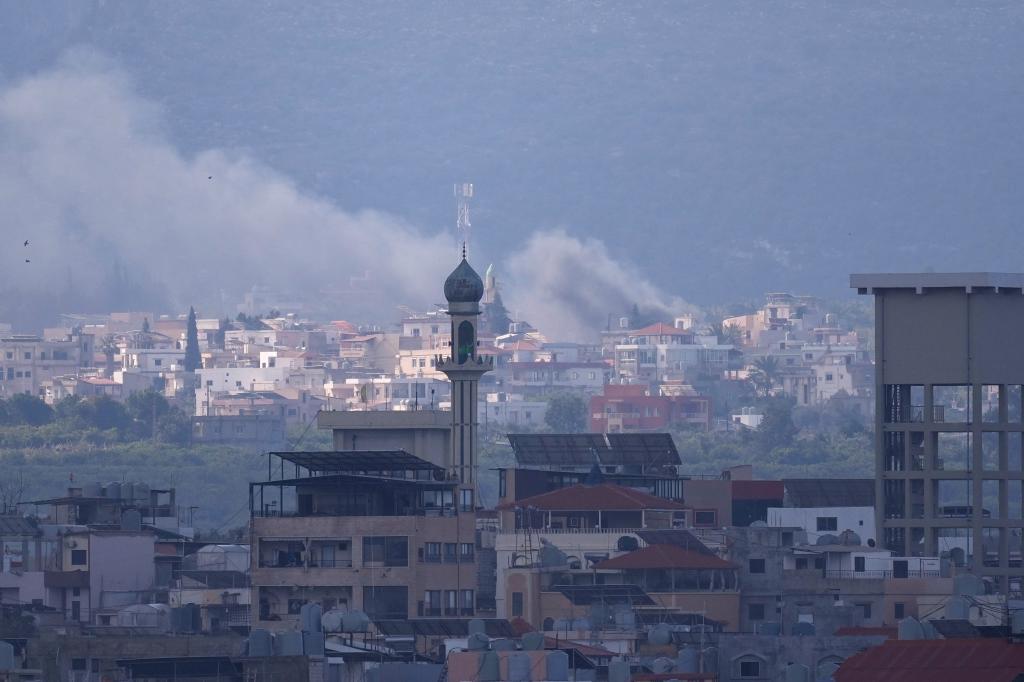
Aware that they do not have to face anti-aircraft defense systems in Lebanon, Israeli Air Force planes had been flying over Tyre for hours. They could be seen leaving trails of smoke in the sky and thundering through the city with their simulated attacks, causing sonic explosions.
Shortly after 14:00, the planes bombed the outskirts of the town. Dozens of displaced people staying in four local schools rushed out to witness the columns of smoke left by the explosions.
"They dropped 6 bombs!" exclaimed one person.
Hezbollah's response did not take long. At 14:58, residents of the port area of Tyre were surprised by a salvo of detonations. Half a dozen. The militants had fired from a neighboring village to Tyre. "Rockets!" pointed out the manager of the Le Phenicien restaurant, pointing to the trail of smoke left by the missiles on their way to Israel.
The bombardment and rocket duel witnessed in the Lebanese city of Tyre, 20 kilometers from the Israeli border, reflects the intensification of the Israeli army's invasion, resulting in violent close combat in the front line of Lebanese villages, where the Israeli assault is stuck, according to witnesses and local media reports.
Although Defense Minister Israel Katz stated on Tuesday that his country plans to occupy all the territory south of the Litani River to create a "defensive strip" - which would account for more than 10% of the entire country - and the military claimed to have killed around 330 Lebanese fighters, the reality is that their troops have not been able to advance beyond the first line of villages located near the border, while Hezbollah continues to strike with rockets and drones the northern Israeli towns, where they have already caused at least three deaths and several injuries.
The latest fatality occurred on Thursday in the city of Nayariha, where another wave of rockets set several cars on fire in the city center. The projectiles also reached the town of Haifa.
Israel also acknowledged the death of a soldier from the elite Golani units, the third since the invasion began, in an ambush by Shiite militants. Others were injured.
Tel Aviv's military estimates that Hezbollah continues to fire an average of 150 rockets per day. Israeli TV Channel 15 estimated that in just 24 hours from Wednesday to Thursday, they had launched around 600 missiles and drones.
Hezbollah released a statement saying that on Wednesday, they had repelled an Israeli assault on the town of Qantara, where they destroyed several armored vehicles. The armed group stated that on Tuesday, they had immobilized several Merkava tanks in the town of Taybeh.
Insurgents shared videos of several armored vehicles being hit by their drones.
Israel has begun justifying Hezbollah's unexpected resistance in the border area by accusing the Lebanese army. An officer quoted by the Maariv newspaper stated that their Lebanese counterparts "lied" when they claimed to have dismantled the armed movement's structures south of the Litani River.
"We have realized that they did nothing. Hezbollah has re-established itself and poses a threat to Israel," stated the Tel Aviv army representative in that newspaper.
Netanyahu himself had boasted in November 2024 of having set back the potential of the group led by Naim Qassem "decades back," a statement that Israeli analysts are now questioning.
Netanyahu emphasized on Wednesday that his army is "determined to profoundly change the situation in Lebanon" and therefore intends to "establish a broader zone" in the south of this country under its control.
According to TV Channel 14, one of the most extremist media platforms in the country - close to Netanyahu's party - Tel Aviv aims to expand the occupation to the southern neighborhoods of Tyre.
Israeli media indicate that the government is considering increasing the number of reservists to be mobilized, with the current maximum around 260,000. Israeli TV Channel 2 reported that the military will request this contingent to be expanded to 400,000.
The journey between Beirut and Tyre has become complicated in recent days after repeated Israeli airstrikes against at least five bridges connecting the south of the country and the Lebanese capital.
The main bridge in the area, Qasmiyieh, has become impassable. The four Israeli projectiles have created a huge crack in the viaduct, exposing the dozens of metal rods that - along with the cement - formed its structure.
The UN peacekeepers and Lebanese army soldiers deployed in the vicinity have evacuated those positions.
The withdrawal of Lebanese troops has been a constant in recent days. They can be seen moving on large trucks with mobile platforms, the few armored vehicles they have, taking them out of the southern part of the country.
Despite Israel's fiery rhetoric, history recalls that the neighboring state has resorted to this same tactic - blowing up bridges - on numerous occasions in the past. "Israel has implemented this plan five times, since the 1978 invasion. The most recent was the 2006 war," wrote the columnist of the An Nahar newspaper, Ibrahim Perm.
In fact, Israel's actions in this war so far are far from the immense devastation they caused to Lebanese infrastructure during the 2006 conflict. On that occasion, Tel Aviv destroyed over 70 bridges in the initial days of the conflict, bombed Beirut airport, fuel depots - causing an oil spill in the Mediterranean -, and electricity production plants.
"We are used to it. I go to Sidon every day to sell at the market. The same thing happened in 2006, and you found a way to cross the river," recounted Walid Zalsweid, a farmer who lives not far from the destroyed bridge.
The 50-year-old Lebanese man speaks to the journalist while looking at the sky, concerned about the Israeli drone flying over the local residents and reporters.
"Be careful. There are many (Israeli) planes circling the area," another local resident comments.
According to military analyst and former general Fadi Daoud, the bombings of these bridges are part of an Israeli strategy, repeated time and time again. "They are trying to isolate areas from each other to weaken Hezbollah's combat capability, disrupting the geographical connectivity between the confrontation points."
The planes have also started to destroy southern gas stations linked to Hezbollah. One of them lies in ruins not far from Tyre. The Israeli missile left a large crater next to the pump, which still displays a Shia movement flag hoisted on a lamppost.
The streets of Tyre are almost deserted. The silence of an absent population - only about 20,000 people remain in an enclave where over 100,000 used to live - has been replaced by the echo of planes and loudspeakers announcing the latest funerals.
"This Tuesday, they killed five young people and injured over 20," Mahmoud, a local resident, points out.
Trapped in a seemingly endless vicious circle, the city has not only regained the warlike appearance of 2006 but also the same behaviors. That's why local authorities have reopened the mass grave used in that year when the refrigerated truck used for such a macabre purpose was filled with human remains.
Excavators have dug a long trench in the same place, next to an army base, where there are already nine graves, including that of the "paramedic" - as read beneath the deceased's photo - Hussein Mahmud Sultan.
"We are using it temporarily. They are the dead from southern villages that cannot be taken for burial. That's what we did in 2006," explains Hassan Malak, the top municipal official of Beit Leif, a village in the border area, from which he had to flee earlier this month along with its 4,000 inhabitants.
"Yesterday, the planes attacked Beit Leif 17 times," he adds.
Malak's life has been marked for decades by successive armed clashes with Israel, ever since the country was founded in 1948. He had to flee to Beirut as a child after the first major Israeli invasion in 1978. He returned to Beit Leif in 1982, this time escaping Israeli pressure on the Lebanese capital. He fled again two years later when the fighting intensified in that village, occupied by Israeli soldiers, and was only able to return in 2000, when Israel withdrew from southern Lebanon. His particular "routine" was reactivated during the wars of 2006 and 2004, when he had to abandon the town and head north.
"We are tired of so many wars, but our fight against Israel will not end," he declares.