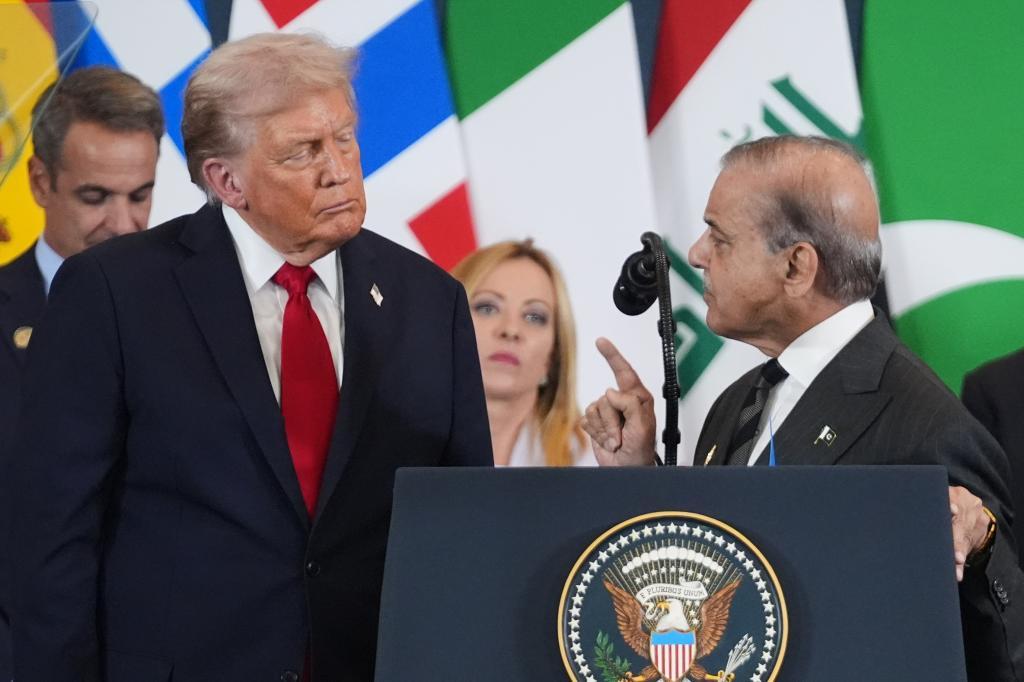
Pakistan is said to have saved the last two capable and willing Iranian political leaders to sit at a negotiation table to end the war. Among Israel's imminent plans was to assassinate the Iranian Foreign Minister, Abbas Araghchi, and the Parliament President, Mohamad Baqer Qalibaf. Both were on their priority target list until Pakistani intelligence intercepted sensitive information. Islamabad then urgently sent a message to Washington: if Israeli forces eliminated Araghchi and Qalibaf, there would be no one left to negotiate with in Tehran, as the regime's full control would shift to the most radical commanders of the Islamic Revolutionary Guard Corps. And these radicals would have no interest in dialogue or in opening the Strait of Hormuz.
Washington listened to Pakistan. According to information published by Reuters and the Wall Street Journal, the U.S. directly intervened for Israel to temporarily remove Araghchi and Ghalibaf from the target list in their political decapitation campaign. "The Israelis had their coordinates and wanted to eliminate them; we told the U.S. that if they also eliminated them, there would be no one else to talk to," said one of the Pakistani sources.
Pakistan has taken on a central role this week in mediating between Tehran and Washington, pushing for negotiators from both sides to meet in Islamabad as a neutral point to achieve a ceasefire and unlock the current energy crisis. Pakistani authorities stated on Thursday that they had managed to open an informal communication channel between Iranians and Americans.
"Indirect talks are taking place between the United States and Iran through messages transmitted by Pakistan", wrote Vice Prime Minister and Foreign Minister, Ishaq Dar. "In this context, the U.S. has shared 15 points that Iran is discussing."
So far, Tehran has reportedly rejected the proposals from the Trump Administration. According to U.S. media reports, the peace plan offers broad sanctions relief in exchange for the removal of all enriched uranium material, abandonment of enrichment processing capabilities, limitation of the ballistic missile program, and cessation of support to militant groups in the region, including Hezbollah and Hamas. It is essentially a hardened reissue of the 2015 nuclear agreement framework, but in a much more volatile context and with fewer incentives for Tehran.
Meanwhile, Islamabad is trying to turn this indirect channel into a face-to-face meeting. According to the U.S. newspaper Axios, there are two possible formats on the table: a technical one, with Araghchi, U.S. envoy Steve Witkoff, and Trump's son-in-law, Jared Kushner; and another with more political weight, involving Vice President JD Vance and Qalibaf. Both options reflect the uncertainty about who truly has decision-making power in each capital.
Behind this discreet diplomacy is Pakistan's strongman, Army Chief Asim Munir, whose influence surpasses that of any civilian actor. Munir has activated a network of contacts that includes both Donald Trump and Pakistani Prime Minister Shehbaz Sharif and Iranian President Masoud Pezeshkian.
Munir spoke with Trump on Sunday while Sharif called Pezeshkian a day later. The general's role is not improvised. It is the result of accumulating political capital in multiple directions: a privileged relationship with Washington —he visited the White House for an unprecedented meal with Trump in June 2025, the first time a U.S. president received a Pakistani military chief without being the prime minister—, and close channels with Tehran, in addition to a strategic alliance with another key regional actor, Saudi Arabia.
During the meeting at the White House between Trump and Munir, the U.S. President publicly stated that Pakistan "knows Iran very well, better than most". The meeting, which lasted over two hours, included discussions on the escalating tensions between Israel and Iran.
Before last year's attacks, Munir also traveled to Iran along with Sharif and held meetings with senior regime officials. Iran's new Supreme Leader, Mojtaba Jamenei, recently mentioned Pakistan in a message for the Persian New Year, saying he felt a "special sentiment" towards its people.
Pakistan's influence lies in a unique combination of ties. It is the only majority Muslim country with nuclear weapons and does not host U.S. military bases. It has long-standing ties with Riyadh dating back to 1947, reinforced by a strategic defense pact signed in September 2025. At the same time, it shares a 900-kilometer border with Iran and hosts the world's second-largest Shia Muslim population.