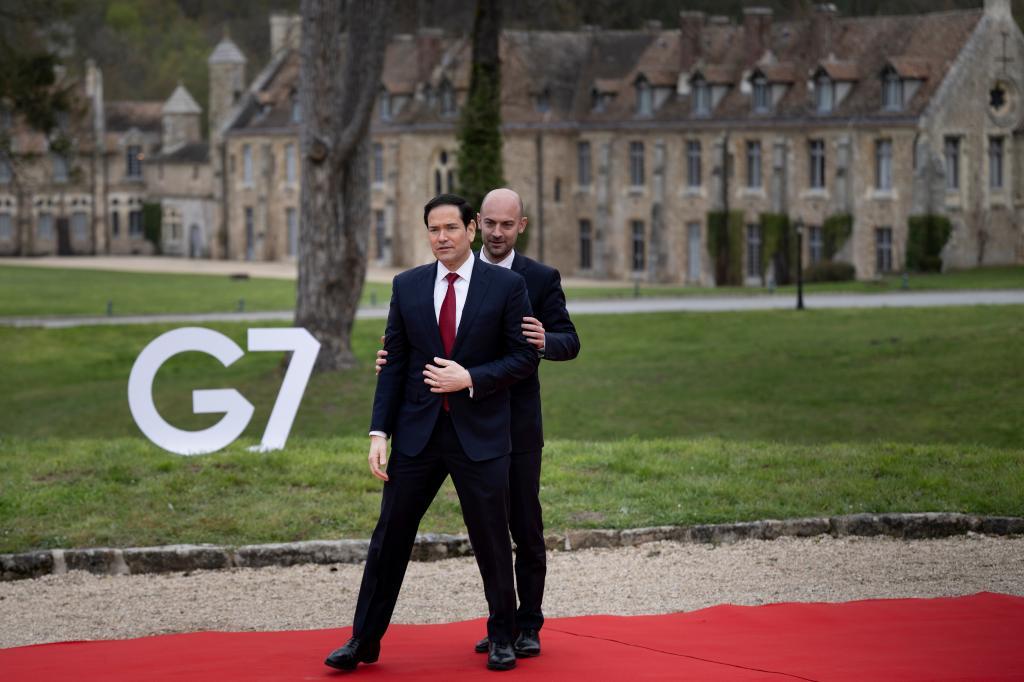
The U.S. Secretary of State Marco Rubio has requested support from his G7 partners to reopen the Strait of Hormuz, as they gather urgently at the Vaux-de-Cernay Abbey, southwest of Paris. France has reported having the support of up to 35 countries for a future mission to allow ship navigation in Hormuz, but only during a period of "calm" or after a hypothetical cessation of hostilities.
On Friday, Rubio joined discussions with the Foreign Ministers of France, the United Kingdom, Germany, Japan, Italy, and Canada, who on Thursday stood united in favor of "de-escalation" of the conflict in Iran. To pave the way for his envoy, Donald Trump announced on Thursday an extension of 10 days, until April 6, for the ultimatum issued to Iran to allow navigation in the Strait of Hormuz.
Meanwhile, allies have requested "clarifications" from Rubio regarding U.S. and Israel military operations and alleged contacts with Tehran to seek a diplomatic solution to the conflict, following contradictory announcements from the Trump Administration and the Pentagon's plans to deploy up to 10,000 combat troops as reinforcements, according to The Wall Street Journal.
This year's G7 President, France, has decided to boost the "strictly defensive" mission anticipated by President Macron coinciding with the arrival of the Charles de Gaulle aircraft carrier in the Eastern Mediterranean.
According to Reuters, Chief of Staff General Fabien Mandon has reportedly contacted a total of 35 potential "partners" from all continents to join the future mission to ensure freedom of navigation in the Strait of Hormuz, through which 20% of the world's oil flows. The mission would involve a first phase to deactivate mines and a second phase of "protection" and escorting of tankers with warships.
Admiral Nicolas Vaujour, Chief of Staff of the French Navy, stated that he has contacted 12 countries willing to provide naval assistance. "We are exchanging information on freedom of navigation and maritime security in this vital artery for the global economy and regional stability," Vaujour wrote on his X account.
"This initiative is independent of military operations in the region and is strictly defensive in nature," read a statement from the French Ministry of Defense. "Its purpose is to ensure freedom of navigation in the Strait of Hormuz once hostilities cease."
Emmanuel Macron emphasized that the mission will be deployed during a period of "calm" after the cessation of hostilities. British Prime MinisterKeir Starmer acknowledged that the plan will be hardly "feasible" without a de-escalation of the conflict.
The G7 meeting, attended by the Foreign Ministers of Ukraine, Brazil, India, South Korea, and Saudi Arabia, as well as the EU's foreign policy chief, Kaja Kallas, will also address sanctions on Russia following the U.S. announcement of temporarily lifting the blockade on oil transported by the ghost fleet. President Zelenski warned that Ukraine has become a "collateral victim" of the Middle East conflict.