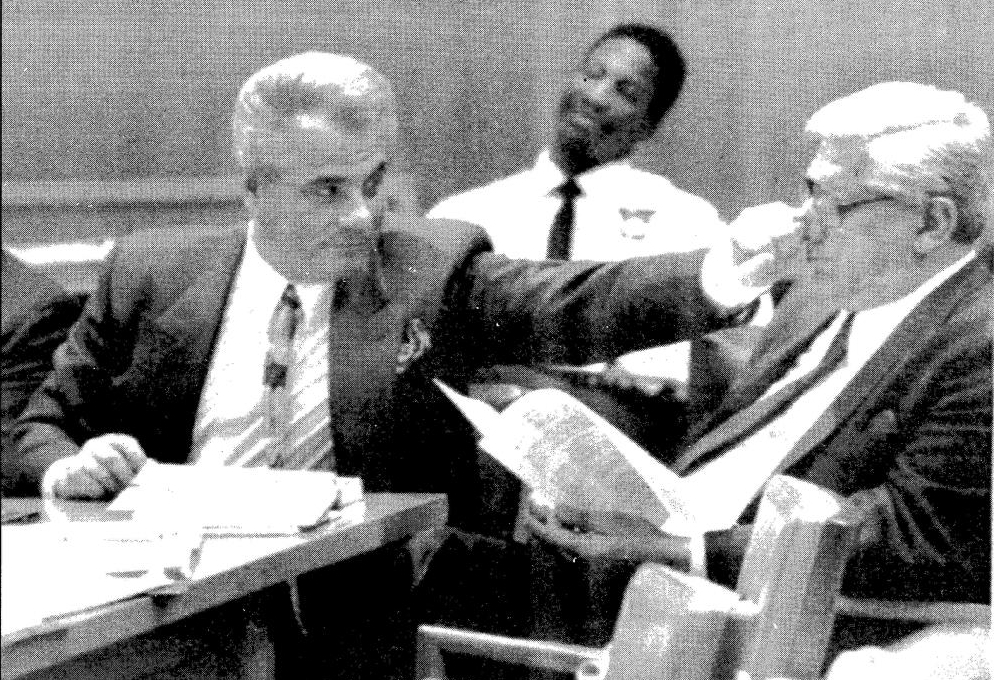
Al Capone, Pablo Escobar, John Gotti,Miguel Félix Gallardo, the Kray twins, Meyer Lanski... All mobsters have in common that they appear in photos with charisma. There is a hint. They seem resolved in the elegance that evil sometimes has, and they also reflect a certain diligence. They know what they are doing. They could solve any neighbor's problem with a phone call while imposing their law of terror in the city. Calling them the underworld is a way to hide under several rugs that power as old as the world. Or at least as ancient as modern states.
Their perception as cultural icons, shining stars, characters used as photo ops, the raw aristocracy, halfway between the streets and the offices, comes later. In fact, it is already a common place. It was Lord Byron the first Talese. The American journalist wrote Honor Thy Father, an article that tells the story of the Bonnano family. And Byron extracted from his travels through the most eastern territories of Europe the poem Childe Harold's Pilgrimage, written between 1812 and 1818. One of the characters that appears in The Pilgrimage is Ali Pasha of Yanina, the Ottoman leader who ruled over a large expanse of the Balkans. Byron describes Ali as a man of wars and enemies. And in five words, he captures the electricity of what had not yet been located as the mafia. It was the first romanticization of cruelty. Byron made Ali an effigy. His descendants would end up feeding the collective imagination through movies and TV series because they fascinated, like Ali, with their brilliant vulgarity.
Ali Pasha of Yanina was executed in 1822. But he propelled another bandit, thug, or proto-mafioso, like Mehmet Ali, to establish the hereditary character of the title of governor of Egypt. What about the Administration if the mafia is the Administration?
"What banditry tells us in much earlier times is that the development of groups committing crimes that require organization represents a challenge to the State. And, in many ways, the development of modern States has been defined by this challenge," says Ryan Gingeras via video call, another man obsessed with the mafia.
"Part of it is personal," he acknowledges. Gingeras's family, a professor in the Department of National Security Affairs and an expert in modern history of Eastern Europe and the Middle East, is from the Bronx, the New York mecca of the bad guys. "Everything related to the mafia, its culture, its stories, is an important part of my family. And of the place where we have lived for generations."
Well. He has just published Mafias. From the Yakuza to the Cosa Nostra (Ariel), an immersion in the phenomenon of this chivalry with changed values. Before mapping out the spread of the mafia across countries over the centuries and tracing its origins, he offers a small sample of what he heard as a child. His uncle Charley -recruited by the FBI as an informant- knew Moretti by sight, a mafioso from New Jersey, possibly the totem that inspired Lucca Brasi in The Godfather, the ground zero, in turn, of The Sopranos. Moretti spent many hours drinking at Ye Olde, a bar in the Bronx. One of those nights, the phone rang. Charley answered. On the other end of the line, someone identified as El Napias, asked to speak with Moretti. Moretti didn't want to talk. Charley delivered the message: "Deliver the five thousand or Willie will take a good dip in the Hudson with cement shoes". It sounds so canonical that it smells like a legend.
"As I learned more about Turkey, I thought more about the United States," Gingeras links the two scenarios through which his studies progress. "I thought about the history of New York and how these places are similar in terms of mafia and crime history, and it just occurred to me that there was a bigger story to tell. A global story." Ryan Gingeras carries in the case of a violin the question that structures the essay. "Who has shaped the world? I would say that the mafias, at different times, have been important actors in the history of very specific countries. Perhaps even more important. They reflect certain phenomena and represent broader problems in world history."
Over the years, mobsters began to adopt their own jargon. In Central Europe, vagabonds and criminals used a vocabulary known as rotwelsch. This thieves' argot fueled the engine of the Camorra when in the 19th century a process of sophistication renewed criminal gangs. In that subculture, a way of life germinated. They were not so original. The Camorra, for example, adopted Masonic rituals and organized themselves as secret fraternities. New members pronounced an oath on crossed daggers and were forced to duel with a more veteran camorrista. They governed their coexistence with a mysterious code of conduct. And they sealed loyalty by pricking a finger and smearing their blood on the effigy of a saint influenced by the Carbonari, one of the first lodges.
When someone says thug life, referring to the tough life of a thug, popularized by rappers, it evokes the thuggee, the Hindus who strangled and robbed travelers.
If Al Capone shaped the United States in the 1920s -"it is related to how the country emerges as a power of the 20th century," adds the author-, Otari Lazishvili spawned a system in the USSR in the 1970s to divert state-manufactured goods by declaring them in poor condition. Lazishvili, who was a driver and had studied Economics, found in smuggling the most effective way to influence, in his own way, the country's economy: "He generated obscene amounts of wealth at a time when most were struggling to obtain basic necessities." He spent thousands of rubles on sports betting and bought two houses with a pool. "His rise was made possible by his relationship with the first secretary of Georgia."
"Today more than ever, we may identify some politicians as mafia. That is, Putin's Russia or Maduro's Venezuela have undoubtedly attracted this kind of attention and comparisons," analyzes Ryan Gingeras. "But what kind of mafias do you see? North Korea has not only benefited from drug trafficking, but has also helped organize elements of drug trafficking in Northeast Asia. Syria benefited from drug trafficking in the Middle East. We have now accepted as part of real life a theme so recurrent in fiction. The Godfather reinforced that idea. Michael Corleone says it in the second part: 'We are both part of the same hypocrisy.' His relationship with the senator is very important."
Not only in fiction. A correspondent for The Guardian, during the interrogation of Joseph Valachi, a soldier in the Genovese crime family of New York, was surprised by the familiarity with which the police addressed the mobster during the McClellan Commission. He provided names, described murders, and verified the existence of "a national crime syndicate" in a completely collegial atmosphere. The interrogators called Joseph Joe.
"Social Bandits"
In the beginning, the first gangsters also fostered the birth of a social consciousness. "What has most intrigued historians about banditry is what it reveals about the development of social and class consciousness." A 1959 study, Primitive Rebels: A Study of Archaic Forms of Social Movements in the Nineteenth and Twentieth Centuries, was highly influential. The author, Eric Hobsbawm, called them "social bandits," that is, "primitive expressions of discontent and mobilization that sought revenge against landowners, tax collectors, and other elements who enriched themselves at their expense and wielded power over them."
Perhaps the Sicilian Mafia, the archetype of a second state, first took its first steps right there. "To the weak, whether peasant or miner, it offered at least some guarantee that the usual level of oppression would not be systematically exceeded; it was terror that mitigated traditional tyrannies," Gingeras quotes Hobsbawm's thesis in *Mafias*.
"In the past," he says on the other side of the screen, "there were times when the people of Sicily, in particular, fostered the emergence of the Mafia. It was part of the culture. Why do certain groups appear out of nowhere?" Some sociologists have argued that it reflects the lack of strong governments in Sicily. The persistence of banditry, a kind of male-dominated culture on the island, also plays a role. Mafias, not only as criminals but also as political actors, played a truly significant part. The influence is global. "In Ancient Rome, the Chinese empire, and relatively modern states, it's a major phenomenon."
Before World War II, the Japanese yakuza gained prominence with the empire's shift to the right. This was the opportunity seized by the fixer, crook, and ultranationalist Yoshio Kodama when he arrived in China in 1937. There, he was allied with a number of suppliers, exporters, and agents—the men who, behind the scenes, managed the country's inner workings. They also took advantage of the local opium trade to boost their businesses. Although his activities couldn't yet be considered yakuza, Kodama was paving the way for the movement that would later follow. The atomic bomb that devastated Hiroshima laid bare the symbiosis: "The yakuza operated as an extension of the Japanese imperial system."
But it's time to stop talking about the mafia without resorting to myth. Tommaso Buscetta suffered a bout of nostalgia when drugs burst onto the scene and the business became international, with all the mobsters wanting to flaunt their money and cars. They were no longer secret societies. Those old-school mobsters didn't fit into the new times. Buscetta missed his parents' generation, the ones who built part of the state by establishing themselves within it. The cocaine revolution, fueled by Pablo Escobar, sidelined the classics, "dignified, chivalrous, and kind-hearted people by nature," as the dispossessed Buscetta described them with melancholy.
We all see something of dignity, chivalry, and kindness in Tony Soprano. The Mafia Museum in Las Vegas receives thousands of visitors a year. Mafia mythology is also about prejudice. "There's something historical about how, over time, certain peoples become associated with different types of crime," the author observes. "Certain groups we identify with the mafia no longer carry the negative connotation of that reputation. Chinese immigrants in the United States, for example, no longer represent insecurity."