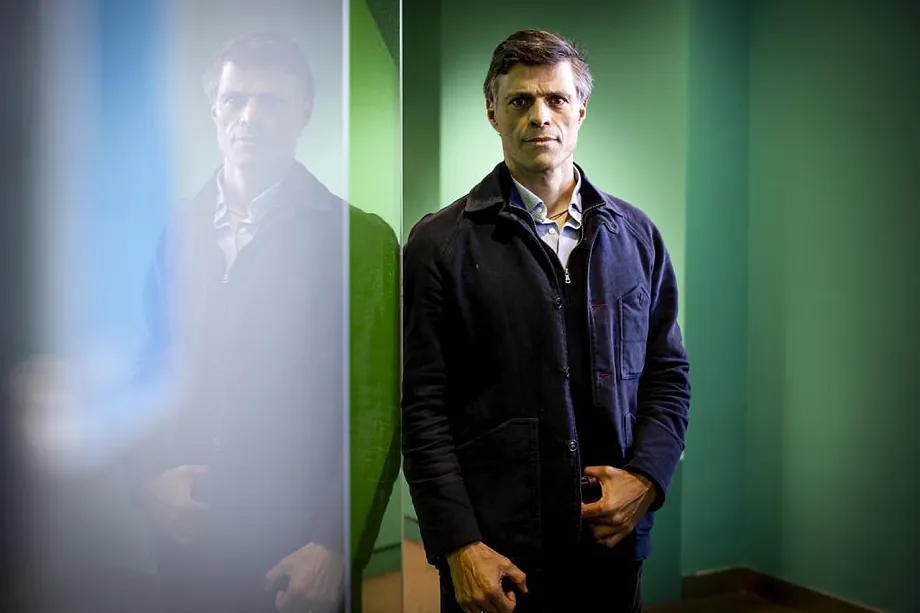
Leopoldo López has the map of Venezuela literally tattooed on his skin, but he does not have a passport, nor is he recognized as a national in his own country. One of the many obstacles that the Bolivarian dictatorship has imposed on him over the years is that of pushing him into a stateless limbo to nullify his citizenship. In 2014, Colonel Humberto José Calle tore up his passport in a cell at the Ramo Verde military prison, and at the end of last year, President Nicolás Maduro announced a process to strip him of his nationality, something that is prohibited by the country's Constitution.
The goal of the Chavista regime was for López to be neither Venezuelan... nor Spanish. They denied him the necessary documents to obtain Spanish nationality, in addition to maintaining his criminal record for being a political prisoner and escaping. But now, the Venezuelan opposition leader exiled in Madrid and leader of Voluntad Popular will finally have a passport. Not from his own country, but a European one.
Because this week, as confirmed by EL MUNDO from sources involved in the operation, the Government of Pedro Sánchez will grant him Spanish nationality through an expedited process, given his special circumstances. Tomorrow, the Council of Ministers will approve a royal decree by which López will become Spanish by "letter of nature."
This is something that López himself requested at the end of 2025, after hitting a wall trying through the regular process. Why? Because to naturalize, one needs documentation that the dictatorship does not provide, and one must not have a criminal record, which in his case is impossible because, after being imprisoned for his ideas, he escaped from prison and Venezuela.
The Government has promptly - and discreetly - granted his request, and this Tuesday will grant him nationality "for being a person of extraordinary relevance and for reasons of foreign policy," according to the sources consulted. The Ministries of Foreign Affairs and Justice have been involved, obviously with the approval of the President of the Government, Pedro Sánchez.
"The persecuted are left in a legal limbo, without rights"
The letter of nature is an exceptional way to obtain nationality, granted by the Government in special cases. It is discretionary and by royal decree. It has no pre-established requirements and is not subject to general administrative rules. It is commonly used to naturalize athletes who will compete representing Spain, for example.
Leopoldo López is one of the most prominent figures in the opposition to the Bolivarian regime currently led by Delcy Rodríguez, three months after the US Army entered Caracas and forcibly removed Maduro. In 2014, when he was the most prominent voice of anti-Chavismo, he was imprisoned for leading protests against Chávez's successor.
The UN Human Rights Council described his detention in Venezuela as arbitrary and called for his immediate release. The Inter-American Court of Human Rights also ruled unanimously in his favor. In 2017, he was placed under house arrest. He managed to escape with the help of Juan Guaidó and a group of military personnel in 2019.
Since 2020, Leopoldo López has been living in Madrid with his wife, Lilian Tintori, and their three children. His parents - former Euro MP of the PP Leopoldo López and Antonieta Mendoza - have Spanish nationality. However, he was unable to obtain it, so he requested the Government's grace. Especially after the Bolivarian regime declared him non-Venezuelan less than six months ago.
"I will always be Venezuelan, but I am no longer stateless,"
For López and his family, the repression has not stopped for a minute since they went into exile in Madrid. Earlier this month of March, the regime vandalized and destroyed his house on the outskirts of Caracas. "The persecution against me and my family has continued. In November, they announced that they were stripping me of my nationality, and now they entered my house in Venezuela, in Caracas, two blocks from where Delcy lives, and killed the dogs, stole everything, knocked down the walls, the rooms, the stairs... This persecution has continued until now. They censored me, pursued me, imprisoned me, robbed me," says Leopoldo López to this newspaper.
"I am and will always be Venezuelan, but I am no longer stateless and I now have a nationality. Spain has welcomed us, and I am very happy," he says. "I appreciate all the support that the Government has given us," he adds, aware that his case is a prerogative of the Sánchez government.
"Given this scenario, receiving Spanish nationality opens up a new path for me," he observes. What path? For López, the story of his persecution underscores the need to embark on a "transition to democracy" in Venezuela as soon as possible, leaving behind the arbitrariness of the dictatorship.
Additionally, his case may serve as a precedent in the future for the naturalization of more Venezuelan opposition members in exile. "This reflects the reality of those persecuted by the dictatorship: they have no rights." "There is a reality of people who are in legal limbo because they cannot provide the necessary requirements for obvious reasons," he explains.
"They demand notarized documents with criminal records, and that, for example, was impossible for me. I have completed the time [of residence in Spain to obtain nationality], but not the notarized documents because for Maduro's dictatorship, I am a fugitive, because I escaped from prison," adds the Caracas opposition leader.
"It's time for the transition, and that means elections"
Leopoldo López (Caracas, 1971) finally receives some good news after so much hardship and injustice. Last week, a government representative called him to announce that he would be granted nationality by "letter of nature." As soon as March 31.
After confirming the news of his expedited naturalization, EL MUNDO contacted the Venezuelan opposition leader exiled in Madrid and leader of Voluntad Popular, who acknowledges feeling "relief" when the Ministries of Foreign Affairs and Justice informed him that they would resolve his case favorably at the next Council of Ministers.
"I have a tattoo of the map of Venezuela on my leg," he continues, but "the reality is that Spain is a country that welcomes us as brothers, Venezuelans persecuted by the dictatorship. I have been in Spain since the end of 2020, I am married to Lilian, who is European, and my children and parents are too." "When they talk to you about the ties of Hispanic heritage and you had to cross the pond, you see that we come from the same historical current, that we have the same names, and that we are united by that same flow of Hispanic heritage," he reasons.
And now what? Is the end of the dictatorship near? "I am very, very optimistic. We are much better off than when Maduro was in power, but we are not where we want to be," López explains over the phone. "Now it is time to build the transition to democracy, and that can only be done through a new electoral process" in which Venezuelans "elect all their representatives again" in a clean and transparent manner. With him back in Caracas "from minute one." "And without Delcy, of course," he concludes.