In The Guns of August, one of the most instructive books on how conflicts arise, Barbara Tuchman describes how Europe entered World War I not so much by a conscious decision but by a chain of inertia, miscalculations, and escalations that no one knew or wanted to stop. A century later, the war with Iran is beginning to show unsettling echoes of that logic: powers convinced they can control the pace of the conflict, allies pushing in different directions, and a succession of blows and reprisals that are closing diplomatic exits. Like in 1914, the danger is not only in the war itself, but in the illusion that it is still possible to manage it before it reaches a point of no return.
Once mobilization begins and the war industry is activated, it is difficult to turn back. The war machine is too vast and complex to stop. Now the war against Iran is escalating and seems out of control. This is evident, to begin with, in the words: Iran issued a harsh warning to the United States yesterday that any ground operation against the country will end with the "humiliating capture" of its troops, who will be "food for the sharks of the Persian Gulf".
In this context, the Pentagon has offered, as confessed yesterday by Karoline Leavitt, White House press secretary, "several intervention options in Iran and the president has not yet made a decision." In the Middle East region, the United States already has over 8,000 deployed ground forces, including paratroopers, marines, and special forces, but Trump has not yet made a decision on the plans presented to him, which include taking one or more islands and even an incursion beyond enemy lines. At the moment, we do not know if Trump will choose one, several at once, or none.
What we do know is that he is not satisfied with that deployment and has asked for more. Another ship for amphibious operations, the USS Boxer, set sail from Hawaii two days ago to head to the Gulf region with thousands of marines on board. It will be the second of its kind, as the USS Tripoli already arrived here on Friday.
Some recall these days that U.S. involvement in the Vietnam War began in 1960 with 900 military advisors, then with 3,500 marines to secure Da Nang airport, and from there to half a million soldiers fighting in 1969.
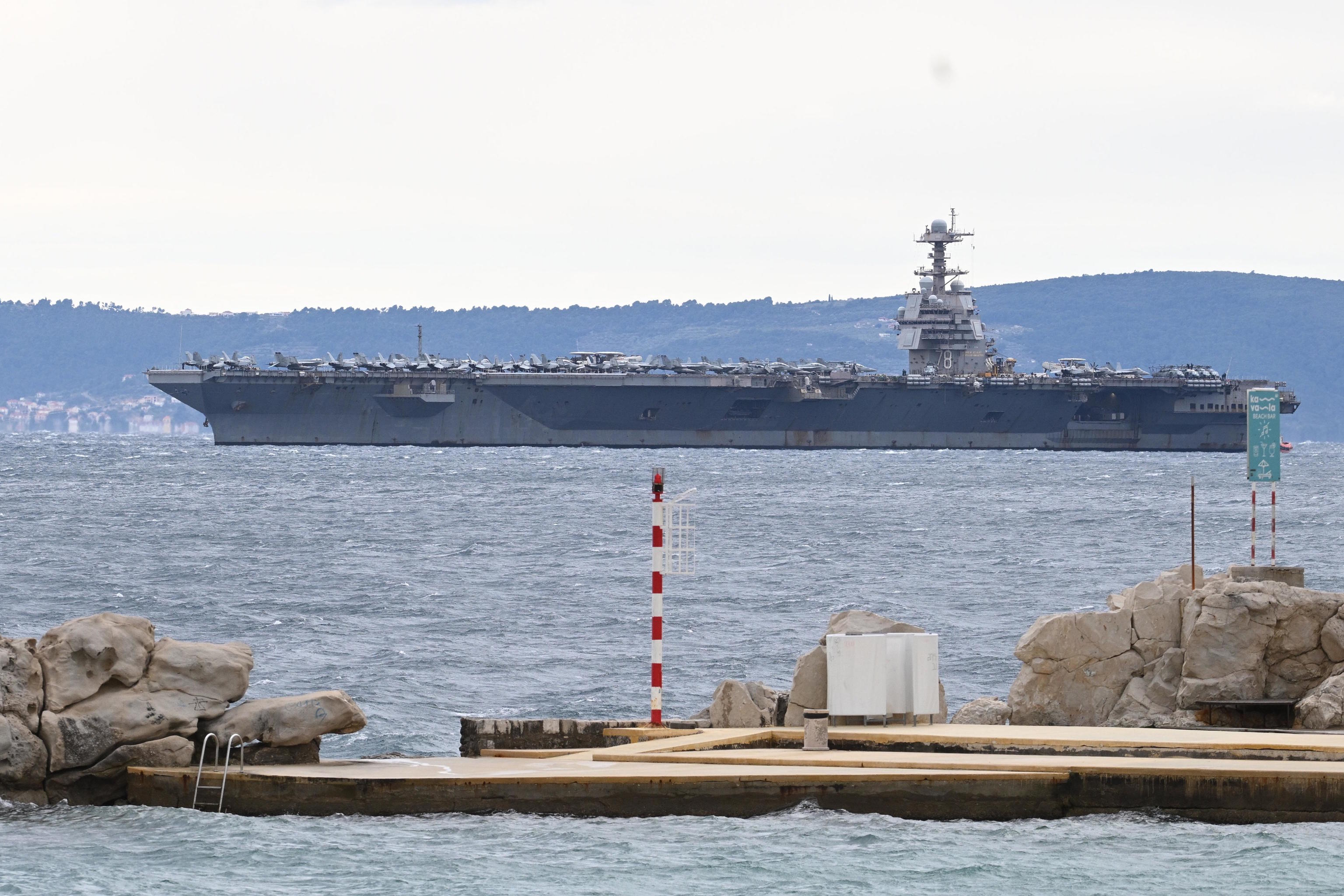
To replace the aircraft carrier Gerald Ford, which is undergoing repairs in Greek waters, the USS George Bush will also be deployed. Some claim that in reality, the Gerald Ford was damaged by an Iranian missile attack, while the United States maintains that there was a massive fire in the laundry room.
Many journalists covering Defense affairs in Washington have complained about the lack of transparency: it has been 10 days since the last appearance of Hegseth and Caine before the press regarding Iran. There has been no CENTCOM press briefing since March 10, nor any daily Pentagon press conference.
The United States has begun bombing key targets in the islands of the Strait of Hormuz, awaiting the blonde president's decision on one of the plans to put boots on the ground. Yesterday, its aviation destroyed ports, bunkers, and other targets on those islands to soften defenses, a preliminary step to any amphibious or airborne operation of note.
The graph showing how Tehran has reduced the number of missiles and drones launched from a high number to a much more moderate one created a narrative: the United States and Israel have destroyed the launchers and a large part of the arsenals, making it more difficult for the ayatollahs to attack their neighbors. Now we see that perhaps that story did not tell the whole truth. It is true that fewer missiles and drones are being launched, but Iran has transformed a military action that was intended to be a "blitzkrieg" into something that increasingly resembles a "war of attrition", which implies that Iran is rationing its salvos.
This does not mean they are not lethal. The attack last Friday on a Saudi Arabian air base has left worrying images for the United States. Several aerial refueling tankers were destroyed along with an AWACS Boeing E-3 Sentry early warning aircraft. This is a scarce and technologically valuable aircraft of which Washington has only 18, not all in service.
It is incredible at this stage how, after experiences like the Spider Web operation in which Ukraine hit dozens of strategic bombers parked and unprotected on a runway, U.S. military personnel still park their planes side by side as if these types of attacks had never existed. Iran, on the other hand, has taken good note of the experience of the war in Ukraine thanks to the help of Russia, its main ally.
This is not the first high-value target that the Iranians have managed to take down. Washington's main radars in the region have also been hit in the last month. Without these radars and without aircraft like the destroyed AWACS, aviation loses its eyes and ears on the battlefield.
In fact, Iran now uses fewer missiles and drones, but hits more targets, even if indiscriminately. In the case of Israel, the highly prohibited use of cluster munition missiles makes it increasingly difficult to intercept them, with the logical consequence that if the war drags on, Israel will struggle to replenish its arsenal of expensive Arrow, Patriot, and Thaad interceptors, which are in short supply in all countries using these Western systems. This is why we see increasing destruction in Jerusalem and Tel Aviv.