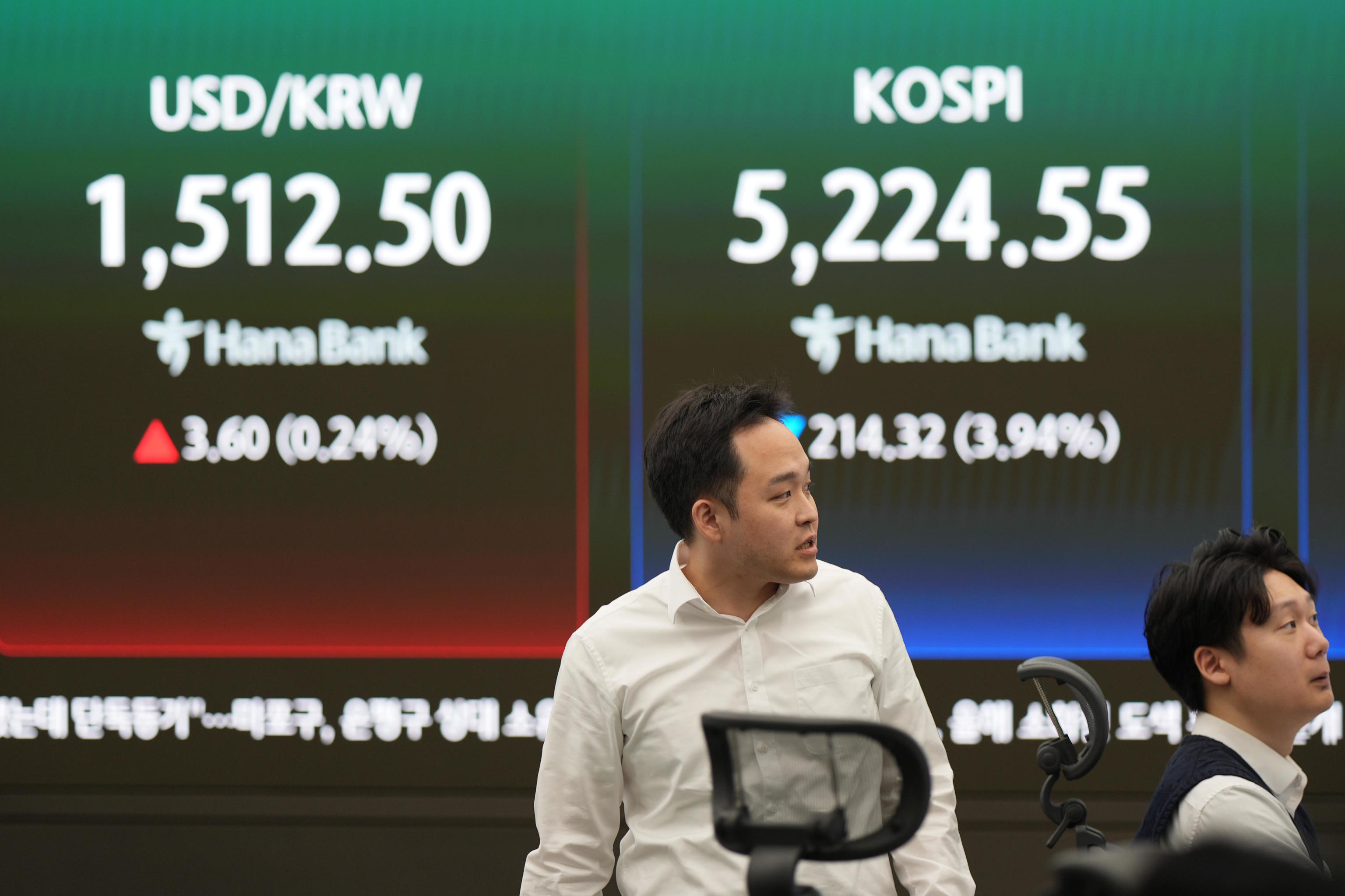
One month after the start of the war, investors are uncertain. The events of the past few days, in which Donald Trump announced a truce, extended this Friday for a longer period - until April 6 - confirm that the lesson learned just a year ago, following the tariff crisis, is useful because it is repeating itself: the markets distrust the words of the US president, both for better and for worse.
Negotiations with the Iranian regime are taking place, as announced by the White House, although their resolution does not seem close given that attacks and bombings continue in the Persian Gulf and with the continuous rise in oil prices. The Brent, the European reference barrel, surpassed $110 again on Friday, surging more than 50% since the first attack back on February 28. European gas, the Dutch TTF, rises almost 80% with prices around 57 euros per MWh when four weeks ago it was trading at 32 euros, which is already double the average price before the Russian invasion of Ukraine. In other words, Europeans have accumulated four years of constant increases in energy prices, which is noticeable in the citizens' pockets. But there's more: silver plunges 26%, platinum 21%, and copper drops 7% in the last month. This contrasts with the soaring prices of agricultural commodities. Sugar futures rise 13% in a month, oats over 10%, corn 8% similar to cotton and milk, and palm oil gains another 9%.
"A lasting peace would require the agreement of the three parties involved (US, Iran, and Israel), although currently the operability of the strait is the only truly decisive factor, so the markets will react optimistically to signals that the passage is reopening," say sources from Banca March. Hence Donald Trump's efforts to show that the passage is reopening. This Thursday, he acknowledged that the "gift" from the Iranian regime was allowing 10 "fully loaded" tankers to pass through the Strait of Hormuz, as he said in his usual language from the Oval Office. Analysts repeat like a mantra that 20% of the world's oil and gas supply passes through the Strait of Hormuz, as do other derivatives used, for example, in fertilizer production, and where Spain is one of the most affected countries, where the cost of living, especially in food, has increased by 4.8% in March.
Nevertheless, despite the US anticipating a conflict lasting only a few days when it decided to kill Ayatollah Ali Jamenei four weeks ago, the impact on the markets has been quite heterogeneous with some episodes of panic, generally in response to a message posted by Trump on his social media. European and American stock markets have suffered losses between 6% and 11% during this period; with gold containing its decline, bitcoin hinting at being a safe haven at times without much success, and a debt market that continues to trigger alarms. Indices like the Paris CAC or the Frankfurt DAX are the most affected - with losses exceeding 10% - considering their exposure to sectors such as luxury, industry, or automotive, which are the most affected by the lack of supply and the impact this war is having on Asia and its consumers, who are the main clients of giants like LVMH, Hermès, or L'Oreal.
The collapse of the gold price is surprising, having exceeded 20% and risking dropping below $4,000 per ounce. The explanation for analysts is simple: in the face of stock market declines, investors need liquidity to hedge or simply increase their cash. This is common at the beginning of recent financial crises, coinciding with another episode calling for liquidity: doubts about private debt funds in the US, where firms the size of Apollo, Ares, Blackstone, or BlackRock have been forced to limit redemptions of a type of funds that are residual in Spain (representing only 0.2% of all collective investment, according to CNMV) and are considered hybrids, as they offer some liquidity window to exit. This is a significant reason why stock markets have not collapsed due to the war. This is what Michael Heldmann, CIO of Global Equities at Allianz GI, pointed out during his visit to Madrid this week. "We see very few outflows from the stock markets, despite the geopolitical situation, which leads us to believe that what is happening in the private market is causing investors to hold on. People have learned (after the war in Ukraine or after Liberation Day) that there is no need to run away," he stated.
There is a notion that the collective memory still vividly remembers the impact that the conflict in Ukraine had on inflation in the eurozone. Bank of America mentions this in one of its recent reports, echoing Christine Lagarde's words from the previous week when she acknowledged that the impact on prices from the war could be "significant" while also recognizing that the economy is much better prepared than four years ago to face it. However, the fact that what happened in 2022 is still fresh in people's minds has consequences. The consumer confidence index in Germany has plummeted to a two-year low. "It is worth noting that uncertainty and price developments now have a greater influence on the savings expectations of eurozone consumers than before 2020" because the pandemic also led to a change in mentality, that of carpe diem, and spending today is higher. With great concern about the impact on prices, "consumption could be weaker than usual in the initial phase of the shock, but its subsequent recovery would also be lower," say BofA analysts.
Yesterday, Friday, it was reported that the CPI in Spain surged by one percentage point in the first month of the war, reaching 3.3%. The Bank of Spain considers that, in the worst-case scenario, prices could rise by 5.9% this year.
With Wall Street calming nerves, investors are constantly keeping an eye on the bond market. This is where everything is decided, and every time the 30-year bond touches 5%, Donald Trump steps in forced by circumstances. So far, the yield on the US ten-year debt has climbed 49 basis points during the month of the war, reaching a yield of 4.45% driven by investor sales. The tension in the last few hours, where the US talks about peace negotiations while Israel threatens massive bombings in the area, has led the 30-year bond to levels of 4.96%, an uncomfortable situation for the Administration. The two-year debt, which best reflects market tensions, is at 3.95%. These yield levels imply a higher financial cost for the US public finances, with a debt of $39 trillion and a deficit that closed 2025 at 6%.
And the situation could worsen. The forecast of several interest rate cuts by the Federal Reserve is a thing of the past. Now the market considers it the lesser evil for the Fed to maintain current levels in a scenario heading towards stagflation (zero GDP growth plus rising prices).