The war in Lebanon has revived the grim tradition of "provisional" cemeteries. Lots of land set aside to bury the conflict's victims who cannot be buried in their home villages, as it is impossible to access them due to them becoming a battlefield.
The bodies of the journalists Ali Choeib, Fatima Fatouni, and her brother, the cameraman Mohammed Fatouni, were buried this Sunday in one of these improvised spaces, where the graves are barely marked with a brick outline and an occasional tombstone.
The funeral took place in the cemetery set up by the Hezbollah group in Choueifat, a town south of Beirut. A place where civilian victims and fighters of this group are intermingled. The latter are clearly identified by their photographs and the yellow flags of the also-called Party of God, waving over the earth covering their remains.
The trio died on Saturday in an Israeli attack near Jezine, in the south of the country, in a bombing specifically targeting their vehicle, which was hit by at least two missiles. According to local media, two paramedics who tried to approach the car also died after being targeted by Israeli drones.
The bodies were received amidst the wails of the mourners and shouts like "Death to Israel!" or "Death to America!".
According to Ali Choeib's colleagues, who worked for the Al Manar television network, part of the media network of the Hezbollah group, the reporter had been "threatened" on several occasions by Israel.
"They sent him messages by phone, by email. They explicitly told him they were going to kill him. It's something they usually do with all of us," said Hosein Mortada, another reporter "marked" by Israel.
Tel Aviv tried to justify the killing on Saturday by saying that Choeib was a "terrorist disguised as a journalist". According to this theory, published by Israeli media, the journalist allegedly was a "member of the intelligence unit" of the special forces of the mentioned armed group. The military did not present any evidence to confirm such an assertion and did not mention the reason used to end the lives of the two Fatounis, who worked for another station, Al Mayadeen TV.
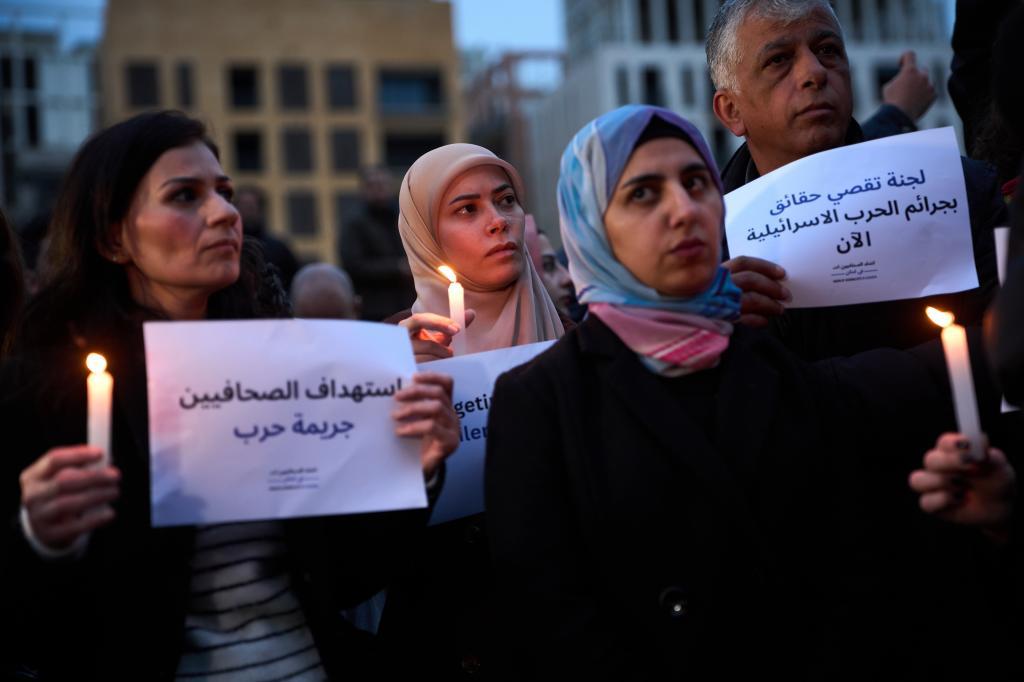
The killing of journalists by Israeli forces has been a constant in both the Lebanon war - which in the last one ended the lives of 13, according to L'Orient Le Jour - and in the Gaza genocide, where the mortal victims of this profession were 261, according to the figures provided by the International Federation of Journalists. Premeditated attacks against journalists are considered a war crime.
The Israeli air force had already killed another journalist from Al Manar, Mohamed Sherri, on the 18th, by bombing his apartment in Beirut, an action that also ended the life of his wife.
The newspaper L'Orient Le Jour, one of the most emblematic in the country - aimed at the French-speaking elite - whose origins date back to the beginning of the last century, published a text today emphasizing its opposition to attacks against journalists.
"Regardless of the opinion one may have about the editorial line or the role of media linked or close to Hezbollah, no journalist should, under any circumstances, become a target of attacks. The survival of freedom of information depends on it," the article read.
The newspaper, politically at odds with Hezbollah, also recalled the threats made by circles close to that movement against local journalists but once again criticized unequivocally the Israeli aggressions.
"After Gaza (where Palestinian reporters suffered a real debacle), we must do everything possible, before it is too late, to prevent Lebanon from becoming another cemetery of information," the newspaper concluded.
The deaths of the three journalists have managed to unite the divided voices of the country's elite, except for the far-right sector sympathetic to Israel. Both President Joseph Aoun and Prime Minister Nawaf Salam, at odds with Hezbollah, criticized the incident, as did the president of the parliament, Nabih Berry.
For the latter, it is a "war crime, committed under premeditated surveillance, in clear violation of all humanitarian laws and norms."
The death of the 3 reporters is part of the escalation of violence in the south of the country due to the Israeli army's attempt to occupy a large strip in that area.
Although Israeli soldiers have managed to capture some villages on the border, their troops continue to face off against Hezbollah militants a few kilometers from the border. The neighboring country's soldiers acknowledged the death of another soldier on Sunday, the fifth in recent days.