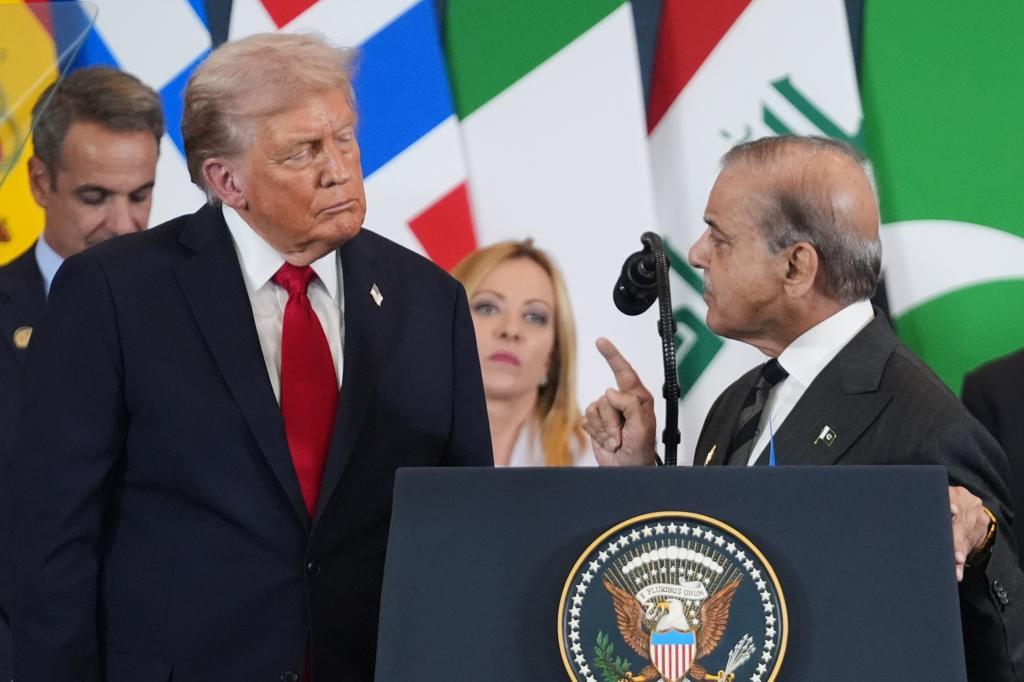
Pakistan announced on Sunday that it will host peace talks between the United States and Iran "in the coming days," even as thousands of U.S. Marines arrive in the region and the Iranian Parliament's president describes the negotiations as a cover for a ground invasion.
Pakistani Foreign Minister, Ishaq Dar, appeared on television to ensure that his country is ready to "facilitate constructive dialogue" leading to a "comprehensive and lasting solution." The announcement came after a meeting in Islamabad with the foreign ministers of Turkey, Egypt, and Saudi Arabia, a quartet seeking to revive a political path while the military escalation continues.
Ishaq Dar stated that the four countries discussed "possible ways to end the war early and definitively." According to Reuters, the initial discussions have focused on finding a diplomatic solution to reopen the Strait of Hormuz. The Pakistani minister did not specify whether the announced negotiations would be direct or through intermediaries.
The response from Tehran was as quick as it was revealing of the atmosphere of distrust. The Iranian Parliament's president, Mohammad Qalibaf, flatly rejected the initiative, calling it a "cover" for a potential U.S. ground intervention. "The enemy announces negotiations while secretly preparing for an invasion," he wrote on Telegram, reflecting the skepticism of the hardline Iranian faction.
In an interview with the Financial Times, U.S. President Donald Trump has assured that "indirect" negotiations between the U.S. and Iran, facilitated by Pakistani "emissaries," are ongoing and showing positive progress. Although he refused to provide specific details when asked if a ceasefire agreement could be reached to reopen Hormuz in the coming days.
Since the start of the war on February 28, there has been no direct contact between Washington and Tehran. Meanwhile, thousands of U.S. Marines have begun to deploy in the Middle East, fueling speculation about a ground operation with strategic objectives such as the island of Kharg or the reopening of the strait. Trump declared hours ago that the U.S. could "take over Iran's oil."
Washington's alliance with Pakistan
In this scenario, Pakistan is playing an ambitious game. Once isolated by Washington for sheltering Osama bin Laden, the country has managed to position itself as a useful intermediary in the current conflict. It has done so by maintaining a delicate balance: it has close relations with Washington but also retains extensive ties with Iran, with whom it shares borders and economic links.
Behind this mediation attempt are weeks of silent diplomacy. Islamabad has strengthened ties with the Trump Administration through agreements ranging from critical minerals to cryptocurrency-related projects, in which the influential army chief, Asim Munir, who has a direct line to the U.S. president, may have been involved. This rapprochement has returned Pakistan to a position of relevance on the White House agenda, something that had not happened in decades.
At the same time, Tehran continues to see Pakistan as a reliable neighbor in an increasingly hostile neighborhood. Evidence of this is that it has allowed Pakistani ships to pass through the Strait of Hormuz despite the widespread blockade, a gesture that Islamabad seeks to capitalize on as a sign of trust.
Pakistan's Prime Minister, Shehbaz Sharif, stated on Saturday that he had a "detailed phone conversation with my brother, President Masoud Pezeshkian of Iran, which lasted over an hour," as part of the preparations for peace talks in Islamabad. German Foreign Minister, Johann Wadephul, also stated this weekend that he expected a direct meeting between the U.S. and Iran in the Pakistani capital "very soon," without revealing the source.
Last week, Washington reportedly delivered a 15-point plan to the Iranian regime through Pakistan to end the war. The Wall Street Journal reported that the peace plan offered Tehran broad sanctions relief in exchange for the withdrawal of all enriched uranium material and the abandonment of its enrichment processing capabilities, limiting the ballistic missile program, and ceasing support for militant groups in the region, including Hezbollah and Hamas.