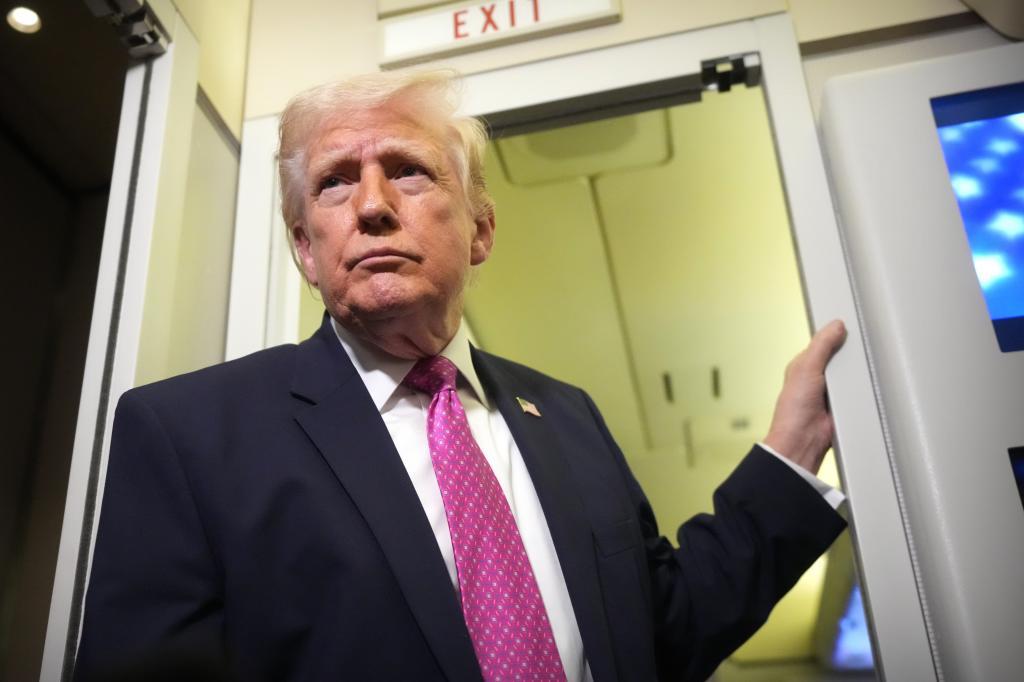
Donald Trump has claimed, at least 12 times, that the United States has won the war against Iran during this first month of conflict. If it were true, all their warships would have returned to their bases and the oil tankers would gradually sail through the Strait of Hormuz again. Looking at the facts, he may have prevailed in some battles, but he is still far from bringing Iran to its knees. In fact, every passing day makes it more evident that by supporting the arguments of Benjamin Netanyahu to combat the ayatollahs, Donald Trump has fallen into a trap from which it is very difficult to emerge successfully.
The first month of conflict in the Middle East has acted like an atomic bomb on the balance of power in the region and has returned the international system to a logic of direct confrontation between States. What started as a limited operation to strike Iranian military and nuclear infrastructures ("special operation," as Trump called it, almost copying Putin's "special military operation" formula for Ukraine) quickly turned into a high-intensity conflict, marked by the early decapitation of the regime, the Iranian response against almost all its neighbors, the escalation from a regional war to a global crisis, and increasing uncertainty about its outcome.
Iran has responded with a strategy that combines ballistic missiles, drones, and indirect warfare. Their attacks have not been limited to Israeli targets but have also reached countries in the Gulf that had previously remained neutral, such as United Arab Emirates, Kuwait, Qatar, or Bahrain. With this, Tehran has expanded the theater of operations and has turned the war into a global issue, administering powerful doses of pain as penance for being friends with United States and questioning the security of economies highly dependent on stability. So far, it is working for them.
Even if the United States were to implement some of its military plans to take Iranian islands in the Persian Gulf or in the Strait, it is difficult that, even if they achieve their objectives, they would be able to reopen the traffic of oil tankers in Hormuz. The trap for Trump is of such magnitude that this escalation could lead to the involvement of Houthi militias in Yemen to close the other major oil tap, the Straits of Bab el Mandeb, in the Red Sea, something they have done on other occasions. These rebels took action yesterday by launching a missile towards Israel, the first since the war began.
Danny Citrinowicz, an analyst at the Atlantic Council, states: "The Iranian regime has realized the great global power it can exert by closing the Strait of Hormuz and causing worldwide economic pressure. If Trump escalates the situation by attacking the Iranian island of Jark, from where 90% of Iran's oil is exported, or by attacking the regional energy infrastructure, the Strait of Bab el Mandeb, it would become a crucial way for the regime to demonstrate its power. We are not in a situation where the Iranians are capitulating, as Trump is also desperate to negotiate."
Militarily, the war has revealed a key paradox: Western technological superiority does not guarantee invulnerability. The United States and Israel have deployed advanced missile defense systems, but the pace of Iranian attacks and their saturation strategy have highlighted the problem of interceptors, expensive and limited compared to cheaper and more abundant weapons. Iran has an arsenal that it has been building for decades, in addition to dispersing it to make it difficult for the enemy to destroy it entirely. The war is being fought, to a large extent, on the arithmetic ground: how much each side can withstand the attrition.
As the days passed and the attacks intensified, the Gulf monarchies shifted from neutrality to toughening their stance against Iran, but without wanting to directly engage in the war. Their strategy combines tacit support for Washington with calculated prudence, aware that open involvement would make them priority targets. Oman, on the other hand, maintains its role as a discreet mediator, while Qatar tries to preserve channels of dialogue in an increasingly polarized environment.
The United States has boasted of having eliminated a good part of Iran's army and Revolutionary Guard. They may no longer have a single flying plane or a floating ship, but they can keep the Strait of Hormuz open with a few drones a day. That's how asymmetric this war is: to win, the United States needs to achieve all its objectives, which are to end the nuclear and ballistic missile programs and cut off funding to allied militias like the Houthis, Hamas, or Hezbollah. On the other hand, to win the war, the Iranian regime only needs to survive. Their ability to withstand blows makes Iran a tough nut to crack. Just like in Vietnam, perhaps the United States will win all the battles but end up losing the war.
Professor and geopolitics expert Óscar Vara believes that "the US military options are full of traps. Seizing the enriched uranium buried in Isfahan may sound surgical on paper, but in practice, it would be an extremely complex operation. Taking Jark or even some key islands to secure Hormuz may seem viable at the beginning, but holding those positions under Iranian drones, missiles, and continuous harassment would be another story."
The numbers of this military adventure are of high-intensity warfare: thousands of dead and a massive deployment with which the United States and Israel have, according to them, hit 10,000 targets in the region and sunk 92% of Tehran's navy. Washington has used 850 Tomahawk missiles in this effort, with a cost exceeding $23 million per second, according to Pentagon data.
Politically, the conflict has rekindled the debate on the limits of military power. The US administration faces the classic dilemma of contemporary wars: how to transform tactical advantage into a clear strategic outcome. But doubts about the "victory theory" are becoming increasingly visible, even among military commanders who warn of the risk of an escalation out of control. Washington does not know today what to call victory, and that is a huge problem. Iran did not pose an imminent threat to the United States, but the war started due to pressure from Israel and its powerful American lobby.
That is why the agendas of the United States and Israel have begun to diverge as the war drags on. Washington maintains a broader view, focused on containing regional escalation, ensuring the security of energy traffic - especially in Hormuz - and avoiding a conflict that could disrupt global balances. For the US administration, the priority is to stabilize the Gulf and protect critical infrastructure for the global economy.
In contrast, the government of Benjamin Netanyahu has opted for a much more direct and aggressive strategy, focused on degrading Iran's regional allies, especially in Lebanon. While Washington weighs the costs of each escalation, Israel has intensified a sustained bombing campaign that responds to Netanyahu's electoral logic, in addition to a bloody invasion of southern Lebanon already underway. In this context, Hormuz is a global problem for the United States, but not a strategic priority for Israel, whose main goal remains to weaken the Iranian axis in its closest periphery, even at the cost of expanding the conflict.
Tras un mes de combates, la guerra no muestra signos de resolución inmediata. Ninguno de los actores parece dispuesto a ceder, pero tampoco existe un camino claro hacia la victoria. Oriente Próximo ha entrado en una nueva fase, más inestable y peligrosa, en la que el equilibrio ya no depende sólo de la disuasión, sino de la capacidad de cada actor para gestionar una escalada que amenaza con ir más allá de sus propias intenciones. Cada uno de los bandos prepara sus dardos en el campo de la diplomacia mientras escala en la fase militar.
Donald Trump y sus acólitos siguen pregonando que la guerra está ganada, pero la realidad es que antes del 28 de febrero el Estrecho de Ormuz estaba abierto y ahora no lo está. O peor aún, lo está sólo para aquellos armadores que paguen a Teherán dos millones de dólares, pero en yuanes chinos. Y mientras la realidad sea esa no hay victoria que pueda cantarse.