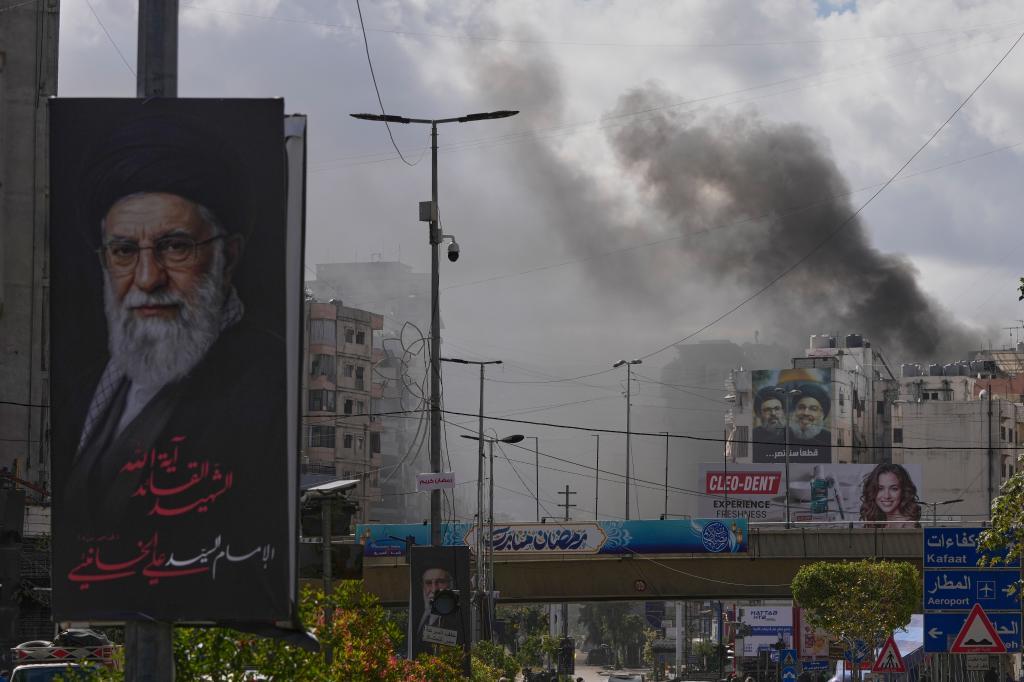
The old black and white photograph published by L'Orient Le Jour showed Shiite protesters from the southern neighborhoods of Beirut carrying a banner that read: "Each of our homes is an embassy of the Islamic Republic of Iran."
The snapshot was taken on November 25, 1983, but it was not much different from the scene formed by the hundreds of protesters gathered this Thursday in front of the same Iranian delegation in Beirut.
"You have the Vatican, we have Iran," declared Amira, one of the Lebanese present near the Iranian embassy in Lebanon, to the journalists there. "Death to the United States," "Death to Israel!", shouted those present, echoing the old slogans of the 1980s.
The small gathering three days ago is another image that revives the troubled memory of this country, where almost everything that happens today already occurred in the past.
The war against Iran initiated by Israel and the United States, to which Hezbollah joined - dragging Lebanon into the conflict - is exacerbating, day by day, the sectarian divisions in a country that only superficially buried the brutal civil war it experienced between 1975 and 1990.
As if recreating step by step the same script from those years, Lebanese authorities ordered on the 24th the expulsion of the Iranian ambassador in Lebanon, Mohammad Reza Shibani, who should have left the country last weekend.
A decision that recalls the one made under the presidency of Amin Gemayel in November 1983, when Beirut ordered the then Iranian representative, Mohammad Nourani, to leave within 72 hours. The authorities' decision led to the mobilization of the Shiite community in the following days, and on the designated day for the ambassador's departure, November 30 of that year, the airport was bombed, preventing his exit.
Gemayel's decision to align with the West against Iran and sign peace with Israel in May 1983 further fueled the confessional fragmentation of that time and ended in catastrophe: in December of that year, Shiite militias occupied West Beirut, and the army split again, triggering another round of the civil war that would not end until 1990.
"Return to the atmosphere of 1983," titled the Lebanese page Al Modon to summarize the escalation of sectarian tension that the decision regarding the Iranian ambassador has caused.
For Hezbollah, the government's order is a "national sin." The group linked to Tehran issued a statement on the same day, the 24th, demanding that the decision be "immediately reversed" due to its dangerous repercussions.
Another chapter in a scenario where everything is now interpreted in sectarian terms. In fact, the displacement of a million people fleeing Israeli military harassment has taken on a very different identity connotation than what was observed in the 2006 war when solidarity among the Lebanese was the general norm. Several altercations have already occurred between local residents and the newcomers in recent days.
"The country teeters on the brink of a precarious sectarian division, with the difficult situation of refugees fleeing the war at the forefront. Displacement is no longer just a movement to escape the flames of war: it now generates anxiety, suspicion, and security concerns," wrote the newspaper Arab al Jadeed, warning about the sectarian turmoil caused by the arrival of Shiite refugees in regions inhabited by other communities.
Apprehension about members of that confession who have had to leave their homes has been fueled by Israeli bombings against people of that religion who have settled in neighborhoods where the majority is of another faith, such as Christians or Druze.
The Israeli army reportedly demanded last weekend that several municipalities in the south of the country "expel" the Shiites they had welcomed, in an effort to exacerbate the identity struggle in Lebanon, as reported by several local media.
"I received a call on Sunday from the Israeli army demanding that I cleanse the city [of Shiite displaced persons] within 24 hours," said Kawkaba's mayor, Elie Abu Nakoul, a predominantly Christian enclave, to the AFP news agency.
"It is obvious that Israel wants to promote civil war, but our leaders [the leaders of the Shiite groups] are aware of that and have asked us to show restraint," said Hassan Malak, the head of the Beif Leif municipality, whose 4,000 inhabitants had to flee that southern village and are now scattered throughout the country.
"The current crisis is not purely Lebanese; rather, it stems from the role of Israeli incitement, which seeks to exploit these internal divisions," commented Ragheb Milli, a columnist for Al Modon.
The mere possibility of dedicating an empty hangar in the Qarantina neighborhood in the capital to receive around 700 displaced persons was left in limbo days ago due to the expressed antagonism by members of the Christian minority and the mobilizations of some residents of that neighborhood.
Ironically, Qarantina was once the site of a Palestinian refugee camp - around 30,000 people lived there - who were massacred by Christian militias in 1976 and expelled from the place.
Even the daily L'Orient Le Jour, aimed at the French-speaking Christian elite, acknowledged in a recent article that the war "has led to the stigmatization of an entire community [the Shiite]".
With the specter of a new fratricidal war looming from social media and many of the country's main media outlets with unprecedented vigor, it is not surprising to encounter daily commentators warning of this danger.
For Firas al Shufi, a columnist for Al Akhbar, for example, the country is facing "the outbreak of a complex civil chaos that would turn it into isolated small islands, governed by local armed groups, accompanied by economic collapse," something very similar to what happened in the last century.
Aware of the direction the nation is taking, President Joseph Aoun has tried to mitigate the fears generated by this sectarian spiral and said, through the main local newspaper, An Nahar, that "there is no civil war [in Lebanon] or a return to previous chapters. The current conditions are different from those of the 1970s," as reported by that newspaper.
However, the crisis could continue to escalate given the rhetoric observed in the media linked to one side or the other. The newspaper Al Akhbar, close to Hezbollah, suggested on Friday the possibility that Tehran may consider the Lebanese authorities led by Aoun as "a hostile entity," similar to what happened with Gemayel in the 1980s.
"If that decision is made, Lebanon could become an open stage for the Iranian-American conflict, with political and security implications difficult to contain," the article added.
Al Akhbar is not the only media outlet considering what is still just a hypothesis. Al Modon also mentioned the vast diplomatic complex that the United States has in Beirut, whose construction cost over $1 billion and now occupies an area twice the size of the White House; it is the second largest in the world after the U.S. embassy in Baghdad.
Local history recalls that the U.S. representation in the Lebanese capital was the target of two devastating attacks in the 1980s. The first, when a van driven by a suicide bomber blew up the diplomatic headquarters, killing 63 people in April 1983. The second occurred a year later, already in the current location: another truck bomb detonated by a militant, killing over 20 people in September 1984.
Furthermore, Washington suffered the death of 241 soldiers in another suicide attack on its base in southern Beirut in October 1983.
The tacit support of U.S. troops to Israel, which had invaded the Arab country in 1982, led American soldiers - who were supposedly part of a peacekeeping force - to be considered enemies by several local factions, who began to attack them.