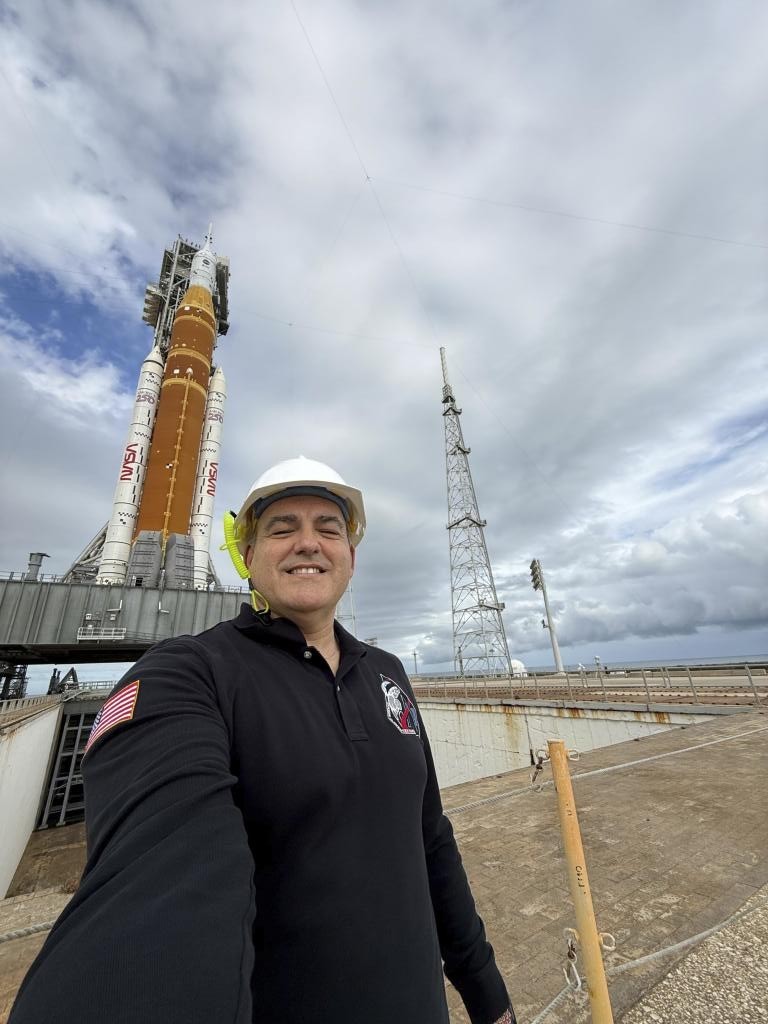
This newspaper interviewed him in May 2019 at the NASA Johnson Space Center, where, alongside a spacecraft Orion, the vehicle that next week will carry astronauts back to our satellite, he passionately shared the details and challenges of the lunar program he knows so well. This 51-year-old Spanish engineer has spent almost two decades at the US space agency, earning the trust of executives and astronauts who will travel in the spacecraft he helps develop. After holding various positions of responsibility, the new NASA director, Jared Isaacman, chose him this week to lead what will be the flagship project in the coming years: the construction of a base on the surface of the Moon (Moon Base).
"Leading the NASA team and all the space agencies that will join us in this project is a very big responsibility, and something very exciting. Just imagine, we are going to build a base on the Moon!" he comments during a video call interview, the current deputy director of the future lunar orbital station Gateway, a project that has been indefinitely suspended following the latest redesign of the Artemis program with which the US aims to send humans back to the Moon.
This engineer, born in Malaga and raised in Madrid, speaks to this newspaper from Houston, the city where he has spent most of his time since working at NASA - he also spent some time in Ohio when assigned to the John Glenn Center. "Living in Houston is good, I love soccer and there are many fields to play with air conditioning, and to play outdoors, but I like mountains and the beach, something I miss from Malaga," says this Real Madrid fan, who spent his summers in Torre del Mar and has two children.
He values in the Texan city "the many companies and the spirit of space exploration." A spirit he has felt since he was young, when he felt "fascination for exploration, whether at the bottom of the ocean or in remote mountains," and dreamed of becoming an astronaut. It is a common desire at that age, but the difference is that he focused his education towards a goal: working at NASA.
"My father was an Iberia pilot and my mother a flight attendant, and since I was 9 or 10 years old, I was very interested in the world of aviation and ships, everything related to complex engineering systems. Then I started reading about the space program. Because of my parents' profession, we were fortunate to travel often as a family. I remember that as a teenager, I went to the Kennedy Space Center in Florida and saw in the movie projections the countdown sequence of the space shuttle. Everything was calm until suddenly the engines ignited, you hear the roar, and feel everything shaking. I was very impressed to see all the systems involved, and from that moment on, I became truly interested in space," he recalls. By the way, his brother also became a commercial pilot and works for a US airline.
It was then that he focused on learning English well and trying to fulfill his dream: "At 16, I spent a year in high school in Middletown, New Jersey, and then started looking at universities. I looked for a career that would allow me to enter the space agency and chose to study Space Sciences at Florida Tech (Florida Institute of Technology) because I thought that being close to the Kennedy Center, I could have the opportunity to meet people from NASA."
In 1998, after graduating, he started working at Barrios Technology as a flight controller for the International Space Station (ISS) in the Mission Control in Houston. He later joined Honeywell Space Systems and was part of the team that proposed Lockheed Martin's development of the Orion spacecraft until he became a NASA civil servant in 2007. The various positions he has held over the years in manned operations, the development of the Orion spacecraft, or the Gateway station have allowed him to acquire a comprehensive vision of the Artemis program that will be essential for coordinating the launch of the lunar settlement.
Meanwhile, he has applied several times to NASA's astronaut selection process, but was not chosen: "I would love to go to space, but now I have other responsibilities at the agency and I am helping in the best way possible with Orion and the base," the engineer points out. "With the commercialization of space and the emergence of new companies in the coming years, there will be more options. I have not given up on my dream of becoming an astronaut, and although I have not achieved it yet, I hope an opportunity arises to oversee the construction of the lunar base, so you never know," he says.
Despite the attention his appointment as director of the Moon Base program is receiving these days, García-Galán has refocused all his attention and energy on Artemis 2, as there is less than a week left until the launch of this 10-day manned mission that will orbit our satellite without landing. If there are no further delays - initially scheduled for early February - astronauts Reid Wiseman, Christina Koch, Victor Glover, and Jeremy Hansen will launch from the Kennedy Space Center in Florida on April 1 aboard an Orion spacecraft powered by the super rocket Space Launch System (SLS).
Carlos García-Galán is a member of the Artemis 2 Management Team, meaning he is one of the experts NASA has assigned to the group that will plan, supervise, and make critical decisions during this historic lunar mission, the first to take humans to our satellite since 1972.
This Sunday, he will travel from Houston to Florida to finalize preparations for the launch from the Kennedy Space Center: "We will stay at the Florida Control Center only during the launch. We will then fly back to Houston on the NASA plane to monitor the mission from the Johnson Control Center," he explains. What have the Artemis 2 crew members said about the announcement of the lunar settlement construction? "I haven't seen them yet because they are in quarantine, but they have sent me messages congratulating me on the appointment; they are very focused on the mission."
It is no small feat. Artemis 2 is NASA's most important manned mission in decades, and its success will largely determine whether the ambitious roadmap to achieve a continuous human presence on the Moon, enabling a future mission to Mars, can become a reality. It is true that this roadmap is very changeable, as the program to return to the Moon has undergone significant and frequent modifications in the last two decades, not only due to a change in the White House administration.
Important changes have occurred within the same administration, as has been happening since Donald Trump began his second term. In just a month, the objectives of the Artemis 3 mission have changed (it will no longer land on the Moon but will test critical technologies for landing in 2027, which is now the goal of Artemis 4, scheduled for 2028).
Furthermore, during the press conference last Tuesday announcing the launch of Moon Base, the NASA administrator also revealed that construction of the Gateway lunar orbital station, which had significant participation from the European Space Agency (ESA) and in which a substantial investment had already been made, was being indefinitely paused.
"We're not going to build the Gateway station as such, but perhaps in the future we'll build a lunar orbital station. Regarding the components that are already ready, we'll certainly reuse some for the base. We're not going to use the modules, but parts of the electric propulsion module will be the main component of the nuclear rocket we're going to send to Mars in 2028," explains this engineer, who emphasizes that the new roadmap "aims to focus on a specific project instead of many things, as was the case until now. The idea is to dedicate all the funding, personnel, and technology to concrete objectives," he summarizes.
"For most of us, this is what we dreamed of, but I understand that for the people who worked on programs that have now been refocused, it's going to be a difficult change because it's always complicated to make that mental and emotional transition," he explains. The cancellation of Gateway will also have consequences for the ESA and European companies—the Spanish firm Airbus Crisa, for example, designs and manufactures the power distribution system for the station's modules. Likewise, NASA had agreed with the ESA that three astronauts from Germany, Italy, and France would go to Gateway, a plan that is now up in the air after the program's suspension.
China, the US's main rival in the 21st-century space race, is also preparing to build its lunar base, in collaboration with Russia, but García-Galán is convinced that NASA's infrastructure will be larger and they will build it first. Its development has been divided into three phases, each with $10 billion in funding. "A large part of that budget was allocated to other smaller and more scattered programs," says García-Galán, who estimates that if all goes well, it will take a total of 11 or 12 years to complete it.
The first phase of construction will begin this year: "In the summer, we'll launch one of the exploration rovers (robotic vehicles) with Intuitive Machines, and there will also be another Blue Origin test mission in 2026 with its lunar lander. In 2027, we want to launch 10 missions, and in 2028, 10 or 12, including Artemis 4, which will be the first crewed lunar landing. The goal is to send robotic components that will be distributed across an area of hundreds of square kilometers—some in the area where the astronauts will land, others in higher areas to obtain more solar energy. It will be like a testing ground for technologies, allowing us to test the equipment before starting the second phase," he explains.
That second stage will take place between 2029 and 2032 and will consist of sending larger spacecraft with the equipment needed to assemble the infrastructure that will be necessary in the future to install the modules where the astronauts will live. Thus, they will bring everything necessary to generate electricity through solar and nuclear power, and will deploy communication systems, including a satellite constellation. "We will also bring the pressurized rovers being developed by the Japanese space agency, JAXA, so that astronauts can live there and move around the Moon."
The modules where the astronauts will live will be installed starting in 2033, during the third phase. The plan, he explains, is to build this settlement at the south pole, although some equipment could be launched to the equatorial region of our satellite.
The director of Moon Base believes that this lunar infrastructure "will offer many small aerospace companies the opportunity to test the technologies they are developing on our satellite, and this will foster the growth of the space economy. Likewise, universities or companies, including Spanish ones, may have the opportunity to put an experiment on the Moon."
Therefore, he encourages Spanish children and young people who are interested in this world to pursue it: "You can follow us because we'll have cameras on the spacecraft, or you can conduct small experiments that will be broadcast. And if your interest is more serious, as an engineer, physicist, or student of any branch of science, you can work for a company or start your own to make space components," he suggests. "We're going to send astronauts back to the Moon; we want to make two flights a year, and we're going to build a base. There's no better time than now to get involved in the space race," he asserts.