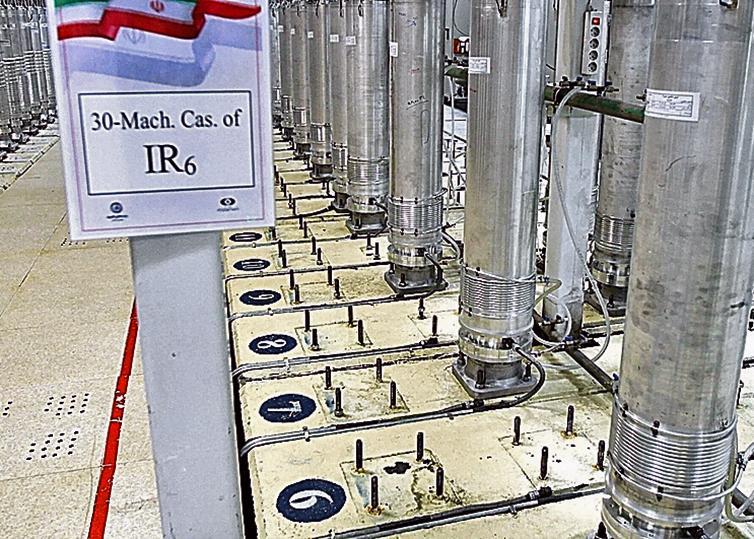
In Washington, the possibility of a special forces operation to locate and secure Iran's highly enriched uranium has been discussed. Donald Trump, as reported by The Wall Street Journal, is considering a potential operation to capture and remove half a ton of this mineral necessary for making a nuclear bomb. Axios also reported that the United States and Israel had discussed sending special forces to secure the Iranian stockpile, estimated at around 450 kilograms of 60% enriched uranium. Secretary of State Marco Rubio stated a few weeks ago: "If they don't hand over the uranium, we will go after it."
The idea exists, but it does not mean it is a simple option. A mission like this, possibly involving special forces like Navy SEALs or Rangers already deployed in the Middle East, faces two major challenges: first, finding the uranium; and second, entering, protecting, and extracting that uranium, which remains hidden in one or more bunkers. U.S. special forces have been training for missions of this nature for years, but this could be one of the riskiest missions that can be carried out today.
Enriched uranium is not highly radioactive nor does it cause massive nuclear contamination like a bomb or a reactor accident. It is not plutonium or spent fuel. However, it does pose real risks of a different kind. Uranium is a heavy and toxic metal. If dispersed as dust or fine particles, it can be inhaled, contaminate soil or water, and affect kidneys and tissues. In other words: it is more dangerous as a chemical toxin than as a strong source of radiation.
Furthermore, several recent reports suggest that a mission like this would hardly be a simple surgical incursion beyond enemy lines, similar to the execution of Bin Laden or the arrest of Nicolás Maduro. U.S. forces would have to fly to the affected locations trying to go unnoticed to avoid ground-to-air missile fire. Once they land, infiltration troops must secure perimeters and search for mines or explosive traps. The extraction of the material requires the intervention of specialized and trained personnel to remove radioactive material from a conflict zone. Highly enriched uranium is usually stored in cylinders similar to diving tanks. These cylinders would need to be placed in transport containers to protect them from potential accidents, which could require several trucks or helicopters.
The Guardian reports that Washington is considering recovering the material with the support of airborne units or Marines, emphasizing that it would be a mission lasting weeks, across multiple locations, with a high risk of American casualties. The same analysis highlights that the current deployment of troops in the region (around 8,000 troops on the ground and another 7,000 on the way) is far from the mass required for a prolonged ground campaign.
The strategic key is this: if the goal is to prevent Iran from retaining a nuclear option, then securing the uranium is crucial. Additionally, a successful mission where Washington can present the uranium as the final prize would give Trump the opportunity to claim victory in a context that is becoming increasingly complicated for him. Analyst David Albright argues that if the United States and Israel fail to secure that material, Iran could quickly resume its nuclear race. However, when it comes to the specific military option of "snatching" it with special forces, it currently seems more like a last resort being studied rather than a clean, mature, and easily executable plan. In other words: the idea is real; the operation, if attempted, would be extraordinarily dangerous.
John J. Mearsheimer, a professor of Political Science at the University of Chicago, states that "Trump has been caught in the Iran labyrinth. He entered a war he cannot win, and from the beginning, it was almost obvious that this confrontation was an inevitable outcome. The reality is that significant concessions will have to be made to the Iranian side, and when those concessions are made, it will become absolutely clear that Iran has achieved a convincing victory, and for the United States, it will be a humiliating defeat."
Enriched uranium is necessary for making a nuclear bomb because only by increasing the proportion of the fissionable isotope (uranium-235) can a nuclear chain reaction be sustained rapidly and uncontrollably. Natural uranium contains only 0.7% of this material, too little for the neutrons released when an atom fissions to trigger an explosive reaction. By enriching it to high levels, U-235 is concentrated to the point that, when a critical mass is assembled, the neutrons initiate an almost instantaneous cascade of fissions releasing a huge amount of energy in the form of an explosion. It is the heart of a nuclear bomb.
Intelligence services (especially Mossad and the CIA) know the type of facilities where this Iranian enriched uranium is stored, but its exact location and current distribution are not known with certainty. Several satellites have photographed trucks with blue containers prepared to transport this type of material, but it is unknown whether they carry uranium or are decoy movements.
Isfahan is the main conversion and storage center. Natanz is the major enrichment plant, with underground facilities. Fordow is a deeply buried installation inside a mountain. All three have been bombed, although they have secret facilities where this material could be distributed. If the material is in a single location, there could be a surprise factor, but if it is distributed in several locations, that advantage is lost.
Meanwhile, Donald Trump has continued to threaten Iran to open the Straits of Hormuz: "If it does not open immediately to maritime traffic, we will conclude our stay in Iran by completely destroying all its power plants, oil wells, and the island of Jark." The reality is that the Strait is open, but not for Western ships, but for their own tankers and those of China. Several Cosco shipping vessels that attempted to pass the blockade a few days ago finally received Tehran's approval yesterday and are now sailing towards their ports. Sources in Iran claim that the Government is already charging a two million-dollar fee in yuan and has turned Larak Island into a kind of customs post. In other words, the ayatollah regime is selling more oil than before, at higher prices, and also has more income than before thanks to the lifting of sanctions by Washington.