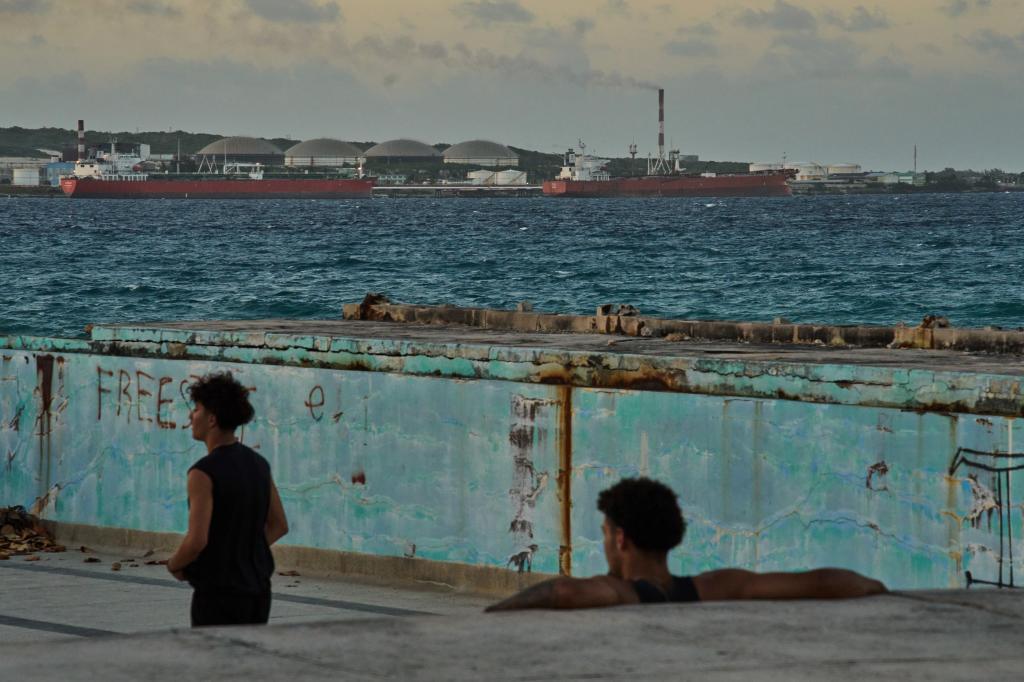
In the mid-90s, when the United States approved the Helms-Burton Act, the big debate in the world of international politics was whether there was a "blockade" or an "embargo" in Cuba. Exactly 30 years later, the debate is still very much alive. This Monday, a Russian tanker carrying around 730,000 barrels of crude oil has arrived in Matanzas after a long and tense three-week journey. The United States has, de facto, imposed an energy blockade on the islands. It has cut off Venezuelan supply, which for decades has sustained the Castro regime and its successors. It has prohibited Mexico and other neighbors from sending anything, with threats of sanctions and penalties. And it even forcibly prevented a Colombian fuel oil tanker from approaching the area in February, as well as thwarted Cuban attempts to refuel in Curacao. But this weekend it has decided to relax its grip, without very precise explanations as to why.
"We don't care if someone sends a huge shipment, because they need it; they have to survive (...) I told them: if a country wants to send oil to Cuba right now, I have no problem with that. Whether it's Russia or not (...) But it won't have any impact, Cuba is finished," said President Donald Trump on Sunday night. "It's a nefarious regime. They have very bad and corrupt leaders. And whether they receive an oil tanker or not, it won't matter," he added.
In reality, the decision does matter, and a lot. This Administration is known for abrupt changes, saying one thing and then the opposite. But behind a humanitarian curtain - with the president stating that Cubans need to "be able to cook and cool off" - there are also signs of inconsistency. Russia has decided to help its old ally and, at the same time, test American seams. It has become clear that a tanker can arrive without problems. The big question is whether there will be more.
On January 29, the president signed an executive order declaring a national emergency and establishing a process to impose tariffs "on products from countries that sell or otherwise supply oil to Cuba, protecting the national security of the United States and its foreign policy from the malign actions and policies of the Cuban regime." The order authorizes the Secretary of State and the Secretary of Commerce to "take all necessary actions" to implement the tariff system. However, it has not been applied now.
This Monday, White House spokesperson Karoline Leavitt said, "It is not a change in policy, there has been no formal change in the sanctions policy," and that the decision to allow the tanker to arrive is due to "humanitarian reasons," and that this type of permit would be evaluated "case by case," not ruling out the possibility of new shipments, from Russia or others, to meet the emergency needs of the population.
In Washington, this change is being analyzed after weeks of increasing pressure from different perspectives.
The first, within the framework of bilateral negotiations, in the Venezuelan or Iranian style, of an Administration trying to find in Havana and Tehran interlocutors who play the same role as Delcy Rodríguez in Caracas. A change within the regime, rather than of the regime, without reaching, for now, to bombs and special forces. Trump wants new figures that accept cooperation, collaboration, instructions, or orders from the White House. In Iran, it is the President of the Parliament, and in Cuba, it could be the relatives of Fidel and Raúl Castro, instead of the current President Miguel Díaz-Canel.
The second dimension is purely operational. Two weeks ago, the Cuban government rejected a request from the U.S. Embassy in Havana to import diesel for its generators, saying the request was "brazen" and a mockery in the midst of the fuel blockade. The diplomatic delegation, despite having many reserves accumulated, is suffering the consequences of the energy crisis, blackouts, and lack of supplies, and, as reported by The Washington Post after accessing diplomatic cables, is considering the departure of its non-essential personnel in May or "possibly earlier."
By allowing hundreds of thousands of barrels to enter, enough to refine gasoline and aircraft fuel for a few weeks, but mainly diesel (40% of the system generates electricity with small diesel-powered plants), it gives everyone a breather: a good card in the midst of negotiations led from a distance by the U.S. Secretary of State, Marco Rubio, himself the son of Cubans, who has demanded a change in the political leadership. Trump wants a lot of pressure, even on the streets, but also to control the process, not to let it slip out of his hands.
The third leg of this decision is geopolitics and has to do with Russia, Cuba's great support during all the decades of the Cold War. The Government of Vladimir Putin has described the oil shipment as a "humanitarian act," explaining that this had nothing to do with crises like the Missile Crisis of the early 1960s when the Kennedy Administration imposed another blockade to prevent more missiles from reaching Cuba, causing a moment of maximum tension with Moscow, one of those episodes where a nuclear clash was almost touched upon. "It was coordinated well in advance with our American colleagues," Kremlin spokesman Dmitry Peskov said on Monday.
This time, Washington does not want problems. Donald Trump boasts of his relationship with Putin: they are negotiating not only on Ukraine but also on the reestablishment of commercial and diplomatic relations. The tanker that has arrived at the port of Matanzas, the Anatoli Kolodkin, and the company it belongs to, Sovcomflot, were actually sanctioned by Washington since 2024. But Trump has decided to lift those sanctions on Russian oil for now, in a desperate attempt to provide relief to the global markets, strained by the war in Iran and the closure of the Strait of Hormuz. If Russia wants to help an old ally and shows interest, Trump has little to gain by forcing a major incident that would cause absolute panic in the markets in general, and in the price of oil in particular.
Furthermore, Putin scores a point with his own allies, who are very puzzled, disappointed, and concerned after the silence and passivity of the Kremlin following the attacks on Iran, the fall of Syria, the capture of Maduro, and the rest of the ongoing operations around the globe. Being a Russian ally or protege does not seem very profitable nowadays. "The brutal blockade," Peskov said, threatens "vital support systems and electricity generation in Cuba, inhibiting the ability of Cubans to provide medical services. Russia believes it is its duty not to stand idly by and to provide the necessary assistance to our friends," he concluded.