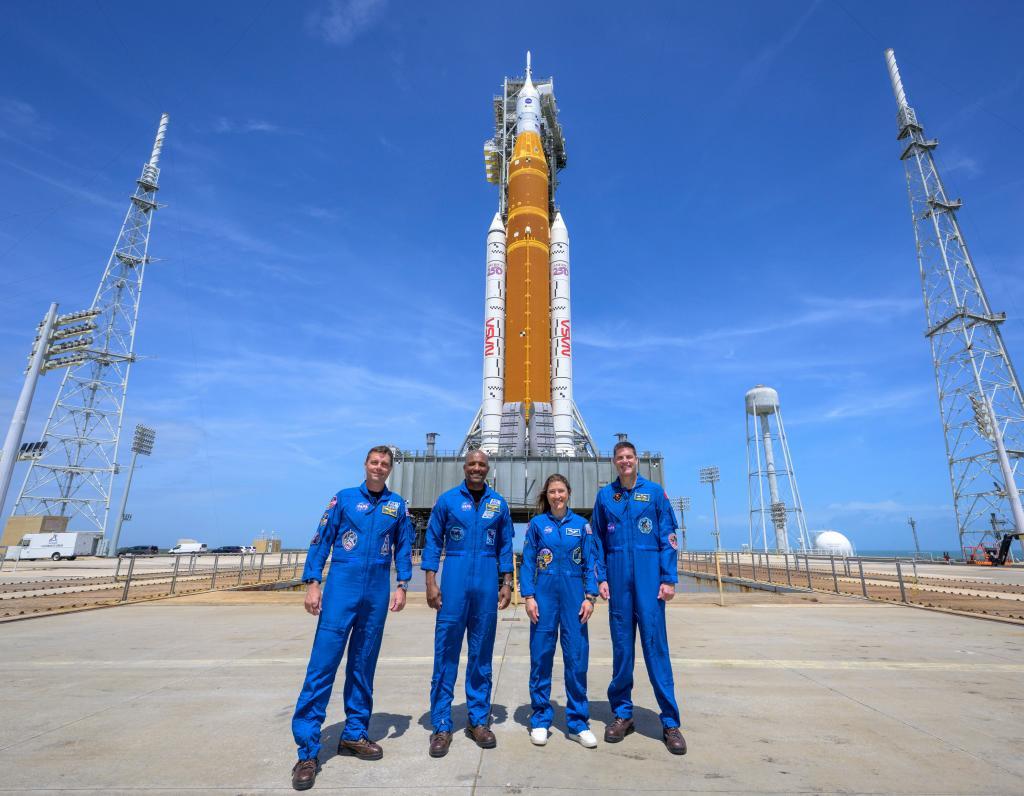
Perhaps their names may not sound familiar yet, but it is likely that in the coming days they will become four of the most famous people in the world. They are called Reid Wiseman (50 years old), Christina Koch (47), Victor Glover (49), and Jeremy Hansen (50), they are astronauts, and millions of citizens will be following their adventures during their lunar journey aboard the spacecraft Orion. A 10-day trip that, if there are no further delays, will begin in the afternoon of Wednesday, April 1 in the US (in Spain, it will be at midnight on Thursday, as the launch window opens exactly at 0:24 hours on April 2, peninsular time).
That is the latest date set for the highly anticipated launch of Artemis 2, the first crewed lunar mission since the last astronauts of the Apollo program returned in 1972. If the Saturn V rocket was used back then, the 21st-century lunar program uses the Space Launch System (SLS), the most powerful rocket in the world, which is already on the NASA Kennedy Space Center's Launch Pad 39B in Florida.
Artemis 2 could not start in February, as planned, due to fuel leaks during the first launch rehearsal, called wet dress rehearsal. The second test was incident-free, so the launch was set for March 6, but NASA technicians detected an obstruction in the rocket's helium flow that aborted the chances of launching that month. And so we have arrived in April, with a window that will extend from day 1 to 6 (from 2 to 7 in Spain), always at a time that will be very favorable for American viewers but will require Spaniards who wish to witness this historic launch to stay up late during Holy Week.
If the first attempt is unsuccessful, there will be other opportunities (in Spanish peninsular time) on Friday, April 3 at 01:22, Saturday 4 at 02:00, Sunday 5 at 02:53, Monday 6 at 03:40, and Tuesday 7 at 04:36 hours.
The US aims to rekindle excitement in the world with this mission, which, despite the great anticipation, will not land on the moon. In fact, it is a test flight whose main objective is to test all the systems of the Orion spacecraft, and prepare for a future landing on the surface, which with the latest program restructuring will not take place until Artemis 4, scheduled for as early as 2028. The four astronauts of Artemis 2 will orbit our satellite at a distance from the lunar surface between 6,400 and 9,600 kilometers, according to estimates from the US space agency.
Once the launch from Florida takes place and the Orion spacecraft (named Integrity) separates from the SLS rocket, the crew will not travel directly to the Moon. They will spend a whole day in a highly elliptical Earth orbit, checking that all spacecraft systems are functioning properly and rehearsing docking maneuvers with other spacecraft that will be necessary for future landing missions.
If NASA engineers give the green light, on the second day they will head to the Moon on a four-day journey. The approach to our satellite is expected on the sixth day of the mission, and will last a few hours. Afterward, they will head back to Earth, which will take another four days to reach. The journey will end with the Orion capsule splashing down in the Pacific Ocean.
"For me, Artemis 2 is a very interesting mission because it represents a paradigm shift. The purpose of the US during the Apollo program was to be the first, plant the flag on the Moon, and demonstrate their capabilities. Although there is still an underlying competitiveness between countries, mainly with China, now the aim is to carry out sustained and sustainable missions, create permanent bases on the lunar south pole, and use the resources of its surface. We are going to learn and develop the necessary technology to travel farther," says Sara García, a reserve astronaut at the European Space Agency (ESA), in a phone interview.
For CNIO biotechnology, this paradigm shift also has another aspect related to the profiles of the astronauts chosen for this mission. For the first time, a woman (Christina Koch), a black astronaut (Victor Glover), and a non-US citizen (Canadian Jeremy Hansen) will travel to the Moon. "I think there is a more inclusive approach, and the chosen crew members are a statement of intentions. Space exploration is no longer just for white male pilot profiles because it is intended for astronauts to represent more sectors of society," reflects García, who considers the choice of the program's name, the goddess Artemis, the twin sister of Apollo, as "very appropriate."
"I hope that there will come a time when it will not be necessary to mention whether one of the astronauts is a woman or a man, of color, or talk about their sexual orientation because it will imply that we are truly an inclusive society. But I believe that today, unfortunately, it is still necessary to provide such opportunities, because if all decision-makers fit a homogeneous profile, they will think of similar people when assigning those missions. Sometimes you have to push a little to open their eyes and minds and see that there are more profiles," reflects García. The astronaut emphasizes that "it is not about choosing someone less qualified. That person is just as or even more qualified than their colleagues, and maybe she is a woman, but you hadn't thought of her," she points out.
The four chosen for Artemis 2 have varied training and experience. Christina Koch has spent the most time away from Earth, accumulating 328 consecutive days in space. Born in Grand Rapids, Michigan, she studied engineering and physics and has the most scientific profile of the crew, as before becoming an astronaut, she developed space science instruments in Antarctica and the Arctic. During her time in space, she conducted six spacewalks, including the first three involving only women.
Commander Reid Wiseman, born in Baltimore, studied computer engineering, spent 165 days on the International Space Station (ISS), and for two years was the head of the NASA Astronaut Office.
California pilot Victor Glover is also an engineer, a test pilot, and has flown to the ISS on the Crew Dragon spacecraft, spending a total of 168 days in space and conducting four spacewalks.
Jeremy Hansen, who has not yet traveled to space, was born in Ontario, graduated in Space Sciences, and before becoming an astronaut in 2009, he was a combat pilot. He has worked at NASA's Mission Control Center and has been involved in space preparation missions, such as NASA's NEEMO underwater mission or the ESA's CAVES program.
They are all around 50 years old, about 10 years older on average than the Apollo program astronauts, who were around 40 when they went to the Moon.
No European astronaut has been chosen for this mission although the ESA is a partner of NASA in the Artemis program. In addition to participating in the lunar Gateway orbital station project, which was canceled last week, the ESA provides one of the two modules that make up the spacecraft Orion, the European Service Module. "This part of the spacecraft carries everything the astronauts will need during the mission: water, oxygen, and nitrogen," explains Guillermo González, Head of European Service Module Production at the ESA. Additionally, this part of the spacecraft houses the system to control the crew module's temperature (designed and manufactured by the Spanish company Airbus Crisa), the engines needed to propel and control the spacecraft in space, and the solar panels that provide power.
At the end of the mission, when the spacecraft is about to enter Earth, the European Service Module will detach from the crew capsule and reenter the Earth's atmosphere to be destroyed. Therefore, it is not reusable, and a new one must be manufactured for each mission. "We have already delivered the modules for Artemis 3 and 4 missions to NASA, which are being integrated in the US, and we have to deliver those for the Artemis 5 and 6 missions," details González.
The Orion spacecraft is small but larger than the vehicle used in the 1960s and 70s. Orion has a volume of about nine cubic meters, compared to the five cubic meters of the Apollo spacecraft, which housed three astronauts on each mission. Now, four people will travel on board, but in general, they will enjoy a much more comfortable stay than their predecessors. A substantial improvement is that Orion has a toilet—the first astronauts who went to the Moon had to make do with a rudimentary system of bags to collect urine and feces.
Orion's tiny toilet is quite similar to the system in the US module of the ISS, called the Universal Waste Management System (UWMS). One of the differences is that while on the ISS urine is recycled to become water used by the crew, in Orion's case, it will be removed from the spacecraft several times a day. The waste is suctioned to the bottom of the toilet, into a bag, which is sealed and compressed inside the container, as this waste will be disposed of on Earth. "We're lucky to have a toilet with a door on this tiny spacecraft; it's the only place we'll be able to go to be alone for a moment during the mission," astronaut Jeremy Hansen commented in a video demonstrating how the space toilet works.
There is still nothing resembling a shower, and personal hygiene is maintained with wet wipes and soap that doesn't require rinsing.
The quality and variety of onboard food has also improved. Because there are no refrigeration systems and it must be consumed in zero gravity, it requires significant innovation. Everything is optimized, although options are limited due to cargo restrictions, which necessitate precise control over the amount of food and drink that can be carried.
Each astronaut tastes all the menus beforehand, combining their personal preferences with the nutritional requirements established by NASA and what the spacecraft can carry. Some foods—such as freeze-dried meals—require rehydration, so the crew will use the drinking water dispenser to rehydrate food and beverages, and a compact, briefcase-like heater to warm meals that require it.
As NASA has detailed, on a typical mission day—excluding launch and reentry—astronauts have scheduled time for breakfast, lunch, and dinner. Each crew member is allotted two flavored drinks per day—they can choose from coffee, green tea, hot chocolate, vanilla milk, a mango and peach smoothie, lemonade, apple cider, or strawberry and pineapple juice. They don't carry fresh food because there are no refrigerators, but also because, for safety reasons, they opt for non-perishable items to reduce the risk of crumbs or food particles floating around and clogging systems. Some of the dishes they'll enjoy include macaroni and cheese, vegetable quiche, mango salad, granola with blueberries, and vegetables like broccoli gratin or green beans, as well as items like nuts and Mexican tortillas.
"We're trained to be comfortable with discomfort. You know you're going to be hungry, stressed, but you're prepared for it and you're not going to complain. Your goal is always to complete the mission, and you put that goal above your ego and your needs," says Sara García. According to the astronaut, the psychological component is also crucial: "During training, communication and empathy are emphasized. Everyone knows each other well and understands the best way to interact," she notes.
Every day in space is extremely valuable to space agencies, so during their 10 days in space, the astronauts will conduct various experiments and monitor their health with different devices to further investigate the effects of the space environment and radiation on the human body. The four will wear a watch called ARCHeR on their wrists at all times, which will record all their movements, sleep patterns, and light exposure.
Another experiment, called AVATAR (an acronym for 'Virtual Astronaut Tissue Analogue Response'), will study the effects of radiation and microgravity on their health. Blood, urine, and saliva samples will be taken before launch and upon their return to Earth, and they will also collect their own saliva during the flight to analyze how this spaceflight will affect their immune system. As NASA explains on its website, stress hormones, viruses, and cells can be affected by the conditions of flight. Previous research has shown that viruses, including the one that causes shingles, can be activated during the extreme conditions of spaceflight, and they want to see if this also happens to these crew members.
Geology will also occupy a significant portion of their time. As Orion passes over the far side of the Moon, the side that always faces away from Earth, the crew will photograph and analyze surface features such as impact craters and ancient lava flows.
The four astronauts will be the humans who have traveled farthest from Earth, reaching over 400,000 kilometers from our planet and breaking the record set by Apollo 13. They could also be the first to see parts of the Moon's far side with their own eyes—this will depend on the spacecraft's final trajectory. During the Apollo missions that left Earth orbit, astronauts saw portions of the Moon's far side, but not all of it, as they were limited by the sections illuminated during their orbits.
Artemis 2 will solidify the Moon as a key exploration target for the coming years, both for the US and Chinese governments—the latter aiming to send a crewed mission to its surface around 2030—and for private companies. While both NASA and Elon Musk, owner of SpaceX, aim to send humans to Mars, the technical difficulties arising from returning to our satellite highlight the enormous complexity of sending humans to the Red Planet.
In fact, much work remains to be done before we see astronauts walking on the Moon again, so the US must accelerate its program if it doesn't want to be overtaken by China, which is already hot on its heels. Commissioned by NASA, SpaceX is developing a lunar version of the Starship spacecraft for the Artemis 4 mission—the lunar module that will take astronauts to the surface, and whose development is several years behind schedule—while Jeff Bezos has won the US agency's contract to develop the lunar lander for Artemis 5. However, the decision made by the Amazon founder at the end of January reflects that the Moon is now the absolute priority for the US.
A few weeks ago, Elon Musk announced he was postponing his Martian goals to focus on developing lunar technology. Meanwhile, Jeff Bezos has decided to temporarily suspend his space tourism program aboard the New Shepard rocket—the same rocket that launched Bezos himself, his brother Mark, his wife Lauren Sánchez, and celebrities like Jesús Calleja and Katy Perry into astronauts—to "further accelerate the development of the company's crewed lunar capabilities." This decision, according to the company's statement, "reflects Blue Origin's commitment to the national goal of returning to the Moon and establishing a permanent, sustained lunar presence."
The latest development was last week's announcement of NASA's imminent construction of a lunar base. This is an objective also coveted by China, which has long planned to build its settlement in collaboration with Russia. Who will live on the Moon first?
CONTROVERSY OVER THE SPACECRAFT'S HEAT SHIELD
All space missions involve risks, so numerous checks and tests are carried out to try to minimize the possibility of something going wrong. In the case of Artemis 2, there is an additional element that has sparked controversy. At the end of 2022, during the final phase of the unmanned Artemis 1 mission, the Orion spacecraft's heat shield suffered cracks during atmospheric reentry. As engineer Víctor Rodrigo, former director of Airbus Crisa and consultant to the ESA, explains, "the origin of this problem lies in the extremely high temperatures, close to 2,800 °C, generated by friction with the atmosphere upon returning from the Moon at speeds of around 40,000 km/h."
After lengthy discussions and tests, NASA has decided not to design a different heat shield for Artemis 2, but rather to reinforce the one from Artemis 1 and modify the spacecraft's trajectory. Thus, during re-entry into the atmosphere, they will perform a skip-entry maneuver, which facilitates energy dissipation. This decision has been criticized by experts such as engineer and former astronaut Charles Camarda, who believes it is endangering the crew.