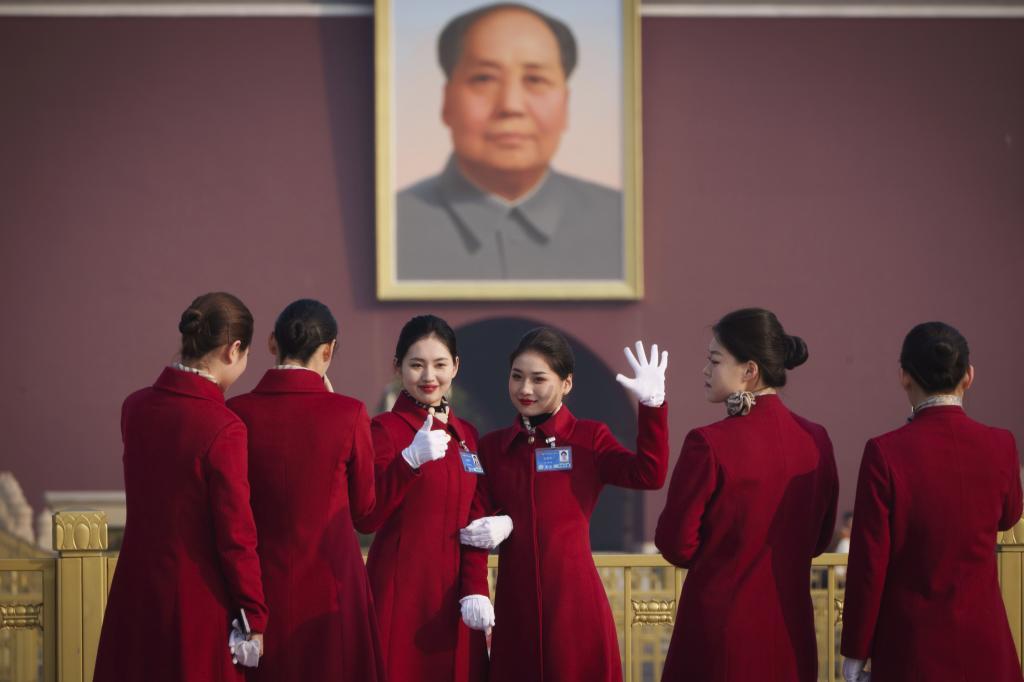
While the top leadership of the Communist Party and around 3,000 delegates from all corners of China listened to the annual parish report recited by Prime Minister Li Qian - figures, growth objectives, and stability slogans - Nigerian Mussa, unable to follow a speech without simultaneous translation, left the press gallery to describe to his social media followers how grand the chandeliers suspended over the vast halls of the Great Hall of the People, the Chinese Parliament, are.
Mussa, a journalist and influencer, passed the time making TikTok videos showcasing the wonders of the gleaming hemicycle of Tiananmen Square: its giant red stars surrounded by rings of light, the red carpets laid out with almost perfect symmetry, the uniformed ushers moving with millimetric choreography. His account did not touch on politics but on aesthetics. Unknowingly, his narrative fit perfectly into Beijing's new strategy.
Mussa is part of a group of around thirty journalists and influencers from the so-called Global South who were invited in early March to attend the National People's Congress, Beijing's annual political conclave. That was just the beginning of an all-expenses-paid trip. Over five months, the group is taking part in a carefully crafted tour from the Forbidden City to the Shanghai skyline, visiting beforehand the robots of Hangzhou, the flying cars of Shenzhen, the futuristic maze of Chongqing, or the programs that have eradicated poverty in rural areas of Yunnan.
"We've been told to show the real China," explains Valeria, a Colombian journalist. For Tafik, a Pakistani youtuber on his second consecutive trip, the change is evident: "For years, China spoke to the world through official statements that few paid attention to. Now they have realized that it is more credible to use external voices to tell their development story, voices that do not seem like propaganda."
Beijing's global charm offensive is a precise response to the current geopolitical situation. Faced with the wars and commercial coercions of the second stage of Donald Trump's White House, Xi Jinping's regime's strategy is to present itself as the stable, modern, peaceful, and responsible superpower; as a reliable leadership alternative in a world order that is increasingly fractured.
As Mario Esteban, senior researcher at the Real Instituto Elcano and professor at the Autonomous University of Madrid, highlights, Beijing insists on portraying the United States as "a disruptive actor that violates the foundations of international law and the sovereignty of other states through the use of force," in contrast to a China that claims to be a guarantor of that principle in all multilateral forums. "This opposition is also articulated through all the global governance initiatives that Xi Jinping has launched in recent years, seeking to establish a normative framework based on rules and with a strong emphasis on the principle of national sovereignty, which contrasts with the bellicose attitude of the United States," he explains.
A staff member draws the curtains during the closing session of the fourth session of the 14th National People's Congress (NPC) at the Great Hall of the People in Beijing on March 12.JESSICA LEEEfe
The narrative is also based on a model difference that Beijing skillfully exploits: against a perceived interventionist United States, China presents itself as a partner focused on development. "The central axis is the commitment to technological development," Esteban points out, emphasizing that this dimension translates mainly into economic competitiveness and international appeal. In this balance, he adds, much of its reputational advantage lies: "China is being subtle. Every time the United States pushes forcefully [Venezuela, Iran...], trying to push Beijing out of critical sectors, the Chinese maintain a low profile, opting to defend their interests more discreetly. This also gains them international sympathies by not appearing as a belligerent actor but as one that adapts to the rules and operates in terms of cooperation rather than confrontation."
In this scenario, the relationship between Washington and Beijing increasingly resembles a chess game in which both players explore the limits of a possible tacit division of influence zones. Asia-Pacific remains the epicenter of rivalry, but the showdown has extended to the Caribbean, the Sahel, the Persian Gulf, and even the Arctic.
"We are witnessing a structural competition in which each power seeks to consolidate its space without crossing certain red lines," says American political scientist William A. Galston, an analyst at the Brookings Institution. "The problem is that these lines are becoming increasingly blurred." According to Galston, Trump's strategy to strengthen US primacy in the Western Hemisphere - capturing Nicolás Maduro or expanding military operations in the Caribbean - has had a collateral effect: "It allows China to present itself as a defender of international law".
In Beijing, this narrative is repeated like a mantra: peaceful rise, commitment to non-interference in the internal affairs of other countries, respect for sovereignty and territorial integrity, and economic alliances based on mutual benefit. A discourse that resonates especially well in countries that have had tense relations with Washington.
"In a current division of spheres of influence, the United States would dominate the Western Hemisphere and keep China at bay, in exchange for accepting greater Chinese influence in some parts of Asia. But a true agreement would involve mutual concessions that are not currently on the table," says Patricia M. Kim, an expert in Asian politics. "As confidence in US leadership diminishes, space opens up for Beijing to expand its economic, diplomatic, and security influence in countries seeking protection against uncertainty."
This game of perceptions becomes particularly delicate in the Middle East, where China has tried to project an image of neutral mediator. Faced with the US and Israel's war against Iran, Beijing has maintained a calculated balance, avoiding explicit alignment with its Tehran ally. Chinese officials say their priority is to protect their energy routes.
"China is not seeking to replace the United States in scenarios like the Middle East, at least not yet. But it does want to demonstrate that it can be a valid interlocutor, especially at a time when Washington's credibility is in question," says Françoise Nicolas, director of the Asian Studies Center at the French Institute of International Relations (IFRI).
Meanwhile, the bilateral relationship between the two superpowers is going through a phase of contained tension. Donald Trump's visit to Beijing, initially scheduled for late March, was postponed by the American to stay in Washington and manage the war in the Middle East. Dialogue channels remain fragile, trade disputes persist, technological distrust deepens, and the military standoff around Taiwan remains latent. Economic interdependence acts, for now, as a brake, but not as a solution. "We are in a new Cold War, but without clearly defined blocs," summarizes Australian academic Hugh White. "It's a more fluid, more uncertain system, where intermediate countries have more room to maneuver."