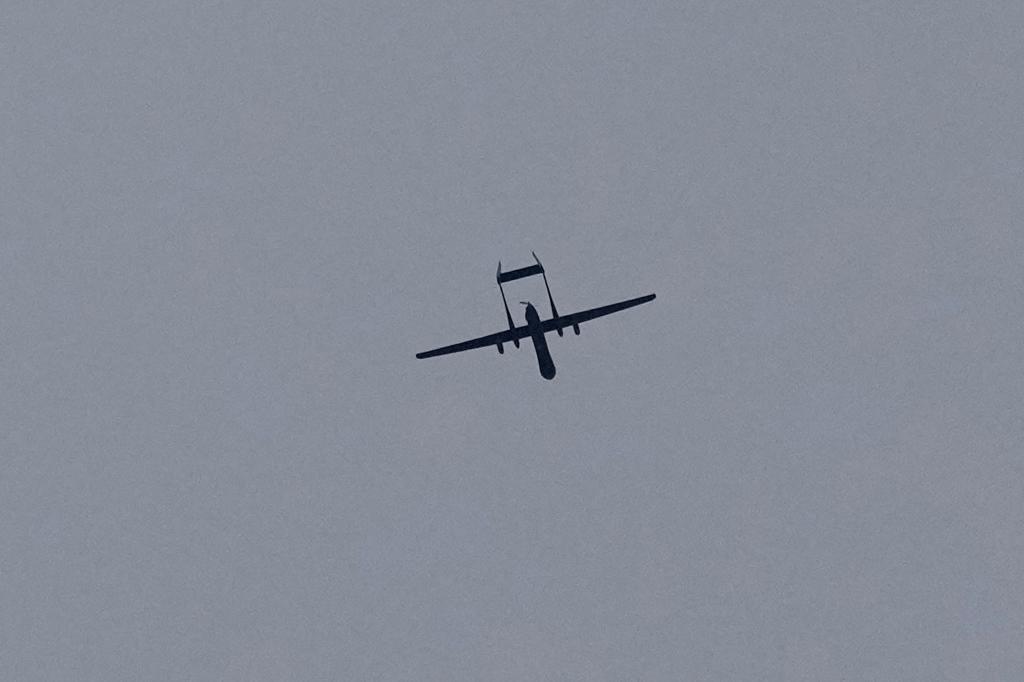
There is another war behind the war(s). When Pete Hegseth, US Secretary of Defense, presented a new generation of drones for the army, he knew that his country was entering a new era in how to face future battles. Trump's tattooed hawk glanced at the LUCAS. "Drones are the greatest battlefield innovation in a generation, responsible for most of the casualties this year in Ukraine. Our adversaries collectively produce millions of cheap drones each year," he said. He did not deny their significant shortcomings. The US had the Patriots, very expensive but effective, but had no response to the Iranian Shahed. They decided to reverse engineer. Yes. Copy their rivals to defeat them.
Thus was born the LUCAS, acronym for Low-cost Uncrewed Combat Attack System. It was developed by an Arizona company called SpektreWorks. "On December 3, the United States Central Command (CENTCOM) announced the creation of a new task force for the first one-way attack drone squadron of the US Army," it was publicly reported. Months after Hegseth's announcement, the Scorpion Strike Operations Force was created, with the LUCAS as the centerpiece.
Just a few days later, on December 16, 2025, the US Army had already successfully launched a LUCAS from the combat ship Santa Barbara. It was in the Persian Gulf. However, its first real test, pun intended and not yet confirmed by the Pentagon, would have been in the operation to capture the dictator Nicolás Maduro. There are videos of a device similar to the LUCAS entering and effortlessly breaching the Venezuelan's meager air defenses. The buzz, for experts in these devices, was unmistakable: they sounded like the Iranian Shahed but were not. On January 3, 2026, in Caracas, they would have been used to protect the helicopters in the Absolute Resolution operation. Just speculations for now. The official start of the Lucas era would come weeks later. It is worth noting that while a Patriot costs around 3 million euros, the LUCAS costs barely 30,000 euros, finally rivaling the estimated 20,000 euros it costs Iran to manufacture the Shahed...
We consulted expert Ermengol Casanovas from Sitep, one of the drone suppliers for the Spanish Ministry of Defense, to discuss this low-cost kamikaze drone warfare. He begins his analysis, first, on the Iranian variant, which has changed the industry since its appearance in the Russia-Ukraine war. Putin has indeed used Iranian technology to attack Zelenski's forces...
"There are several models of Shahed drones, but they are generally slight variations on the same base. It is a drone with low-performance technological equipment that does not allow its flight to be corrected once launched; this is why its manufacturing cost must be kept very low since it is used massively in 'swarm' mode to ensure that some of them are not shot down and reach the target. When it impacts the target, its explosive payload comes into action, which, depending on the nature of the target, can be more or less devastating," explains the creator of the Spanish superdrone type helicopter H004.
Producing the LUCAS costs around 30,000 euros per unit. Born from reverse engineering on Iranian drones, with a minimal cost compared to traditional missiles, it redefines modern warfare: it is no longer about who shoots better, but who launches more. In the image, a 'battalion' on the runway of a US Central Command base.
The significant aspect was its cost. By being able to clone it, Iran lost a good part of its operational advantage. Therefore, its use in the war against Iran has been more than symbolic. When on February 28, the US started Operation Epic Fury, the LUCAS entered combat. That day, Ayatollah Jamenei died under a bombardment that ended the Iranian leadership. Admiral Brad Cooper, in charge of the US Central Command, held a press conference to boast about its use. It was a sharp blow that also reaffirmed that it was based on the Shahed and that one of the main operational advantages of the Iranian forces had been eliminated.
PROPULSION MODERNIZATION
After that attack, it has been scarcely seen. Ermengol emphasizes its operational importance and its origin... "The American replica is also known as FLM-136. This drone has been produced by the US through reverse engineering from unexploded Shahed and remnants of these." He points out that "its redesign implies a great modernization in propulsion."
Although one reaches a distance of 2,500 kilometers, its clone has not been seen flying more than a thousand. However, it surpasses it in precision and versatility. "Essentially, the LUCAS is faster, and its flight mode is different, changing by proximity to the target, transitioning from level flight to a high-speed dive. In turn, the explosive payloads it can transport are the most advanced produced in its weight range, capable of causing significant selective devastation."
Therefore, Trump's team has gone beyond a mere copy. "It surpasses the Iranian in something very important: its geolocation and guidance capacity and target recognition intelligence."
"Although they use the same base technology in geolocation and guidance, the LUCAS employs the latest versions of these systems, characterized by their satellite constellation leap and inertial devices... And, most importantly, it uses Elon Musk's Starlink satellite system for flight positioning with very good precision, thus being guided much more effectively, a capability denied to Iranian drones."
To offset this difference, the new Shahed drones have borrowed technology from their ally Russia. This was confirmed by British intelligence when analyzing the drone used to attack the Akrotiri base in Cyprus. It was discovered that its navigation system is the Kometa-B from Putin's forces. A bipolar alliance: Russia-Iran... Thus, Ukraine's role is also crucial in countering them. Not only for its knowledge of the terrain. A third player emerges, from whom the West, especially Europe, wants to learn: the FP-1, a kind of cheap missile.
With an approximate cost of 47,000 euros —and decreasing—, it can produce more than 3,000 per month. It is precise and with a higher explosive payload than those of the US and Iran. Manufactured by Fire Point, it is on its way to go a step further. It has been leaked that they have achieved an interception function with artificial intelligence technology. It is no longer just a suicide drone. It can act as a cheap shield.
With Iranian factories at a minimum, Russia's role in Shahed production will be crucial. For now, it is known that mass production of LUCAS is underway. Zelenski has declared his FP-1 of national interest. Casanovas concludes: "Soon, if the war continues its current course, we may witness the battle between kamikaze drones."