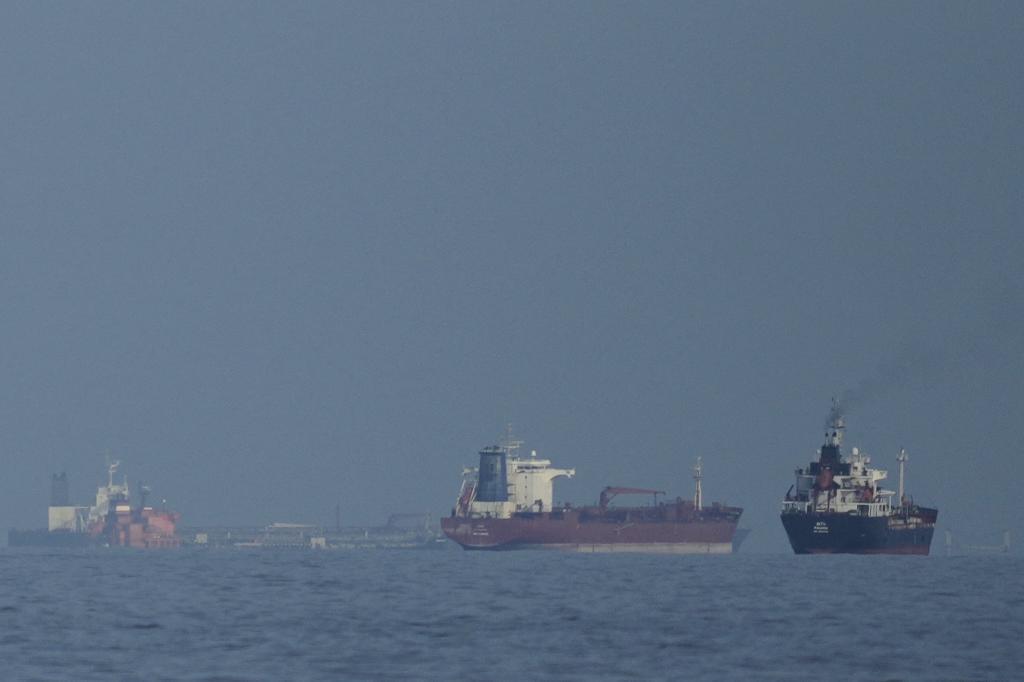
It is difficult to follow the war if we listen to the words of Donald Trump. A few days ago, he claimed to be ready to force the opening of the Strait of Hormuz and unleash hell on Iran with all kinds of bombings on its energy network and desalination plants. Yesterday, The Wall Street Journal revealed that the President of the United States has discussed with his advisors the possibility of withdrawing from the war without trying to reopen that oil tap and declare victory, although at this point no one in their right mind sees where that victory lies.
However, real-time ship tracking pages and satellite images offer a much clearer snapshot of what is actually happening in the Strait of Hormuz, the key point of this energy and geopolitical crisis. What we can see in the tracking of tankers and cargo ships is that this channel is not completely closed, but opens and closes based on something that strikes against Washington's influence in the Middle East: Iran is allowing those ships whose shipping companies pay a fee to cross the Strait. In other words, the ayatollah regime has set up a customs checkpoint in Ormuz.
Tankers wishing to leave the Persian Gulf approach the channel between Larak Island and Qeshm Island, near the coast of Iran. That is the new passage route, once Tehran mined the old route, which passed through the waters of its neighbor Oman in the center of the passage. This means that tankers venturing to cross are within range of Iranian weapons and, therefore, under their control.
No one knows anything about those "20 gift tankers" that, carrying "crude under the flag of Pakistan," Tehran had allowed to leave the Persian Gulf as a "gesture of goodwill for the negotiations." The fact is that Pakistan only has eight large tankers registered; five of them are in the Middle East region and two of them passed through this Strait a few days ago. What exactly did Trump refer to?
What is leaving are ships from shipping companies linked to Iran or China. Yesterday, for example, two giant cargo ships from the Chinese shipping company Cosco crossed that had tried to leave two days earlier and had to turn back. The difference between leaving and not leaving can be summed up in one word: paying. According to Iranian sources, the cost of crossing the Strait of Hormuz is two million dollars for each large tanker or cargo ship.
In other words, to no one's surprise, Iran is exerting its control and influence over this geographical accident since being attacked by the United States and Israel and has turned it into its most profitable customs. It works as follows: two boats, perfectly visible via satellite, approach the vessels between Larak and Qeshm. These collectors ask for the money or proof of that payment. When it is paid, they are authorized to continue, always hugging the coast of Iran, until they can sail to the Gulf of Oman and the Arabian Sea.
United States, in another strategically incomprehensible move, lifted a good part of the sanctions on Iranian oil to try to lower the price, although that price never dropped. In other words, the current situation allows Iran to earn much more money from its crude oil than before, and it is cashing in while other rivals like Saudi Arabia, Kuwait, or Qatar have stopped earning a good part of their profits from their hydrocarbons by closing the tap at Ormuz. It also lifted oil sanctions on Russia, which has made Vladimir Putin another big winner of this crisis.
As global supply decreases and prices rise, Iran earns more per barrel. At the same time, it charges a fee for maritime transit. In addition, it has managed to sell more oil to countries like China using mechanisms in yuan or alternative circuits. The result is paradoxical: in the midst of war and international pressure, Iran not only resists but has found ways to monetize the conflict and increase its energy revenues. According to Bloomberg, Tehran is earning 8% more in oil. Furthermore, Iranian crude is even being offered at a discount to Brent. Karen Young, an analyst at the Middle East Institute, states: "The increase in oil prices eases the pressure on Iran and reduces the impact of sanctions".
Iran has taken a step further by trying to formalize control of the passage through a law that would allow charging fees to ships in transit. Although the rule is not fully consolidated yet, in practice Tehran already applies this selective system. The move represents a profound change: from an occasional pressure tool, Ormuz becomes a kind of strategic customs from which Iran decides who can sail and under what conditions. For global trade, and especially for the energy market, the implication is enormous: it is not just a vulnerable bottleneck, but a route that is starting to operate under rules unilaterally imposed, in open tension with international maritime law. The message is: if you are a friend of the United States, your economy will suffer; if you are a friend of Iran, your economy will improve.
Iran charges this customs fee in yuan as part of a strategy to evade US financial sanctions and reduce its dependence on the dollar. By demanding payments in the Chinese currency - often through banks and channels linked to the Asian giant - Tehran avoids the financial system dominated by Washington, limits the risk of transaction blocking, and strengthens its ties with its main crude oil buyer. The result is twofold: on the one hand, it ensures income in a sanctions environment; on the other hand, it contributes to eroding the role of the petrodollar, shifting part of the energy trade to alternative circuits that are more difficult for the West to control. Helima Croft, an American commodities economist and strategist, states that "any disruption in the Strait of Hormuz tends to benefit Iran financially, although it increases risks for others".
This payment in yuan is another blow to the United States and its war against Iran. It is a blow - although limited for now - because the petrodollar system is based on most of the world's energy trade being conducted in dollars, forcing countries and companies to go through the US financial system and reinforcing its influence.
By demanding payments in yuan for transit or trade linked to the Strait of Hormuz, Iran introduces an alternative route that allows some actors to operate outside that circuit, reducing the scope of sanctions and marginally weakening global demand for dollars. The impact is limited (perhaps 15% of the total), as it remains a partial mechanism concentrated in countries willing to accept that risk (especially China), but it marks a relevant trend: the emergence of spaces where energy trade begins to escape Western financial control.
In the fifth week of the war, Gulf countries are increasingly pressuring Trump not to withdraw, something he threatens to do while insulting his allies. At the same time, the United States already has 50,000 troops in the region, with another 8,000 on the way.
Rosemary Kelanic, an expert in geopolitics and director of the Middle East program at the Defense Priorities think tank, believes that the news of toll collection is bad but not catastrophic, or at least not as dramatic as going to a large-scale war: "The tolls themselves are not that high: two million dollars for a tanker carrying two million barrels is just a surcharge of one dollar per barrel, equivalent to a 1% tax. It's not great, but it's better than what oil prices are doing now. It would also incentivize Iran to keep traffic moving safely through Ormuz by monetizing safe transit. Yes, I know it rewards bad behavior and morally stinks that a hateful regime benefits, but that is the reality that Trump's clumsy war has left us all".