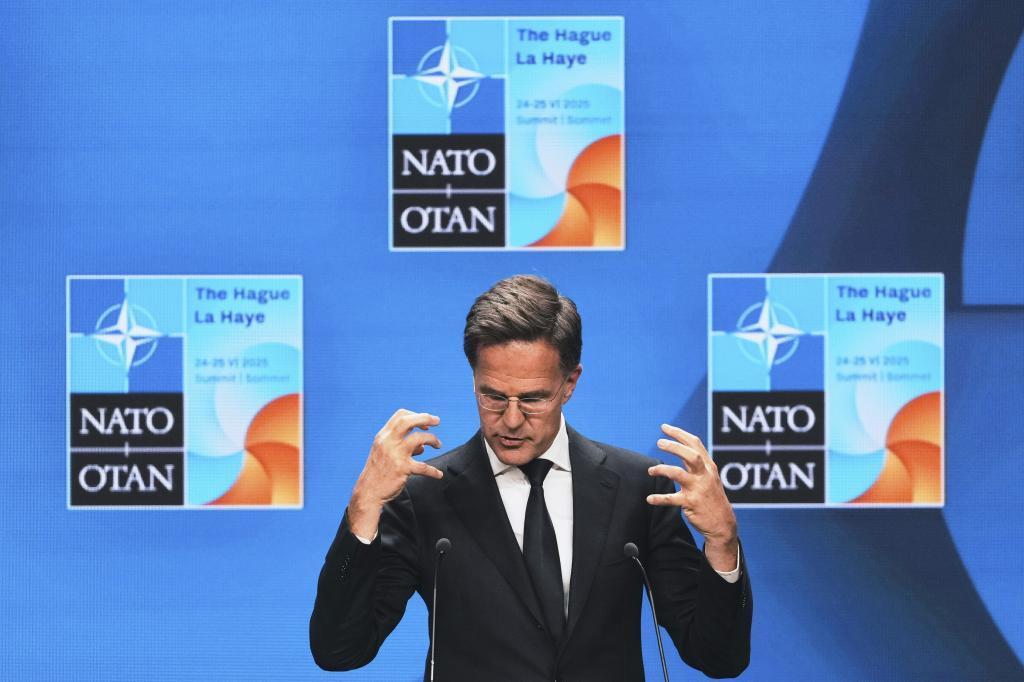
In NATO headquarters, they often say that perspective and long-term vision are the most important. For a decade now, whenever military, civilian, and diplomatic leaders are asked about the latest threat of rupture from Donald Trump, clashes between two of its members, or phrases like Emmanuel Macron's statement in 2019 that the Alliance is "brain dead," the secretaries-general respond that things may be bad, even dire, but in the past, it was worse and everything eventually got back on track. They point out that the current media cycle, 24-hour news, and social media amplify the apocalyptic feeling, but the allies are strong, have achieved something unprecedented in history, and therefore, one way or another, they will stay together. They did it when De Gaulle decided to kick NATO out of France, forcing it to relocate to Belgium. It happened after the Iraq War and the division over weapons of mass destruction. And it will happen again, they argue, because there is no alternative.
It is hard to believe, at this moment, that the Alliance can fully recover from the deep crisis it is going through. The wounds are deep and growing, and various Atlantic sources assure that the situation is very serious and frankly more severe than in previous crises. The Russian invasion of Ukraine achieved something that was impossible during the Cold War: uniting Sweden and Finland. But since then, with Trump's return to power, following threats of annexation of Greenland, the war in Iran, the seizure of material purchased by Europeans, and Secretary-General Mark Rutte's decision to fully align with Washington, the fractures are widening. Once again, the threat seems existential.
The White House, furious over its partners' and allies' refusal to get militarily involved in the Middle East, openly talks about the end of the Alliance. It is no longer about shifting resources to the Pacific or focusing on China while Europeans take care of their own defense, an evident interest for decades. In their National Security and Defense Strategies, and in the testimonies of military commanders in Congress, it is clear that even the deployment in Europe is mainly conceived for containing China, with the Old Continent serving as a springboard for rapid operations in other scenarios. Allies' coverage is only the third priority, not even categorizing Russia as a threat. But now, Trump goes further, stating that he always knew NATO would not be there when the United States needed it and, therefore, it is superfluous to him.
"To all those countries unable to get fuel for planes due to the Strait of Hormuz - like the UK, which refused to get involved in the decapitation of Iran - I have a suggestion for you: number one, buy from the United States, we have plenty; and number two, gather that late courage, go to the Strait, and just TAKE IT (sic). You will have to start learning to fight for yourselves because the United States will no longer be there to help you, just as you were not there for us. Iran has essentially been decimated. The hard part is done. Go get your own oil!" wrote the US President on his Truth Social account this Tuesday, implying that if the bombings cease now and he withdraws, the problem will be others', not his.
Spain, France, or Italy, each with different nuances, do not allow the use of their bases to bomb Iran; they have restricted their airspace or both, annoyed by the unilateralism or repeated attempts by Washington to act without permission or coordination. The government of Giorgia Meloni, one of the most ideologically close to Trump, has distanced itself again this week by denying access to the Sicilian base of Sigonella as it could not guarantee that the planes requesting to land, without prior notice, were merely logistical, as stipulated in the agreements between both countries. Meloni has denounced the intervention as contrary to international law, and public opinion is completely against it.
"The country of France did not allow planes destined for Israel, loaded with military supplies, to fly over French territory. France has been VERY UNCOOPERATIVE (sic) regarding the 'Butcher of Iran,' who has been successfully eliminated! The USA will REMEMBER IT!!! (sic)," Trump added this morning in a new message to Macron, whom he systematically belittles by stating that "soon he will no longer be there," referring to the upcoming French presidential elections. Unlike Spain, which has closed its airspace to US planes, France has not taken this measure, and American support aircraft use their bases in Istres and Avord, although Paris insists on requesting permission case by case, known as "diplomatic overflight clearance."
But it's not just the Mediterranean countries. After Denmark mobilized its troops in the face of a possible American invasion of Greenland, Poland, a great Atlantic enthusiast, refuses to deploy its Patriots in the Persian Gulf. The United States, through its controversial ambassador in Warsaw, had suggested the possibility, and in a new confrontation, the government of Donald Tusk (who, during his time as President of the European Council, was the most vocal EU voice against trumpism) has said no. "Our Patriot batteries and their armament are used to protect Polish airspace and the eastern flank of NATO. Nothing changes in this regard, and we have no plans to move them anywhere else!" wrote Polish Defense Minister Wadysaw Kosiniak-Kamysz on Tuesday. "Our allies are fully aware of the importance of our tasks here and understand it. Poland's security is an absolute priority," he added.
As if that were not enough, audio recordings released this Tuesday also show that the Hungarian Foreign Minister, a NATO and EU member, is a Moscow lackey who declares himself a "servant" of the Kremlin. The Washington Post reported last week that Péter Szijjártó called Sergei Lavrov even during breaks in EU ministerial meetings to provide real-time updates on discussions about sanctions against his country. Now, various media outlets such as Vsquare, FRONTSTORY, Delfi Estonia, Insider, and the Ján Kuciak Research Center have accessed the audio recordings and transcripts of conversations between them, in which the Hungarian commits to removing those requested by the Russian from the sanctions lists.
When Trump began hinting in his first term that if members did not spend more on defense, he could not guarantee collective defense, it caused a historic shock. Now, the American says several times a day that he will not be there for others if something happens, and practically nothing happens. It has become almost a central scenario. "I don't necessarily think this leaves NATO mortally wounded. There has been a process underway for some time for Europe to do more. NATO is transforming at a very fast pace beyond Trump. It is a structural phenomenon. Trump obviously accelerates it, gives it a more dramatic tone, but he has also given it a breath of fresh air because he has made Europeans step up. I wouldn't ridicule that argument because the main indicator of burden sharing is investment in defense, and in that regard, Europe has made a significant leap. The truth is that most European countries prefer a vague, uncertain, hesitant commitment from the United States rather than having to seek a real alternative because the problems are enormous," clarifies Luis Simón, principal researcher in Defense at the Elcano Royal Institute and an expert on the Alliance.