Josep Madurell recites his track record by heart. He has 58 Spanish champion titles. Two European championships. Another world championship. "At the veterans level, I have won many titles. At the senior level, some as well. I continue training two or three days a week and compete one or two days," he comments. At 88 years old, he has been addicted to ping-pong since he was eight when he discovered the small gong that makes the ball sound when hit from one side of the table to the other in the parish of Gràcia, his neighborhood in Barcelona. "I didn't know there was a federation back then. It was a game. As soon as we found out, we signed up," he recalls.
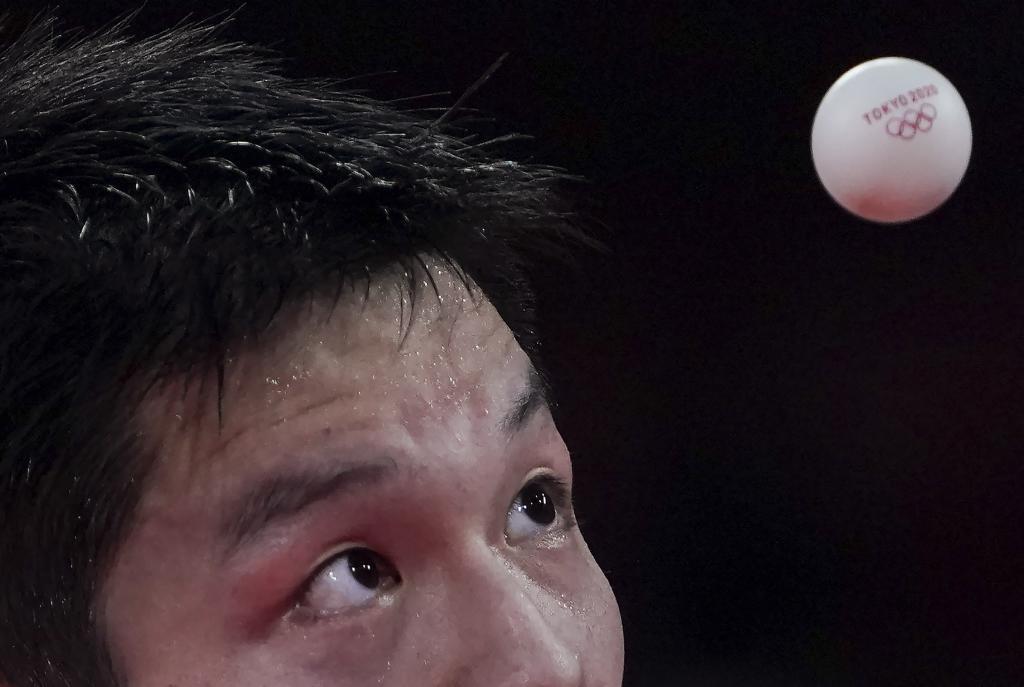
Madurell is one of the oldest champions in Europe, a junkie of this promising sport like a drumroll. There is something halfway between mysticism and a slot machine in the exchange of table tennis. "Non-Euclidean geometry comes into play," tries to explain the magnetism of table tennis writer Guido Mina Di Sospiro, author of The Metaphysics of Ping-Pong. He is Argentine and contradicts the Greek philosopher Euclid. For Euclid, space is flat, parallel lines never intersect, and it is possible to achieve the shortest distance between two points. At a certain level, Guido Mina claims to find ecstasy. Players disrupt the planes. They undo the calculation of the wise. "The ball never behaves normally. It is very complicated to decipher or understand what it will do on your side of the table. A big part of the work is to understand it," he comments over the phone.
A few years ago, he published an essay about his fascination with the reduced tennis. He went from being what he calls a basement player to another dimension the afternoon he played ping-pong at the Henry Miller Memorial Library in San Francisco, on the table of the American writer. Guido lost against his 18-year-old son. A month later, he joined a club and embarked on the journey that led him to publish the cartography of his hobby. "A moving bomb with two speeds", he writes the X-ray of the sequence that hooked him forever. "One circumferential and one linear, due to the displacement of its center. That is the marriage between spin and speed." The culprit of his madness.
Marty Supreme, the movie starring Timothée Chalamet and inspired by the real story of the American table tennis champion in 1958 and 1960 Marty Reisman, tells the excessive ambition to reach the top of ping-pong of a Jewish boy whose existence depends on returning the ball more times than anyone else. The ambition to be the best of all time distorts reality and turns it into a back-and-forth against the world. Like table tennis. The film directed by Josh Safdie, and nominated for an Oscar, shows this religion trivialized by the exchanges of blows in the basement of the friend who hosts barbecues in his garden on Sundays.
"I have a deep awareness of esotericism", details Guido Mina. "And I found many esoteric and initiatory things in table tennis. Initiation is a typical concept of traditional sense and thought. Nowadays, there is almost no initiation. In table tennis, there is. It is a matter of quality and level. I was lucky to find a master from the Dominican Republic capable of beating the Chinese. The relationship is classic. In modern culture, it has been lost. That's why the quality of everything we do decreases," he reflects.
Josep Madurell leads, as a master, the nearly 20,000 people federated in Spain, according to data from the Higher Sports Council. A year ago, a group of neurologists from La Princesa Hospital analyzed the neuroprotective capacity of table tennis. In six months, the patients "greatly improved their cognitive capacity and delayed the progression of symptoms of diseases they showed, such as Alzheimer's," said then Dr. Lydia López Manzanares, head of the Movement Disorders Unit.
Table tennis is a chess game of everyday life. There was a time when Silicon Valley giants and their imitators reserved part of the office to play. Workers could vent their frustrations with paddles. If the war simulator placed on a board called chess summoned the kings, table tennis puts in front the person who doesn't reply to emails on time. "The concept I first turn to explain table tennis is the notion of deep play, that is, deep play. [Anthropologist] Clifford Geertz develops it in his famous study on cockfights in Bali," adds Richard Dosis, Professor of Anthropology at the University of Connecticut and author of The Ping Pong Player and the Professor.
"It is a philosophical concept that describes the type of irrational game from a utilitarian point of view: it makes no economic sense," explains Dosis. "I applied this idea directly to my experience with my son Eliel. Youth training in table tennis is economically irrational: the comparison between the earnings of tennis and table tennis is almost ridiculous. But that's not the point. Table tennis is about friendships, commitment, and growth, things that go beyond money. It reflects the struggles of everyday life."
Eliel, his son, fell under the spell. And the professor seeks an explanation. "The book is a love story between an introverted father and his introverted son who share a bond around the table. Its role as a social activity is explained by third places," he elaborates in an email. Third places are ecosystems where people spend time outside of home and work. "Cafes, bars, things like that. In our club, a radiologist, an accountant, a coach of the national team of Haiti, a retired Math teacher, a doctor in Physics, and a bearded anthropologist meet as equals. Sports communities, like table tennis, level social status. Interestingly, members don't even seem to realize how extraordinary their cooperative achievement is, which may be precisely why it works."
"The ball never behaves normally. It is very complicated to understand what it will do on my side of the table"
Like almost everyone, Dosis also had an adventure with table tennis in a friend's basement. "It happened in the 70s, at my best friend Timmy's house. Physically and mentally, I like it," he summarizes. "It offers endless opportunities for creativity and has a huge diversity of styles." There, like Madurell, he got hooked. "Yes. It's addictive. It seems that our mental structure makes us vulnerable to things that offer constant positive feedback, like Facebook likes, and table tennis could work similarly when you score points. I also suspect that there is an almost meditative comfort in giving the same stroke over and over."
Table tennis, like other sports, helps satisfy the human need to play. It's a sport with the aspirations of a table game, a competition in miniature. "Table tennis began as a pastime intended for the upper class of Victorian England, meant to imitate lawn tennis," reads Guido Mina in his book. "So yes, we need these games. Not because competition is about dominating others, but because it propels us forward," Dosis concludes. "As the philosopher Michael Novak says, sport is rooted in the needs and aspirations of the human spirit."
The comfortable, home version of table tennis has experienced its golden age in recent times. Decathlon's portable nets facilitated a game in every room. Suddenly, it was as if beach rackets had been placed in the living room. In this expansion, Algy Batten found a niche. In 2016, he founded Art of Ping Pong, the leading brand, as he describes it on his LinkedIn profile, "in bringing a touch of contemporary design to the fun game of ping pong."
"Our mental framework makes us vulnerable. Earning points would work like Facebook 'likes'."
Richard Dosis, Professor of Anthropology at the University of Connecticut.
Batten is a London-based creative who has taken a different path. "It all started when I stopped playing ping pong. My partner and I closed our design agency, and suddenly I had nowhere to play. I tried putting a table in the garage, but family life soon took over that space. I realized that most tables are ugly and spend most of their time hidden away. So I designed one that could live on the wall as a work of art," he says.
His best-selling product is the Face Off ArtBat, a collectible paddle with eyes. Algy Batten takes his hobby in a more practical way. "It's addictive because it's accessible. It's easy to start, but difficult to master. And it maintains that rare balance between being truly playful and, at the same time, intensely competitive," he explains.
Art of Ping Pong offers collaborations to different artists. "The interesting thing is that the collaboration often rekindles a childhood love for the game. Some are lifelong players, others have no real connection to it, and that's never the deciding factor."
Batten has an artistic intuition about a sport as well-trodden as a highway. "I like that it gives me certain limits. Not in materials or dimensions, but in the very framework of the game. By choosing the game as my lens, I narrow down the field of ideas I allow myself to explore. I bring a design mindset to two passions: ping-pong and objects. It's a civilized form of competition: fast, reactive, ego-driven, but contained. You see the personality immediately. It reveals a lot about people. Although I wouldn't romanticize it too much," he says, clearing away some of the incense accumulated in other paragraphs.
The advertising executive discovered, almost by accident, that functional objects have more influence in our homes than paintings. Just ask Josep Madurell. Eighty years later, the passion still lingers. "I have a hip replacement. Stents in my right and left legs. I still practice it because over the years it improves my movements. It helps me stay in shape. It keeps my mind clear. And it wards off Parkinson's," he says. Madurell, the grand master of this four-dimensional puzzle.