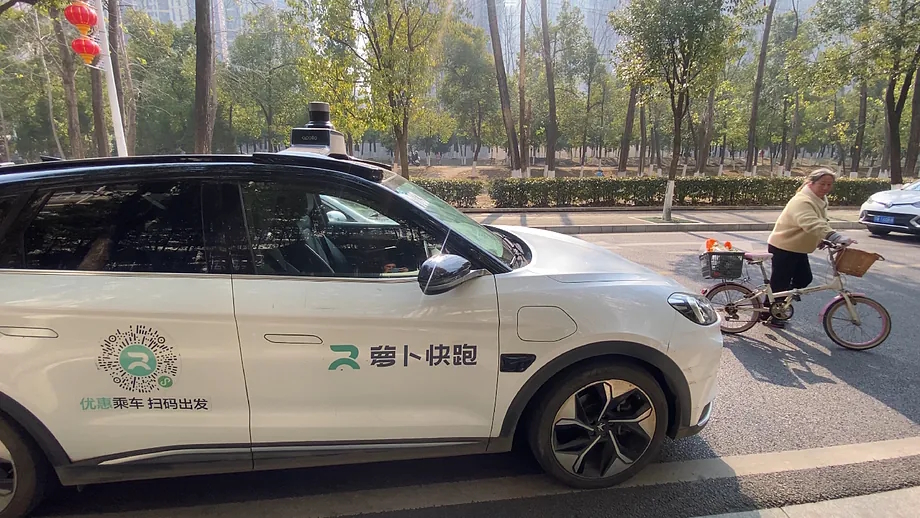
Over a hundred autonomous vehicles from the Apollo Go platform, operated by the Chinese tech giant Baidu, simultaneously malfunctioned last night in different areas of Wuhan, leaving passengers stranded and causing several accidents on the roads and main avenues of this city of over 11 million inhabitants in central China.
Several witnesses shared videos on social media showing these popular robotaxis stopped in the middle of traffic, unable to resume their journey. One passenger recounted on their Weibo account, equivalent to X, that their driverless vehicle stopped after turning a corner, displaying the message on the screen: "Fasten your seatbelt, an operator will arrive in five minutes."
Other users have reported being trapped for over an hour inside the vehicles, in the middle of the road. The door system was locked and could not be opened manually. Some images show the aftermath of collisions caused by the robotaxis' failure.
One of the accidents from last night caused by the malfunction in the autonomous taxis.EM
"I was with my family when the taxi suddenly stopped in the middle of an overpass. A very dangerous situation occurred when the other cars behind had to swerve to avoid hitting the stopped vehicle," recounted an affected woman to a local newspaper.
Local police confirmed on Wednesday that it was a company system failure and that "around 100 to 180 units" were affected, although there were no serious injuries. The affected locations include elevated roads and main arteries of Wuhan: at some points, up to seven or eight vehicles simultaneously stopped, causing traffic jams for several kilometers.
Baidu launched its first robotaxis in Wuhan in 2022, which has traditionally been a key laboratory for intelligent mobility in China: it is the first city in the world to boast a fleet of autonomous cars that have been integrated into the daily transportation offering.
This newspaper rode one of these robotaxis last year, which are requested through a free mobile app. The vehicle that picked us up had a cylinder-shaped sensor on the roof. To open the door, a code (the last four digits of the client's phone number) had to be entered into a digital frame that lights up on the rear right window. Upon entering, a female voice indicated that fastening the seatbelt is mandatory.
The car, relying on multiple sensors guiding autonomous driving, merged with surgical precision onto a busy avenue, skillfully dodging the chaotic traffic of cars, motorcycles, and bicycles. The 12-kilometer journey in the robotaxi cost the equivalent of 2.5 euros, much cheaper than other services. At these prices, Wuhan taxi drivers protested a couple of times in 2025, claiming that the competition from these autonomous cars would leave them without work.
Over 400 driverless cars are currently operating in Wuhan under Baidu's platform, which is heavily investing in the growing industry of robotized taxis. These vehicles are already in operation, in testing phase, in other modern Chinese cities like Shanghai and Beijing. But only in Wuhan does this service operate like conventional taxis or those requested through the Didi app, similar to Uber or Cabify.
The incident from last night once again highlights the challenges of autonomous mobility: the reliability of systems, emergency management, and passenger safety remain an ongoing debate. Although Wuhan leads the integration of autonomous taxis in China, massive failures show that technology still has limitations in real traffic conditions. Baidu, so far, has not provided an official explanation for the system failure.