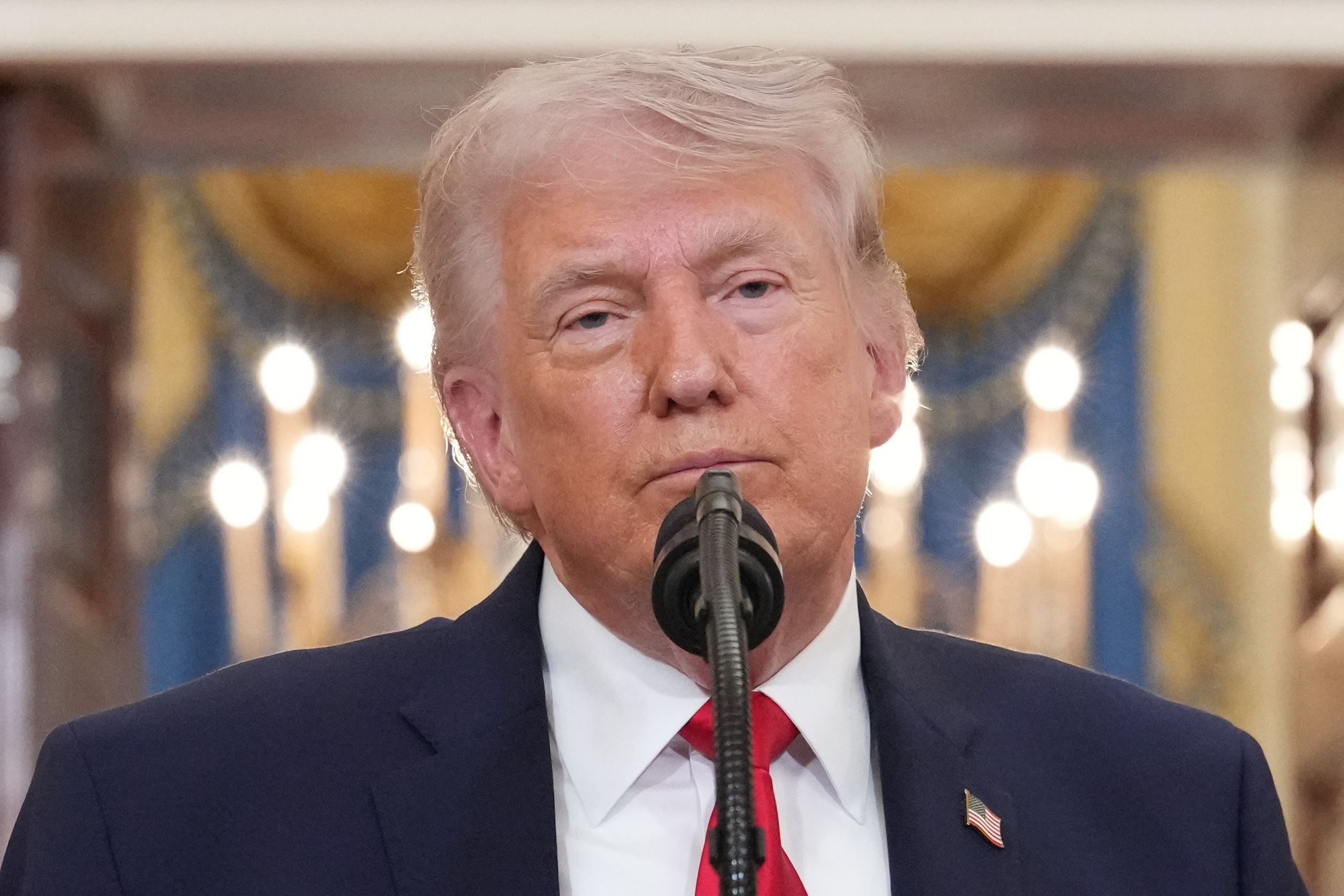
Donald Trump is running out of cards. He can't bluff at this point, get up from the table, and claim victory. His gains have disappeared from the table while his rival remains alive and holds an ace up his sleeve: Ormuz.
Hours before his address to the nation on Wednesday night, several leaks from inside the White House to prestigious media outlets claimed that the blond president was going to end the war and withdraw troops. We don't know what happened between that information and his live appearance, but the message was read, unlike others, and it was confusing and bewildering, as if he was just commenting again on all the messages he has been sending from his Truth social network, even those contradictory or not fitting with reality. Markets responded to the uncertainty with rises in oil prices. The Strait of Hormuz has been closed for three weeks now.
The president has extended the war and decision-making by two weeks, which is his favorite timeframe for ultimatums. It is the same timeframe he gave to Vladimir Putin on several occasions during their chaotic negotiations for peace in Ukraine (a threat he never fulfilled) and the same he has used here a couple of times without Tehran budging an inch from its position. Once again, the punishment is to bomb Iran's energy infrastructure "to send them back to the Stone Age".
This morning, he reiterated threats through the Truth Social network: "Our Military, the greatest and most powerful (by far!) anywhere in the World, hasn't even started destroying what's left in Iran. Bridges next, then Electric Power Plants! New Regime leadership knows what has to be done, and has to be done, FAST!""
Beyond the threats to Iran and insults to its allies, the feeling is that the blond president is paralyzed and trying to buy time, hoping that the passing weeks will solve a problem that has no easy way out. The reality is that each passing day worsens the situation because Iran can absorb the damage from each bombing and sell its oil at higher prices, while the world heads towards a global economic crisis. That's how powerful the leverage the ayatollahs hold is.
The assertion that unlocking the Strait is the responsibility of NATO allies and not his own sounds more like impotence and frustration than a real conviction. In the same speech, again in a contradictory manner, he stated that any ceasefire agreement depends on the Strait of Hormuz being "open, free, and clear". The United States needs to reopen the passage, and it needs to do it now. "We are going to finish the job, and we are going to finish it very quickly," he said, but it's the same thing he said at the beginning of the Epic Fury Operation, and the war is entering its fifth week with no end in sight.
For weeks now, Trump has had several plans on his presidential desk elaborated by the Pentagon to untangle the situation through military means: ranging from invading Jark Island, the islands of Qeshm and Larak in the Strait, or a raid to seize half a ton of enriched uranium. All of them are extremely difficult and would result in casualties among assault troops. The problem is that, even if successful, none of them guarantees that tankers can navigate the channel smoothly as they did before February 28.
In the diplomatic field, there is no progress either, no matter how much Trump insists on revealing alleged conversations that the regime denies minutes later. No one knows who the Administration is talking to or if they have any power in Iran. The mogul referred to a "president" with whom he can have constructive conversations, while Masoud Pezeshkian, the actual president, published a letter to the American people yesterday stating that it is Iran that wants to abandon the logic of escalation and opt for dialogue.
Beyond the self-interested exchange of messages, the truth is that Tehran now has no incentives to negotiate a ceasefire unless it is under its conditions. The closure of the Strait of Hormuz allows them to charge for each ship that passes through, deny passage to enemy ships, and improve their negotiating position with each passing day. The Revolutionary Guard, the armed tentacle of the regime, maintains power and takes advantage of the war abroad to win its war at home, the one it wages with its fierce repression against its own citizens.
United States, on the other hand, expands its military contingent in the Persian Gulf every day. In addition to the landing troops it already has in the region, about 7,000 including marines, special forces, and paratroopers, another 8,000 will join in the coming weeks, already on their way. On Wednesday, moreover, several A-10 bomber squadrons were seen for the first time arriving in the UK on their way to the Middle East. What does this movement mean? The A-10 is a ground-attack aircraft to support assault units. No one moves that type of aircraft unless they are considering putting boots on the ground. To complete the deployment, another aircraft carrier is en route to the Gulf to join the USS Abraham Lincoln. This is the George H. W. Bush, which departed from Norfolk and will arrive on April 10. If this is not a military escalation, it certainly looks like one.
James Acton, co-director of the Carnegie Center, states: "Frankly, I still have no idea what the United States' strategy is at this point. Was Trump preparing the country for an escalation? Or for withdrawal? I have no idea, and I suspect Trump doesn't either." Patrick De Haan, head of Oil Analysis at GasBuddy, believes "there is no plan. Trump's speech was empty in addressing the real issues of the Strait, leaving them in the hands of others, and there is no reason to expect the Strait to reopen soon. Without a plan, there is no concern; this will likely cause oil prices to rise again."
It is possible that the United States has achieved tactical successes in its operation, such as eliminating Iran's aviation or its navy, which are exactly what Israel was pursuing, but with the capture of Ormuz, the rest of the objectives seem secondary. Michael McFaul, a professor of Political Science at the Hoover Institution, stated: "If opening the Strait of Hormuz is as easy as Trump just hinted, why hasn't the most powerful military in the world done it? Because it is actually very difficult."