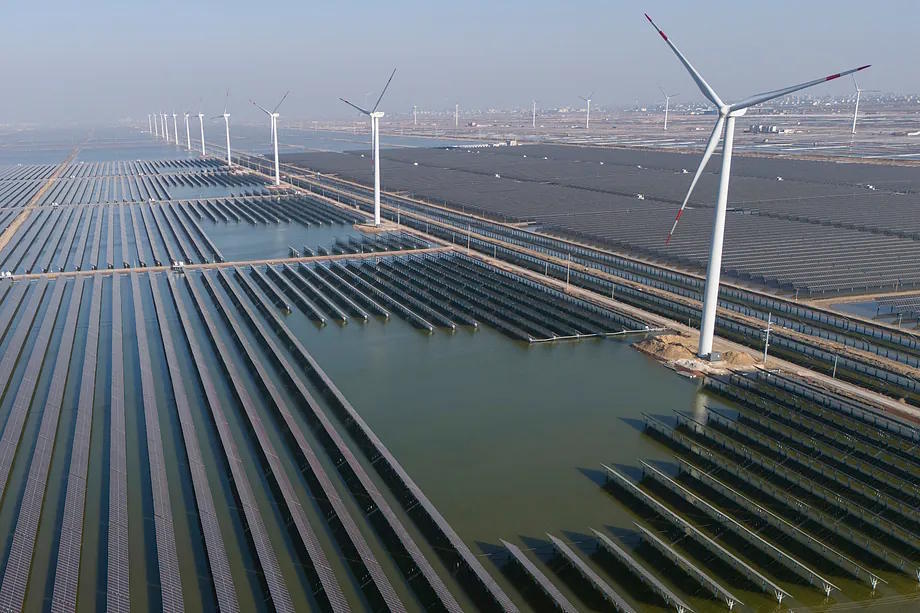
Unlimited oil, green hydrogen, and floating wind turbines. While the war in Middle East unleashes turbulence in energy markets, and the effective blockade of Ormuz Strait highlights the vulnerability of global supply, China is intensifying its ecological machinery to reduce dependence on traditional fossil fuels. This week, Beijing launched a pilot program to expand industrial use of green hydrogen, while Carbonology, a startup from Shanghai co-founded by a former senior executive of Tesla, claims to have developed a process capable of converting carbon dioxide extracted from the air and water into competitive synthetic fuel.
According to the company, which uses solar and wind energy to power its process, gasoline, diesel, aviation fuel, and naphtha can be produced at prices comparable to those of the traditional market, a significant advancement considering studies that point out the main issue with synthetic oil is its high production cost and the requirement of large amounts of energy.
These projects underline China's ambitious strategy — the world's largest carbon emitter and a global leader in renewable energy capacity — to diversify its energy sources and move towards a self-sufficiency model. Last year, when the world invested $2.3 trillion in green energy, over a third of that investment came from the Asian giant, nearly matching the combined investment of the United States and the European Union.
One of Beijing's current strategic bets is green hydrogen. Several years ago, while much of the world focused on electrifying transportation, the Chinese government began promoting programs to turn hydrogen into a fuel that would reduce its dependence on imported oil and gas: over 70% comes from abroad, with around 40% passing through Ormuz.
Last Monday, the Ministry of Industry and Technology announced specific objectives: expanding hydrogen-powered public transportation and exploring the integration of this element in gas pipelines and industrial boilers as a renewable heat source.
China already leads the transition of its automotive market to electric vehicles faster than any other major economy. Currently, half of the new cars manufactured are electric or hybrid. "For decades, China has invested hundreds of billions of dollars in electric vehicles and renewable energies, a long-term strategy that allows it to face market oil turbulence with greater resilience," argues Hu Jianwu, deputy director of the oil and gas department at the National Energy Administration.
"China has a cushion compared to other countries; supply cuts and price increases do not significantly affect the functioning of its economy," adds Michal Meidan, director of energy research at the Oxford Institute for Energy Studies, who also refers to the fact that the Asian country has enough leeway to avoid extreme measures that other nations on the continent have already adopted, such as reducing the workweek.
In the region of Inner Mongolia, where winds blow strongly most of the year, state-owned companies like Sinopec and China Energy have built huge plants to convert electricity generated by wind and solar parks into green hydrogen. In modern cities like Shenzhen or Hangzhou, the fleets of hydrogen-powered vehicles are growing, and local governments offer significant subsidies: up to two million yuan (around 250,000 euros) per refueling station.
By 2030, the Asian giant aims to have one million hydrogen vehicles and an annual production of 100,000 tons of green hydrogen. This drive is reinforced by the new five-year plan, which incorporates green hydrogen as an integral part of the energy system, leaving behind its old consideration as a hazardous chemical.
In Jiading, northeast of Shanghai, where new startups are developing electrolyzers and systems aimed at decarbonizing heavy industries, hydrogen fuel cell bicycles can be rented, recharged with less than half a liter of water, and costing just 1.5 yuan (0.20 euros) per trip. The company Youon even markets home recharging kits that produce 40 grams of hydrogen in five hours from 400 milliliters of water.
There are other energy alternatives that Beijing is investing in. In the province of Qinghai, for example, a pioneering project of storing thermosolar energy with molten salts is being built, capable of generating electricity even at night or on cloudy days, stabilizing the grid and reducing dependence on fossil power plants. In southern Guangdong, several companies are experimenting with floating wind turbines offshore, able to harness the constant winds of the South China Sea and directly supply electricity to nearby industrial cities.
In the tropical island of Hainan, a hybrid oceanic and solar energy system is being tested, combining marine current turbines with solar panels on floating platforms, generating continuous electricity. In the east of the country, in Zhejiang, technology companies are working on smart grids powered by urban wind energy, capable of storing local electricity surpluses and efficiently distributing them to nearby buildings and factories. All these projects, in addition to increasing renewable capacity, point towards a more resilient electrical system against international crises.