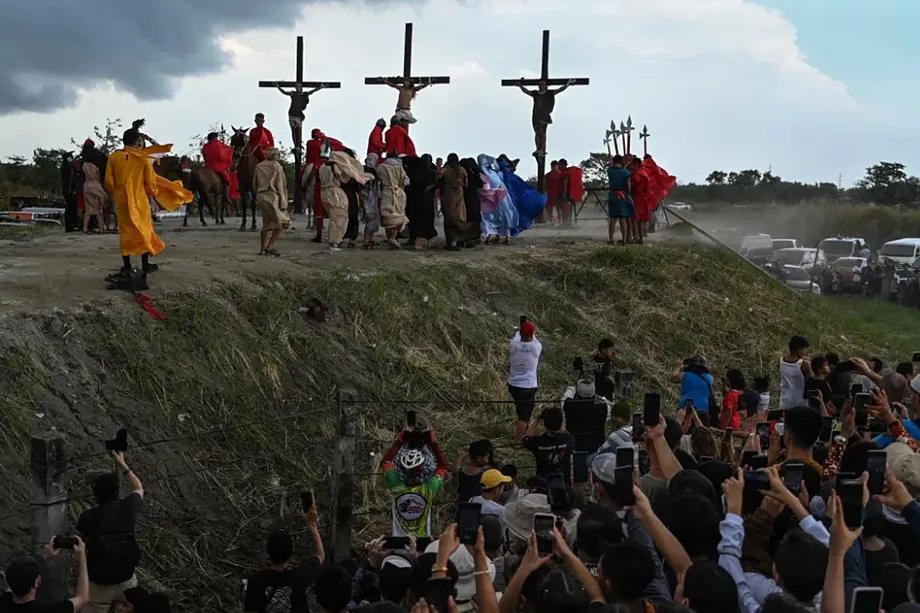
Every Good Friday, in some towns in the Philippines, dozens of faithful walk barefoot while being whipped with bamboo whips by men dressed as Roman centurions. Some end up being hung on a cross. In this country, where Holy Week mixes Catholic fervor and extreme rituals, the processions have coincided with protests over the energy crisis triggered by the blockade of the Strait of Hormuz. Filipinos, who import 95% of their oil, anticipate that inflation will reach 5.1% this year due to the rise in fuel prices. The war in Iran is particularly shaking Asia, the main destination for interrupted energy flows. A very untimely crisis: many of the most affected countries were counting on approaching greater stability and channeling their economic growth. According to the IMF, Asia currently generates two-thirds of global GDP growth and represents 40% of global trade.
China's Shadow over the European Union's Flagship Project in Africa
In Africa, there is a strategic railway network that connects the copper and cobalt mining areas of Congo and Zambia with the Angolan port of Lobito on the Atlantic, allowing key resources to be exported to Europe faster and cheaper. The modernization of the corridor is one of the most important projects of the European Union's global infrastructure initiative (the Global Gateway, endowed with 300 billion euros), which was launched with great fanfare in 2021 as a rival to Beijing's new Silk Road. For Brussels, this project is central to its attempt to reduce China's dependence on critical minerals, but it exposes a contradiction: part of the infrastructure and companies involved have links to Chinese capital. The initiative driven by Ursula von der Leyen herself highlights the limits of the European plan, which seeks greater autonomy but operates within global chains where Beijing's influence remains difficult to avoid.
The Rise of the 'Ghost Fleet' Amidst Chaos in Energy Markets
Several international analysts point out these days that the war in the Middle East has revitalized the so-called ghost fleet of tankers carrying sanctioned oil from Russia, Iran, and Venezuela, making it an even more central player in the global energy market. The disruption of conventional traffic in the Strait of Hormuz and the price hike have led the United States to relax sanctions, allowing these vessels to operate more freely and generating billions in revenue for Moscow and Tehran. Despite years of Western pressure, this opaque and very difficult to control logistical network has proven to be very resilient, using tactics such as turning off transponders or transferring oil at sea to other vessels. In a context of high energy demand, illegal energy trading not only persists but strengthens.
Why a War in the Middle East Brings the 'PetroYuan' Closer
The war has reignited the debate on the petro-yuan as an alternative to the petrodollar system, questioning an order in place since 1974 where oil is traded in dollars. According to Deutsche Bank, the conflict could accelerate a structural shift by bringing Gulf countries even closer to Asia, especially China. The possibility of soon invoicing part of the oil in yuan, along with precedents such as Russian and Iranian oil trade outside the dollar and futures contracts in Chinese currency, suggests a gradual erosion of the dollar's dominance. For now, the advancement of the petro-yuan is still limited by Chinese capital controls and the convertibility of its currency. Nevertheless, Bloomberg points out that the combination of geopolitical tensions, the fragmentation of energy trade, and the transition to alternative energies points to a more multipolar system, where the dollar could progressively lose weight in favor of other currencies.
Putin Calls on Oligarchs to Donate Money to Fund His War in Ukraine
Vladimir Putin is increasingly turning to the Russian business elite to sustain the growing cost of the war in Ukraine, a clear sign of structural tension in the Russian state finances. Under the guise of "voluntary donations," the Kremlin reinforces a model of political capitalism where oligarchs, largely enriched thanks to their proximity to power, are now called upon to repay favors in the form of direct funding. This move adds to tax increases and extraordinary levies that reveal a budget increasingly strained by military spending and international sanctions. The measure, more than a one-time strategy, reveals the progressive privatization of the war effort and the total subordination of the private sector to the regime's objectives, in a context where refusal is not a real option.
Talent Recruitment and the Great Pitfall of Artificial Intelligence
The massive use of AI is distorting the job selection processes, forcing the human resources departments of large companies to rethink their recruitment methods in the face of an onslaught of increasingly homogeneous and difficult-to-evaluate applications. Far from improving efficiency, recruiters complain that AI has created an environment of distrust where candidates not only optimize CVs but even "train" for interviews with real-time responses, diluting authenticity and improvisation. Faced with this, companies tighten filters, prioritize in-person interviews, and design "surprise" tests that require demonstrating real thinking (not through a chatbot). This reveals a paradox: the technology that promised objectivity is revaluing human judgment. A growing gap emerges between appearance and actual ability, making the hiring process more uncertain.