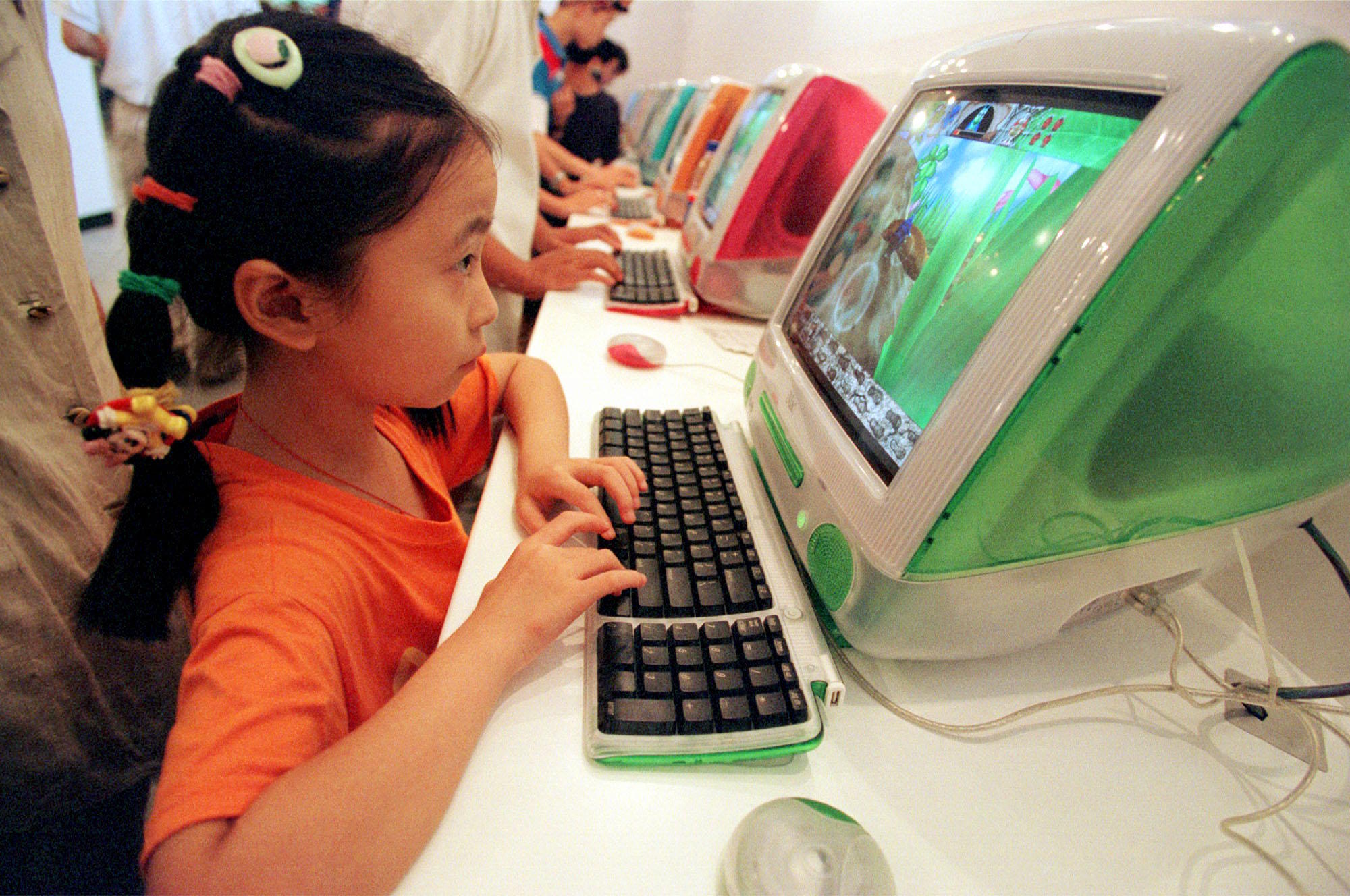
Century Park in Shanghai, the largest green lung in the economic capital of China, is famous for combining Western and Chinese styles. Wide areas of classic European gardens coexist with ponds surrounded by stones and aquatic plants, connected by traditional curved bridges. Normally, during the week, this place is filled in the mornings with retirees practicing tai chi and playing badminton. But since the end of March, the scene has changed: it is increasingly common to see groups of schoolchildren jogging along its paths, in a line, under the supervision of teachers.
"Now we are forced to take the children to walk in the parks during school hours," explains Tian, a young primary school teacher who watches over about twenty nine-year-old students. The order is part of a new set of measures promoted by national authorities to alleviate the academic pressure suffocating students from increasingly early ages. Tian does not hide her skepticism: "Then they return to class all revved up, full of energy. It's very difficult for them to concentrate like this."
Lu Bei, a thirty-something mother, found it amusing the first time she heard her seven-year-old daughter mumbling numbers in her sleep. She thought it was a funny anecdote to tell her friends. But it stopped being funny when it started happening more intensely. Her daughter repeated mathematical operations in her dreams that she couldn't get out of her head during the day. This family's case is not an exception.
China has been dragging for decades an educational model based on fierce competition, memorization, and a cultural obsession with academic performance. A system that has its roots in ancient imperial exams - the keju - and that in modern times has transformed into a massive selection machinery whose ultimate symbol is the gaokao, the dreaded university entrance exam that paralyzes the country every year. This atmosphere also has demographic roots: the one-child policy, in force for almost 40 years, concentrated all family expectations on a single descendant.
Many experts point out that school anxiety now begins in primary school, even earlier. Nurseries advance content, parents stack up extracurricular classes - advanced mathematics, piano, programming - and children grow up with the feeling that any misstep could condemn their future. The bottleneck is not only in the gaokao. The zhongkao, the entrance exam to upper secondary school (equivalent to our high school), has become an equally distressing filter: nearly half of the students are left out and redirected to vocational training, which still carries some stigma among urban middle classes.
There are studies reflecting the cost of this pressure. A national study conducted four years ago by the Chinese Academy of Sciences placed the prevalence of mental disorders among children aged 6 to 16 at 17.5%: anxiety, insomnia, and mild depression. Another study by Tsinghua University, based on 420,000 adolescents, detected a depressive risk in 14.8% of the respondents. "Some show disinterest in the real world and a marked inability to socialize," warned psychologist Peng Kaiping, one of the authors.
The Shanghai-based newspaper Sixth Tone recently reported that the emergency psychological helpline has seen a steady increase in calls from minors since its establishment in 2021. "Initially, only a quarter were related to children and adolescents. Now it's close to 30%," noted Jin Jin, in charge of the service at the Mental Health Center in the city. Behind that percentage are stories of 12-year-old students unable to sleep, children developing exam fears, or, like Lu Bei's daughter, carrying math into their dreams.
Faced with this scenario, the central government is trying to correct the course. The Ministry of Education has just announced a new set of measures to alleviate the academic burden. Among them, "the prohibition of assigning excessive homework," limiting the frequency of exams, and, in a symbolic but revealing gesture, the explicit order not to "invade" break time. In a country where some schools had even eliminated breaks to dedicate more minutes to study, the directive sounds almost revolutionary.
The new rules also prohibit educational institutions from punishing teachers based on their students' academic results, a practice that had contributed to inflating the pressure. And they go further: nurseries cannot advance primary content, a common strategy driven by families seeking to give their children an advantage. These measures add to previous initiatives, such as a policy to reduce homework and limit the lucrative business of private academies. Also, the introduction of more vacations and increased physical activity.
"The problem is not only the educational system but also social expectations," points out child psychologist Zhang Yue, who doubts that administrative reforms are sufficient to dismantle a deeply rooted culture. "As long as parents continue to believe that success depends solely on grades, the pressure will find a way to persist," she warns.
In the Asian giant, education has historically been the great social elevator. In a country of over 1.4 billion inhabitants, competition is a statistical reality. Every family, from large cities to rural areas, tries to ensure that their children do not fall behind in a race that starts earlier and earlier.