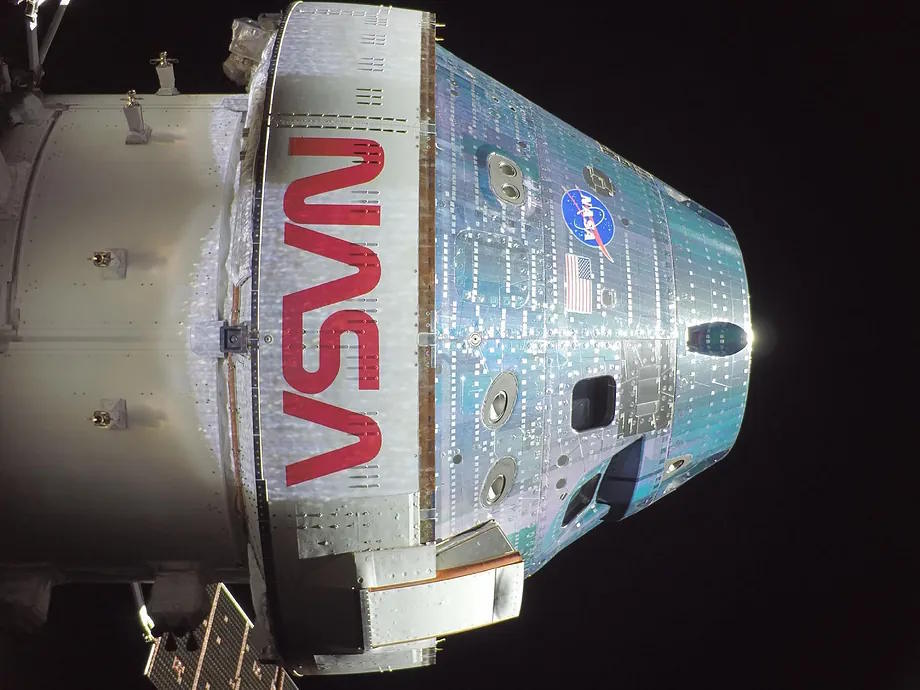
Five days after its spectacular launch from Florida, the Orion spacecraft is about to reach its closest approach to the Moon. The four crew members of Artemis 2 are finalizing all preparations for the flyby around our satellite, as they will not land on the Moon.
This Monday will be the big day of this mission that has taken humans to our satellite for the first time since 1972. The astronauts will orbit the satellite, positioning themselves at a distance of about 7,400 kilometers from its surface. They will then begin the journey back to Earth, a journey that will last another four days and will culminate on Friday, April 10th (April 11th in Spain) with the spacecraft splashing down in the Pacific.
Over the weekend, Reid Wiseman, Christina Koch, Victor Glover, and Jeremy Hansen continued preparing for observations, studying which geological features to photograph, while taking new images during their deep space journey, some of them of the Moon.
Each day, NASA wakes up the astronauts with a song, which on the fifth day was Working Class Heroes (Work) by CeeLo Green. They also heard a message from Charlie Duke, astronaut of Apollo 16 and one of the few heroes of the Apollo program still alive.
Christina Koch and Jeremy Hansen took turns manually piloting the spacecraft, conducted tests with the spacesuits, and had to deal with a new issue with the spacecraft's toilet, which had already caused problems in the early hours of the journey but were resolved by Christina Koch, the mission specialist and self-proclaimed "space plumber." They also held a video conference with Canadian children and youth - one of the crew members, Jeremy Hansen, is a citizen of that country.
During the early hours of Sunday to Monday, the Orion spacecraft will enter the Moon's sphere of influence. What will this flyby be like? The lunar observation period will begin at 8:45 p.m. on Monday (in the Peninsula) and will last a total of seven hours. It will take four hours to complete one orbit around our satellite. As detailed by NASA, the crew will see both the near side and the far side of the Moon. They are likely to be the first humans to visually observe some parts of the far side.
Due to limited space at the windows of the Orion spacecraft, the crew will split into pairs, with two members observing for periods of 55 to 85 minutes while the other two work on other tasks.
The Houston Mission Control Center expects to temporarily lose communication with the crew when Orion passes behind the Moon, at 1:02 a.m. on Tuesday in Spain. A communication blackout that will last around half an hour if all goes as planned. The astronauts will make their closest approach to the Moon and reach their farthest point from Earth at 1:05 a.m. on Tuesday in the Peninsula, according to NASA.
At this distance, NASA compares the astronauts' view of the Moon to a basketball held at arm's length.
Once the observation period ends, the astronauts will start sending some of the images back to Earth, which will be reviewed at night by NASA's scientific team and discussed with the crew the following day.
If everything goes according to plan, the crew of Artemis 2 will become the humans who have traveled farthest from Earth. They are expected to surpass the record set by the Apollo 13 crew in 1970 by about 6,000 kilometers, as they traveled 400,171 kilometers from Earth. It is estimated that the Artemis 2 mission will reach a maximum distance of almost 407,000 kilometers.