The astronauts of Artemis 2 made history last night with their lunar adventure and have already begun the journey back to our planet.
Monday was the crucial day of this NASA mission, with the Orion spacecraft flying around our satellite. It was a seven-hour observation period that the four crew members - three Americans and one Canadian - executed as planned, becoming the humans who have traveled the farthest from Earth and the first to see some areas of the far side with the naked eye, the most enigmatic part since it cannot be seen from Earth. They even witnessed a spectacular solar eclipse.
At 7:56 p.m. in Spain, Commander Reid Wiseman, Pilot Victor Glover, and mission specialists Christina Koch and Jeremy Hansen surpassed the record set by the crew of the ill-fated Apollo 13 mission in 1970. Back then, James Lovell, Jack Swigert, and Fred Haise were situated 400,171 kilometers away from our planet. A few hours later, Artemis 2 added 6,600 kilometers to their record by reaching the farthest point from our planet in this mission, so the history books will note that they were situated 406,771 kilometers away from Earth, as specified by NASA Director Jared Isaacman.
"Before departing, our astronauts said they hoped this mission would be forgotten, but it will be remembered as the moment when people began to believe that the U.S. can once again do the nearly impossible and change the world," declared Isaacman, extending his congratulations to the international and commercial partners making it possible to return to our satellite. Despite the excitement, he reminded that "this mission will not be over until the spacecraft splashes down in the Pacific," next Friday night (Saturday early morning in Spain).
For Lori Glaze, one of the mission's top officials, their dedication goes beyond breaking records: "It carries with it the promise of returning to the surface of the Moon, this time to stay as we establish a lunar base."
From the Integrity cabin (the name chosen by the astronauts for this Orion spacecraft), Jeremy Hansen, the first non-American citizen to go to the Moon, made reference to past and future astronauts: "Here, as we surpass the greatest distance humans have ever traveled from planet Earth, we do so in honor of the extraordinary efforts and achievements of our predecessors in human space exploration," he solemnly stated. "We choose this moment to challenge this generation and the next to ensure that this record does not endure for long," he pointed out, recalling the true objective of this test mission: to pave the way for humans to return to the Moon, establish a base, and prepare to leap to Mars.
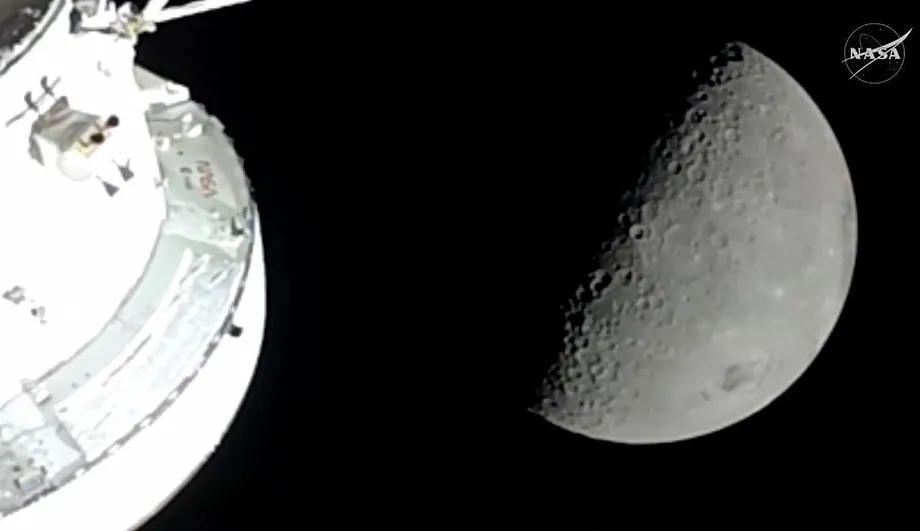
Five days after their spectacular launch from Florida, the Orion spacecraft returned humans to the Moon's orbit after more than half a century, to observe it from above, at a distance from its surface that at its closest approach was 6,550 kilometers.
Artemis 2 did not land on the Moon, as the goal is to test the spacecraft and systems for a future landing that will not happen before 2028. If Donald Trump's plan in his first term had been followed, we would have already seen astronauts walking on the Moon again in 2024.
Despite the delay - 2028 still remains for many experts an overly optimistic date - NASA has made efforts and has managed to excite the world with this test flight, highlighting the milestones and records being achieved. During the flyby around the Moon, these four astronauts - including the first woman and the first Black astronaut to go to the Moon - also became the first to see some areas of the enigmatic far side with the naked eye.
China remains, however, the only country that has managed to send a rover to the far side of the Moon that we do not see from Earth, and even succeeded in 2024 in bringing back samples to Earth with the Chang'e-6 robotic spacecraft, a major milestone in space exploration. Now, both the U.S. and China are competing to land on the Moon first and to build a permanent settlement, in the case of the Asian giant, in collaboration with the Russians.
A crater named after the commander's wife
The phase of the NASA mission that took place last night, like this entire journey, was full of symbolism and emotional moments. This is something where Americans continue to outshine the Chinese. One of the most touching moments was the announcement that they will propose naming a lunar crater after Carroll Taylor Wiseman, in honor of Commander Reid Wiseman's late wife who passed away in 2020 due to cancer. "There is a feature in a beautiful location on the Moon, on the border between the visible and the far side... We would like to call it Carroll," said Jeremy Hansen. Wiseman, 50, and a father of two girls whom he cares for alone since he became a widower, broke down in tears.
They have also proposed naming another crater after the spacecraft, Integrity.
Victor Glover took the opportunity to declare his love to his wife when, while reading a report to Mission Control, he saw that she was following the mission from Houston: "Hello, darling, I love you from the Moon. I'm glad you can be there," stated the Artemis 2 pilot.
Coincidentally, Jim Lovell, the legendary astronaut of the Apollo 8 and 13 missions, who passed away in 2025 at the age of 97, also named a crater in honor of his wife, Marilyn, in 1968.
The Apollo 8 mission is very present in Artemis 2 as acknowledged by Christina Koch, it is very important to them. Even the mascot, Rise, the plush toy serving as a zero-gravity indicator, is based on a design inspired by the iconic Earthrise image taken by the crew of that flight.
Before the flyby, the crew received a special message that Lovell recorded for the mission some time ago: "Hello, Artemis 2! I'm Jim Lovell, astronaut from the Apollo program. Welcome to my old neighborhood! When Frank Borman, Bill Anders, and I orbited the Moon on Apollo 8, humanity had the first close-up view of the Moon and a perspective of our planet that inspired and united people worldwide. I am proud to pass the baton to you as you orbit the Moon and lay the groundwork for missions to Mars for the benefit of all. It's a historic day, and I know how busy you will be. But don't forget to enjoy the view. So, Reid, Victor, Christina, and Jeremy, and all the great teams supporting you, good luck and may God be with you! From all of us here on Earth."
It was good advice because to say that the views they enjoyed from the Orion windows were enviable is an understatement. In turns, they were able to observe both the near side and the far side of the Moon, and perhaps - we will know in the coming days - they discovered some areas of the satellite. As explained by NASA, "human eyes and brains are very sensitive to subtle changes in color, texture, and other surface features," so "direct observation, along with all the scientific advances made in recent decades, could reveal new discoveries and a deeper appreciation of lunar surface characteristics."
When the spacecraft ventured into the far side, as planned, Houston Control Center temporarily lost communication with the crew when there were 10 minutes left until 1 a.m. An interruption that lasted about 45 minutes. "It's fantastic to hear from you again from Earth," exclaimed Christina Koch when communications resumed.
The observation period concluded shortly before 4 a.m. on Tuesday. The highlight was a spectacular solar eclipse they were able to witness after communications were restored. It was like a gigantic solar eclipse with one fundamental difference: the silhouette blocking the Sun was not the Moon but the Earth, surrounded by a faint reddish halo. A ring that literally contains the light of all the planet's sunrises and sunsets projected simultaneously.
No Apollo astronaut witnessed a complete eclipse of this kind from lunar orbit simply because the trajectories and schedules of those missions did not coincide with the phenomenon.
The First Images
It is also expected that, during the return to Earth, they will already send some high-resolution images they have taken, although part of the material will be downloaded upon their return.
Scientists are eager to see them, as the far side of the Moon presents a very different landscape from what we see from Earth. While the visible side is dotted with large lunar seas - the extensive dark plains formed by ancient volcanic eruptions - the hidden side is dominated by plateaus covered with craters. The main reason seems to be geological: the lunar crust is thicker there, which prevented the magma from the interior from ascending as easily as on the side facing Earth. As a result, the surface retains a much higher density of impacts, a kind of natural archive that records billions of years of collisions with asteroids and comets, when the Solar System was a much more violent place.