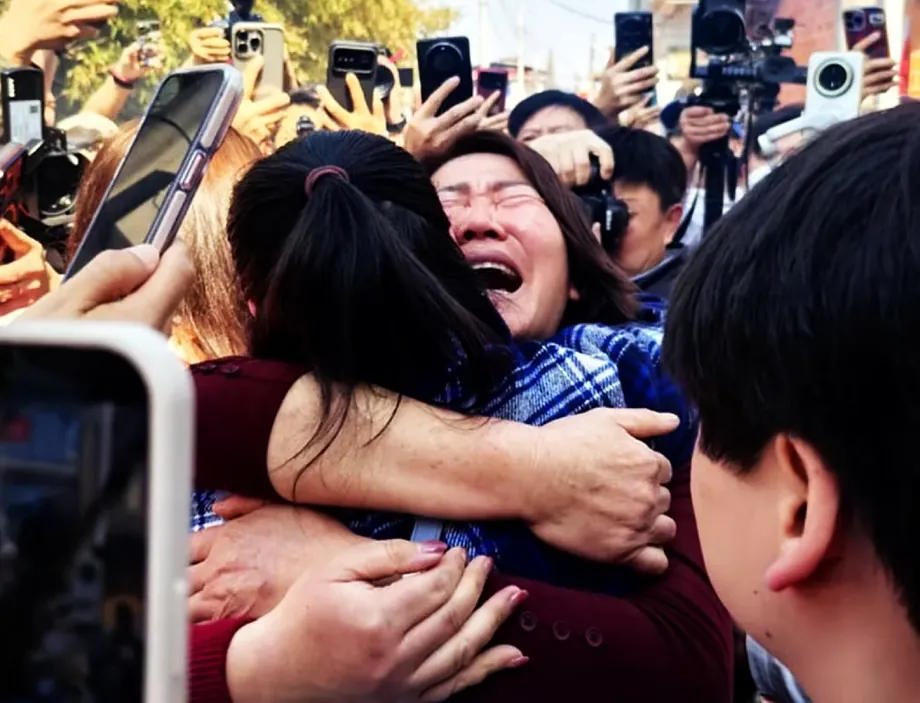
The grandfather entered a public restroom with the baby wrapped in a blanket. His granddaughter was barely two days old. He left her there, on a toilet, along with a bag of powdered milk, 120 yuan — around 15 euros —, and a note with her date of birth. Then he left. No one in the family heard from her again for 28 years.
The baby was born in Nanchang, in the central province of Jiangxi, into a peasant family. Her mother, Yang Xiaoying, had just given birth when her father-in-law offered to take the girl home to care for her. That was the last time she saw her. The grandfather, who never hid his displeasure that his second granddaughter was also a girl, abandoned her in that restroom and refused for years to reveal her whereabouts. The parents searched for her tirelessly.
A passerby found the newborn crying and took her to a foster home. There she was named Hong Yangli. Shortly after, she was placed with a temporary family and, within a year, adopted by a Dutch couple. From the Netherlands, Hong never gave up on the idea of finding her biological family. In 2024, she decided to take it a step further: she submitted her DNA to a database of missing children in China.
There is no comparable system in the world. It brings together over 100,000 family profiles searching for missing or abducted children. It also relies on facial recognition programs and artificial intelligence algorithms developed by the tech giant Tencent, capable of simulating the current appearance of a missing child and cross-referencing it with national databases. Authorities claim that over 2,000 people have been located thanks to this system, including a hundred cases over half a century old.
In mid-March, Hong received a call from China: they had identified her parents. She doesn't speak Mandarin, but she returned alone to Nanchang for a reunion as intimate as public: banquet, fireworks, and hugs in front of local television cameras. "My daughter has returned!" shouted her mother. Her father gave her a gold bracelet and a jade pendant, symbols of welcome.
Her story echoes an era marked by extreme birth control measures and a structural preference for male children. In rural areas, where economic pressure intertwined with patriarchal traditions, the birth of a daughter could become a silent tragedy. In the late 1970s, as China began to emerge from Maoist isolation and embrace market reforms under Deng Xiaoping, the one-child policy was implemented, in force for almost four decades and applied particularly harshly in rural areas. In this fertile ground of state coercion and inequality, an underground economy around babies flourished: abandonments, sales, and kidnappings.
The cultural bias towards males was exacerbated by birth limitations. Having "only one" made the choice existential. In many villages, a girl was seen as a future loss —"spilled water," as the popular saying goes—. Thousands of newborn girls were abandoned in markets, public toilets, stations, or rural roads. Others ended up in informal adoption networks or directly in trafficking circuits.
Some family planning officials, subject to numerical targets and political pressure, went as far as kidnapping babies from families unable to pay fines for having a second child —penalties that could amount to several years' worth of income— and selling them to orphanages. With the opening of international adoption in the early 90s, these centers paid high sums for children, especially girls. Thousands were adopted by families in the United States, Europe, or Australia. For years, the official narrative maintained that they were abandoned orphans with no trace of their origins. DNA databases have begun to crack that story.
A woman named Yu Huaying spent from 1993 to 2003 kidnapping children from very poor areas in southwest China and selling them to wealthy families in other provinces. Her first victim was her own son, whom she sold for 5,000 yuan (650 euros). Yu was arrested in 2022 and executed in 2024. One of the children she abducted was Ching, who now lives in Shanghai and told this newspaper how, after his adoptive mother confessed that he had been a stolen baby, he joined the DNA program and in 2022 was able to reunite with his biological parents.
In 1989, when Li Jingwei was four years old, a neighbor kidnapped him from his village in southern China and sold him to a trafficking network. A family bought him for the equivalent of 300 euros. Three decades later, watching reunion stories on television, he decided to search for his biological parents. He had few memories, but he drew a map with images from his village: a school, a bamboo forest, a pond, stone paths, mountains, and two rivers. He posted the video on Douyin, the Chinese version of TikTok. It went viral. Police compared his drawing to a village in Yunnan where, decades earlier, a woman had reported her son missing. DNA confirmed the intuition: Li went back home.
In the year 2000, in a poor village in the center of the country, twins Fangfang and Shuangjie were born. Two years later, when authorities discovered it, they forcibly took one of them. The family never heard from Fangfang again, adopted in the United States and renamed Esther. Her sister grew up marked by the absence and silence of parents caught between pain and helplessness. Decades later, an American journalist, Barbara Demick, located Fangfang while investigating baby trafficking in China and facilitated the reunion.