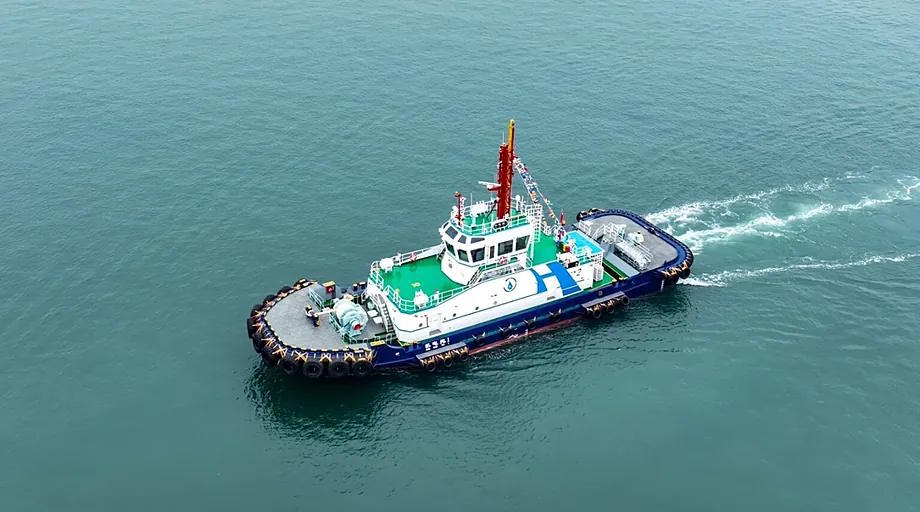
In February, an electric cargo ship sailed the Min River in the province of Fujian, southern China. It moved silently, smoke-free. With a range of 200 kilometers per charge, the boat completed its first test journey transporting industrial products between two local river ports, while engineers monitored the performance of its batteries.
China does not want its energy transition to stay on solid ground. After turning its major cities into the world's largest electric car laboratory, it has now shifted its focus to its rivers, canals, and coasts. The stated goal is for the same revolution that silenced millions of combustion engines on roads to now start phasing out diesel engines from its massive river fleet. And if successful, export the model to the rest of the world. A revolution that would be more than timely after the blockade of the Strait of Hormuz exposed global energy vulnerability.
The starting point, for now, is internal: nearly 500 electric-powered vessels already operate in the extensive network of inland waterways in the Asian country, although most are passenger boats. These are figures from the Ministry of Transport showing a still experimental phase. The novelty, experts point out, will be the leap towards heavy cargo. Some local governments and state-owned companies claim they will move away from tourist boat models to experiment with cargo ships, like the cargo ship that sailed the Min River in February.
Last October, the world's first fully electric container ship, with a cargo capacity of over 10,000 tons, was launched near the Three Gorges Dam, the world's largest hydroelectric project. With nearly 130 meters in length, this ship, built by the Gezhouba Group Machinery Ship company, features 12 lithium battery generator sets, providing it with a range of 500 kilometers.
Chinese authorities have committed to peak emissions before 2030 and carbon neutrality by 2060. Achievable climate goals with a massive deployment of renewable energies, starting with global leadership in solar panel and battery manufacturing. Now the focus expands to sectors that are difficult to decarbonize, such as maritime transport, responsible for a significant portion of global emissions and pollution in rivers and port areas.
President Xi Jinping's government aims to mobilize its colossal shipbuilding industry, and the role of giants like CATL, the world's largest producer of electric vehicle batteries, is key to transforming part of the fleet. State media have reported that this company has partnered with the state-owned Jining Energy to develop ships of 2,000 tons with up to 270 kilometers of range. Last December, five units were launched, and another fifty have been ordered.
"We are now transitioning from technical demonstration to large-scale commercial operation," a statement from CATL notes, which has also partnered with the French shipping company CMA CGM to develop an electric boat that will cover 180 kilometers in Southeast Asia, a strategic region for Chinese logistics chains.
During the presentation of a river cruise powered by batteries developed by CATL, Su Yiyi, director of the company's marine division, predicted that large fully electric ships will be able to make oceanic journeys in the next three years. A CATL subsidiary also unveiled its first electric fishing boat last year, offering four hours of operation and reaching speeds of up to 52 km/h.
CATL —known in Spain for its agreement with the automotive group Stellantis to build a gigafactory in Zaragoza— is headquartered in the province of Fujian, where 34.5% of the national electric fleet is concentrated. The issue, as reiterated by the industry itself, is that the current price of an electric boat can be double that of an equivalent diesel one. Batteries and propulsion systems increase the project's cost and put pressure on shipping companies accustomed to operating with narrow margins.
To overcome this obstacle, CATL proposes a model change of "battery and ship separation": the shipowner purchases the vessel and leases the battery, reducing the initial investment and transferring some of the technological risk to the provider. It is a formula similar to what was tried in the early years of electric cars in China, where the state subsidized both the purchase and infrastructure.
The other barrier will be adapting the charging network to ports and locks, with systems capable of supplying high power in a short time to avoid disrupting logistics. In a world seeking to decarbonize global trade, Beijing wants the next green maritime wave to also bear the Chinese stamp.