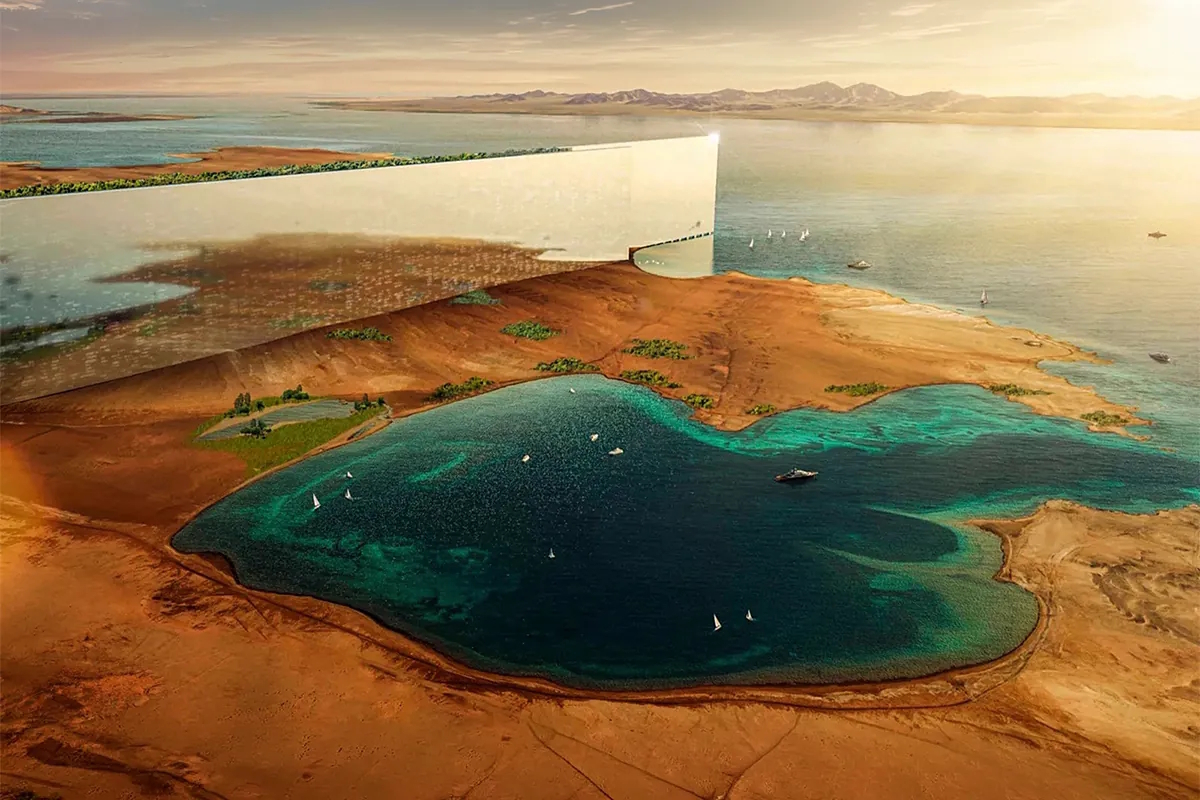
The Malaysian steel company Eversendai, the Italian construction company Webuild, and the engineering subsidiary of the Korean group Hyundai have announced in the last month the cancellation of their contracts with the Saudi Sovereign Fund, which is the main promoter of The Line and the large projects in the special region of Neom, in the northwest of the country.
The most recent case is that of Eversendai, which has reported that its Saudi clients have suspended the awarding of their works at the Trojena ski resort, in the mountainous region of Tabuk, near the border with Syria. Webuild has also renounced its contract for the construction of three dams for the artificial lake that was to receive desalinated seawater and supply snow to the resort. Finally, Hyundai Engineering and Construction was the first company to inform its country's stock regulator of the cancellation of its contract for a tunnel in The Line, the 180-kilometer-long city.
The withdrawals come at a time of extreme geopolitical tension in the Middle East. The Islamic Republic of Iran bombed oil facilities of the Kingdom of Saudi Arabia on March 2 and 19. One of their targets, Yanbu, is in the Red Sea, just like Neom, although further south. The other, Ras Tanura, is on the other side of the country, in the Persian Gulf. Saudi Arabia has not responded militarily to the attacks and has minimized their impact. Meanwhile, the price of oil, the main source of wealth for the state, has increased by 7%. However, the cancellations in Neom are part of a broader crisis that began before the United States and Israel's attack on Iran.
As early as 2024, the year Eversendai and Webuild received their awards, the Saudi Sovereign Fund began to cut its forecasts for Neom. In 2021, the investment company and its American and Japanese partners presented The Line as a linear city on a 170-kilometer-long and 500-meter-wide plot, enough to accommodate nine million people by 2030 with revolutionary urban conditions. All movements within the city would use public transportation, and all necessary services would be within a five-minute radius for all citizens. The Line also had a groundbreaking aesthetic value: its image was that of an endless prism cutting through the desert, from the sea to the mountains.
Since 2023, skepticism began to surround The Line. The founder of Archigram, Peter Cook, one of the employed architects, said that The Line was only "a possibility" and that its dimensions were "a bit stupid." By 2024, it was already assumed that the city would only be partially built, that it would be, in part, a prototype for the future. Finally, in 2025, the Sovereign Fund announced that it had hired external consultants to reconsider the concept. The works, which until that moment had focused on the foundation of 2.4 kilometers, were put on hold.
Now, the resignation of Hyundai Engineering and Construction (awardee of a 12.5-kilometer-long tunnel segment dedicated to transportation) indicates that the suspension of the works will be lengthy. So far, in the first months of 2026, there has been talk of a version of The Line for 300,000 inhabitants in a greatly reduced section. To date, the construction of The Line has consumed 50 billion dollars. Saudi Arabia has not been able to attract as many foreign investors to the project as expected in 2021.
In Trojena, the news is even worse. Saudi Arabia had already given up on hosting the 2029 Asian Winter Games, which were planned to take place on its slopes. On February 2, a month before the war, the Asian Olympic Committee received the news that Saudi Arabia would not be able to fulfill its commitment. The costs of the Trojena project had skyrocketed to 38 billion dollars, double the amount estimated two years ago. The inflation is not due to changes in the project but to access to financing markets. Trojena was designed by the LAVA studio and included pieces from UNStudio, Zaha Hadid Architects, and Aedas. With its water supply suspended, the whole project is on hold.
Over these years, the viability of Neom was both a revulsive and dependent on the strength of the Saudi oil economy. In 2026, the kingdom expected its per capita GDP to grow by 4%. So far, the economic authorities of the Kingdom have not adjusted their forecasts despite the war in Iran, their neighbor and traditional enemy.