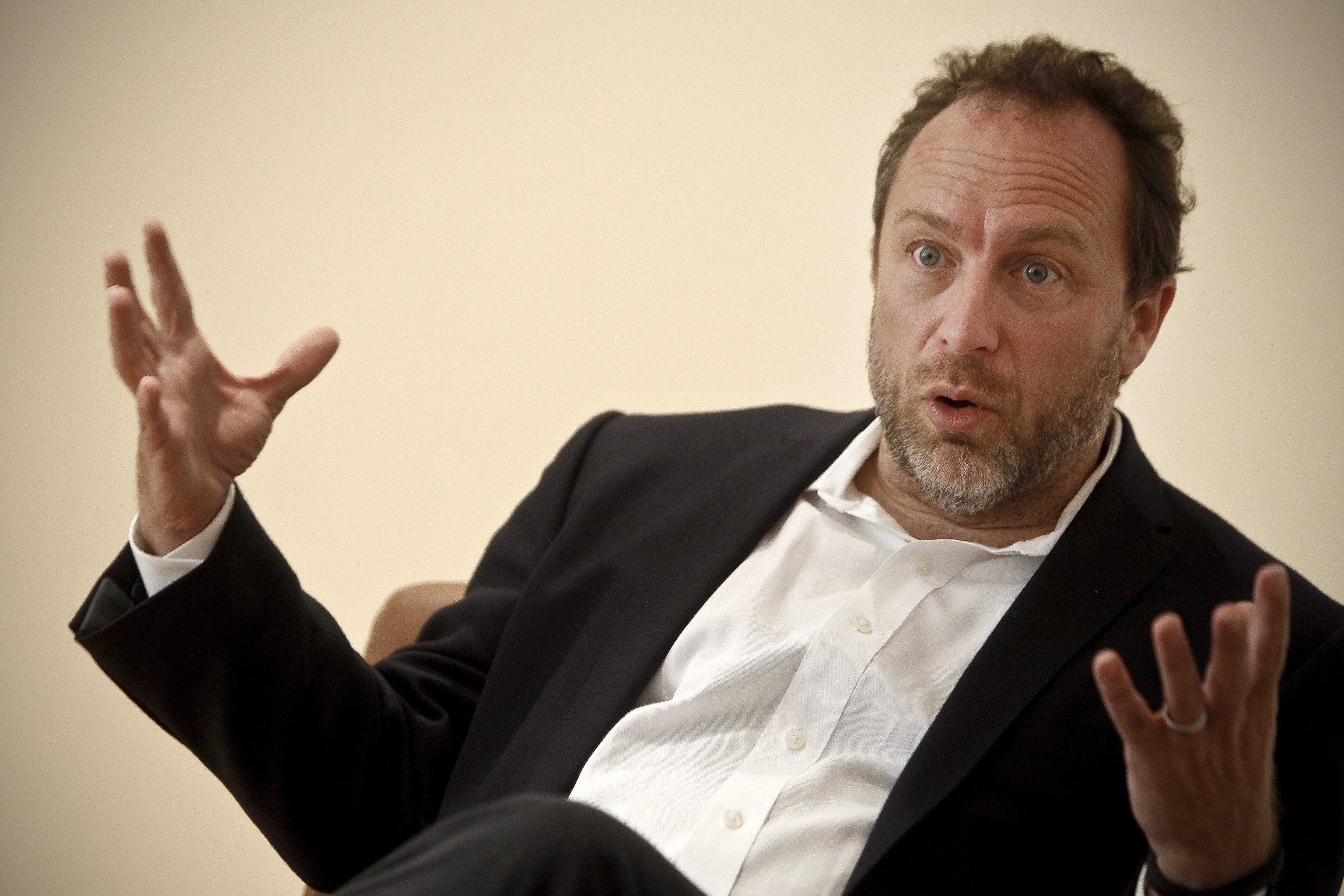
According to his Wikipedia profile, Jimmy Wales will turn 60 on August 7. At one point, someone added a seemingly insignificant sentence to that same article revealing that Wales frequently played chess with his friends. It wasn't true. However, this information led to the founder of Wikipedia being invited to make the ceremonial first move at the World Chess Championship as if he were Zinedine Zidane performing the kickoff at a Champions League match at the Santiago Bernabéu. That's the power of... Wikipedia.
That lie has since been removed from his profile.
Son of a supermarket manager and a teacher from Alabama, Wales, along with his most famous Silicon Valley contemporaries, forms a group of chosen ones who have changed our world through the internet.
However, Wales is different from the rest.
He is the only one who is not a billionaire.
And the only one who seems like a regular guy.
The creator of the most famous encyclopedia describes himself as shy even though he is used to chatting with political leaders, giving lectures at schools, and visiting volunteers who write from every corner of the planet. He is relatively accessible. He responds directly through the Zoom link sent to his assistant. There are no barriers. He connects from an office in the basement of his house in London, a city where he has lived since 2012 due to his relationship with Kate Gevey, a former assistant to Tony Blair whom he met at the Davos Forum.
Wales is not at all grandiose compared to his digital olympian counterparts. He is not like the robotic Mark Zuckerberg, whose admiration for the power and aesthetics of Roman emperors is reflected even in his haircut. He is also not known to have dangerous friendships like the connection with Jeffrey Epstein that is compromising Bill Gates. Nor has he sworn to reveal the identity of the Antichrist as Peter Thiel has. Wales does not seem to resort to testosterone consumption to rejuvenate his body like Jeff Bezos or to want to populate the world with children in order to "save civilization" like Elon Musk.
By the way, Musk is undoubtedly the companion who gives him the most trouble. Musk is openly hostile towards Wikipedia from his X account. He calls it wokepedia, accusing it of having a progressive bias and tries to sabotage its donation campaigns. It should also be noted that behind these attacks there is more than just an ideological struggle: the owner of Tesla is determined to promote Grokipedia at all costs, the online encyclopedia managed by his AI, and he knows that its success depends on discrediting its rival.
"Elon is someone extravagant and sometimes gets a bit dramatic," says the emeritus president of the Wikipedia Foundation, not giving much importance to the skirmish. "I don't pay much attention to him and wish him the best."
In an era of polarization and uncertainty, Wikipedia represents on its 25th anniversary a collective and altruistic effort that, despite the changes experienced during this century, remains relevant. This is very commendable considering that the Internet is a graveyard of great ideas that were devoured by the market or simply committed suicide. Just ask Netscape, Hotmail, or, among others, Fotolog.
Whether Musk likes it or not, Wales embodies one of the most fascinating projects not only on the internet but in the history of humanity.
To understand how crazy the idea he had to aggregate knowledge a quarter of a century ago was, we turn to the beginning of The Seven Rules of Trust, a book not yet translated into Spanish that was published a few months ago in which Wales reveals the secrets of his success. The text is a mix of business autobiography and practical lessons in which he defends the importance of having a strong purpose, transparency, and independence.
"Many years ago, when the world was still learning about this strange novelty called Wikipedia, most people were sure it was a terrible idea. An online encyclopedia that anyone could write and edit. Anyone? The premise seemed to defy logic. How could readers trust that their data were really verified facts and not nonsense written by amateurs or pranksters? The public would never trust Wikipedia. And without trust, Wikipedia would be nothing," writes Wales. "Sooner or later, Wikipedia would fail and be forgotten, like so many other crazy ideas on the internet. It was all ridiculous. A joke...".
Wikipedia was many things, but not a joke.
To prove it, we can turn to the renowned fashion designer Diane von Fürstenberg, who once paid the best compliment a tech baron has ever received for his creation: "We all use Wikipedia more often than we go to the bathroom to pee."
Wikipedia is edited in 334 languages. It has 65 million articles (two million in Spanish) and 3.5 billion edits. Its 180 billion annual visits make it the fifth most visited website, a magnitude similar to the estimated number of stars in the Milky Way. A quarter of a million people write on it for free, and eight million support its maintenance through financial donations.
I regret to inform you that I am not a very glamorous journalist: I lack a Wikipedia entry. I know people who measure glory by that yardstick. Perhaps after this interview, someone will create one for me.
That would be fun.
What's funny is that when you launched Wikipedia in 2001, the project was labeled as communist for not wanting to charge, when in reality one of the inspirations was Friedrich Hayek, a proponent of classical liberalism, who through an article gave you the idea of how to organize the encyclopedia in a decentralized way with a collaborative process that worked from the bottom up.
It's true. Many people are still surprised that Wikipedia is a charitable organization. If you look closely, it's a really simple project. However, some seek something extremely profound in its conception. They consider that because it is a non-profit system, I am not interested in business, and of course I am interested, I have other ventures that are profitable.
However, in your book, it seems that you are not very concerned about money.
I have a lot, and I admit that if I had more, I wouldn't know what to do with it. It's true that it has never mattered much to me. My only goal was to have an interesting life and job, and I can tell you that I have achieved that. I have attention deficit disorder that only allows me to focus when I am stimulated by what I do. Here in the City of London, there are many bankers who earn much more than I do, but what they do seems supremely boring to me.
Wales knows what he's talking about. Between 1994 and 2000, he worked in finance. He was successful as a trader speculating in currencies at a Chicago firm dedicated to the futures market. With a significant amount of savings, he left that "boring" job to pursue his dream of setting up something on the internet, a unique environment of opportunities. He first created a search engine for young people called Bomis, which featured erotic content, and then he bet on a large encyclopedia, a vocation he had since childhood when he spent hours in Alabama reading the Great World Encyclopedia. So, like a Diderot in jeans, he founded Nupedia, a digital encyclopedia of articles written by experts and registered under a free content license.
Nupedia operated with a very complex system. The article review process had seven stages. Authors had to fax their resumes for their credentials to be investigated. Rigor was combined with distrust. For Wales, everything was quite boring, and we know what happens when he gets bored...
On December 26, 2000, his first wife went into labor. Doctors warned that something was wrong. Wales' newborn daughter had inhaled a mixture of amniotic fluid and feces that was obstructing her airways. They informed him that there was an experimental treatment that could help her. The problem was that he had no idea what meconium aspiration syndrome she was suffering from. He needed to study it. Online comments were incoherent, and the scientific papers he found were too technical and he didn't understand them. Nupedia couldn't help him either because it only had 21 articles at that time that had nothing to do with the issue that was troubling him. "It was like searching in the rubble of a bombed library," Wales would admit. He finally made a decision and succeeded: his daughter recovered without any problems. However, that knowledge gap had a profound impact on him. Enough to start over.
Three weeks after his daughter was born, Wikipedia was born. On January 15, 2001, Wales wrote the first entry for this encyclopedia that he would build with the American philosopher Larry Sanger, and following an old tradition of programmers, he wrote in his first post: "Hello, world."
The design was an evolution of Nupedia, but with a substantial change: the articles would not be written by experts but by volunteers from anywhere who were interested in promoting knowledge. The term wiki - which means quick in Hawaiian - refers to the name given to a virtual community whose pages are edited directly from the browser, where users create, correct, and delete content that is shared with any other user.
For its programming, Wales installed wiki software, which was so simple that it didn't even require passwords, so any user could start a session.
What was a confusing experiment quickly became a great editorial success. In three years, Wikipedia surpassed the Encyclopaedia Britannica in the number of articles.
The internet buried paper encyclopedias. Will AI bury Wikipedia? That is a super interesting topic. Currently, there are large language models that are not very good at describing facts. They have many hallucinations. This becomes evident when researching a complex topic. Of course, if you ask these chatbots about something very popular, like Taylor Swift, the information is good, although some errors may slip through. But when it comes to a much more niche topic, you can detect flaws and inventions. There are cases of lawyers who have used ChatGPT to cite case law that the judge later overturned due to using incorrect references. However, this does not prevent me from acknowledging that technology continues to improve. I am sure that AI will help us better understand the world, document knowledge, and verify facts. In a 'living' encyclopedia, is it more important to build trust or maintain it? Maintaining it is easy if you do everything right, if you have built quality standards over time. If it is lost, it is difficult to regain. Just ask Airbnb. This company experienced a huge trust crisis right from the start that required a lot of effort to repair. Its founders had to quickly learn that trust was a key factor for a business like theirs. To have people lend their homes to strangers, you must first provide them with a huge sense of security.
For Wales, everything boils down to trust. Gaining it. Maintaining it. The consequences of losing it. Wikipedia can only survive if it defends it. We turn to the article Reliability of Wikipedia that we found, where else, in the homonymous source: "The reliability of Wikipedia refers to the validity, verifiability, and truthfulness of Wikipedia and its user-generated editing model [...] The online encyclopedia has been criticized for its factual reliability, mainly regarding its content, presentation, and editorial processes. Studies and surveys attempting to measure Wikipedia's reliability have been mixed, with varied and inconsistent results."
That's it.
Wikipedia is aware of its risks and also the need to safeguard trust and increase it at all costs.
The truth is that despite its errors, Wikipedia has gained a respectability that seemed unimaginable before. In the early 2000s, seeing it cited as a source in a journalistic article was almost impossible. The credibility gained has required a lot of investment in control mechanisms. "I have to say that we were not so bad before, nor are we so good now," admits Wales.
The power of misinformation was quickly realized by its founding team when they faced the first reputational crisis in 2005. That year, it became public that in the profile of a U.S. government official, he was defined as an accomplice in the assassination of JFK and his brother Robert Kennedy. An editor had slipped that hoax in because he thought Wikipedia was a humorous website.
The damage was enormous. Wales recalls it with horror.
Today, volunteer editors are required to follow very strict rules regarding sources, which if violated, results in a block preventing them from publishing.
As Wikipedia grew, its creators discovered that most efforts had to be directed towards countering manipulations not only from inexperienced or malicious editors but also from the protagonists of the articles, companies, NGOs, activists, intelligence services, and governments. In short, all those interested in ensuring their version prevails over others. It was proving that tampering with a Wikipedia entry could clean the record of a corrupt politician or elevate a mediocre scientist to greatness. Its popularity as a source of information gave it so much power that lobbying groups and agencies dedicated to pressuring to safeguard the Wikipedia reputation of their clients were formed.
The threat of non-informative interventionism is much deeper than users believe. In Wikipedia, there is a page listing the most delicate articles, those that have sparked the most discussions. There are key topics that generate controversy, such as the definition of genocide, the evolution of species, or sex. Also, historical figures that provoke endless interpretative debates, like Jesus and Muhammad. Not to mention highly polarizing political figures like Donald Trump. But there are also surprising frictions. One would not expect that Elton John, the Baltic Slavic languages, or the drink Gatorade would sneak into Byzantine discussions among Wikipedians. Consider that the biggest controversy of the past decade in the English version was about how to write the title of the movie Star Trek Into Darkness.
In the early hours of the Iran War, social network X was a pit of misinformation, propaganda, and lies. How do they control manipulation from both sides on Wikipedia?
The community obsessively and constantly fact-checks. I often talk about the importance of quality journalism. Distinguishing between good work and nonsense is a huge human effort. Fortunately, fake news hardly affects Wikipedia, as it is a much more harmful phenomenon for social networks, where consumers are less sophisticated and often share information just because it seems exciting or alarming. They do not distinguish sources, while our community is obsessed with them. So much so that we spend a large part of our time debating their quality.
Is it very difficult, without being a professional, to be objective when writing about abortion, euthanasia, or the Israeli-Palestinian conflict?
We have had Wikipedians killed in war zones. The effort to remain neutral is sometimes very challenging, requiring facing many challenges. There is an analogy that I like and apply in this case: if you ask a fish about water, it will say, "What water?" I mean that you have to understand the environment from which you are writing. Bias comes from what we see, the media we consume, how we have been educated. That is why the best way to work is to take a step back and say that you are not going to try to provide an answer to a controversy, but rather describe a controversy as firmly as possible. Like journalists, we want to be neutral, objective, but we, like everyone, make mistakes.
In his book Seven Rules of Trust, Wales talks about the specific case of a Ukrainian Wikipedia editor who sets aside his feelings to write about the war with Russia: "Neutral facts still favor Ukraine, right?".
How do they defend threatened editors?
Unfortunately, it is becoming a larger part of our work. We have collaborators arrested in Belarus or in other countries, like Saudi Arabia. We have been blocked in China and for a while in Turkey. Their situation is very concerning. Volunteers have to take many protective measures to safeguard anonymity and work with Virtual Private Networks (VPNs). We also invest heavily in legal support, with human rights defense lawyers.
There was much talk about your campaign to seek donations. Where does the money go?
The funds are used to invest in technology and software to keep the pages running. Being the fifth most popular website in the world entails enormous responsibility. We need servers and bandwidth, although the actual hardware costs are lower than many people think. There are, of course, expenses in accounting, finance, the legal department I mentioned, communications... We fund our local affiliates, organize community meetings in different parts of the world, training courses to familiarize academics with Wikipedia.
Despite the challenges, Wales conveys enthusiasm. But a tempered enthusiasm. Much more verbal than gestural. "I know I have a problem: I am pathologically optimistic," he says. "I know what wars mean, the concern about oil prices, the risk of a recession. But I also see the enormous advances in science and technology, what the revolution of autonomous cars will mean, because there is no doubt that a computer drives much better than a human. Thanks to this, we will stop seeing scandalous accident figures."
For Jimmy Wales, everything depends on where you look and once again, on the trust with which you do it. "It is easy to think of anger and uncertainty. When you look at the news and browse X, you think we are in a horrible world, but when you look at the people around you, who are usually kind and generous, you realize that the world is much better."