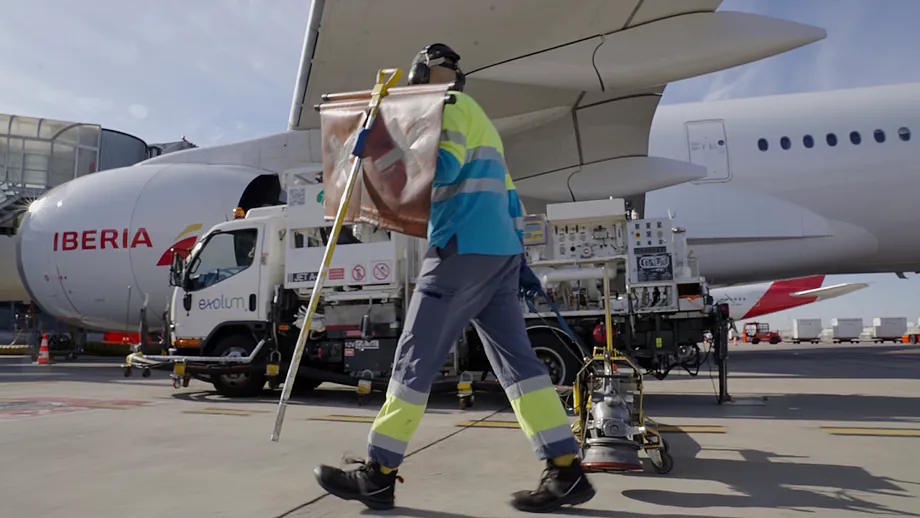
The airline sector usually plans its summer operations - which run from March 31 to October 30 - before the end of the first quarter of the year. In 2026, however, they will not be able to do so until at least the end of April. Airlines and airport managers know that, now that the major Covid crisis is over, demand is strong despite growing at a slower pace. The question now is whether they will have enough fuel at a good price to surpass the numbers from the previous summer season.
The forecast for how many passengers will travel this summer will be delayed for another two weeks. There are two uncertainties surrounding jet fuel - the fuel derived from crude oil that powers aircraft. The first is whether the supply will be cut off due to the war in the Middle East. The second is whether the conflict will drive its price to unaffordable levels. Today, it is already 120% more expensive than before February 28, when the joint attack by Israel and the United States unleashed hostilities and led to the closure of the Strait of Hormuz.
During the last summer season, Spanish airports recorded a record schedule of 247 million seats. It is now unclear whether this figure will be surpassed. "In the short term, we do not see any jet fuel supply issues that would force planes to remain grounded as has happened in other countries," says Javier Gándara, president of the Airline Association (ALA).
"Another issue," he explains, "is the prices." Fuel represents around 30% of an airline's operating costs. Companies hedge against price spikes like the current one with contracts where between 60% and 80% of their supply is locked in at rates well below market prices. However, this financial coverage has its limits because the remaining fuel must be purchased in a market that the war has stretched to the extreme.
According to Ryanair, this containment wall will not hold beyond next May, when they expect the extra cost to strongly impact ticket prices. Volotea has already cut 1% of scheduled flights in all the regions where it operates due to "geopolitical instability."
For now, the adjustments are surgical, but the situation could worsen in a matter of days, on the eve of the summer holidays. "If jet fuel prices are not corrected, companies will reduce capacity even if there is fuel available because they will have to raise prices, and not all customers will be willing to pay them," Gándara anticipates.
Thus, airports, airlines, and all economic activities dependent on the flow of travelers anxiously await a quick resolution in the Middle East and, above all, a return to normalcy in the Strait of Hormuz. For the European Union, the risk is critical because 45% of its jet fuel imports come from the Persian Gulf. Some of the 27 member states depend almost entirely on foreign product.
"Ships loaded with jet fuel that left Hormuz before the closure and take about a month to arrive are still arriving in Europe," say sources in the oil sector, who describe jet fuel as "the most threatened product" in the energy war. This maritime lag explains why airlines have started to worry much later than oil or gas markets, which reacted almost immediately.
"Jet fuel demand has increased by 3% to 5% annually, but in Europe, the production capacity of this fuel has not grown at the same rate because many countries have chosen to import it instead of producing it due to the increased costs resulting from environmental restrictions," explains Pedro Antonio Merino, former Director of Studies at Repsol.
Eight out of every 10 of the nearly 100 million tourists who arrive in Spain each year do so by plane, mostly on low-cost airlines. Despite this, the country has not yet activated panic mode. "There are no supply problems or concerns at the moment," reassure sources from Aice, the Spanish oil companies' association. Spain faces this new shock from a position of strength: it has the most powerful refining system in Europe.
Jet fuel production is complex. In broad terms, for every liter of crude oil that enters a refinery, only about 10% of what is extracted is aviation fuel, compared to 30% gasoline or 40% diesel in the most sophisticated plants. In recent decades, Spain has been an outlier in Europe, where refineries were closing, and dependence on foreign fuel was increasing. In 2025, national jet fuel consumption stood at 7.7 million tons. Nearly 30% was covered by imports, according to Cores. However, Spain would have room to self-supply as its refineries have the capacity to produce almost 9.9 million tons of jet fuel per year, according to industry sources.
Nevertheless, energy sector sources acknowledge that it is impossible to anticipate the situation in a few months. Even if there is a surplus of jet fuel here, aircraft on long-haul routes will be forced to refuel in areas affected by scarcity and price rallies. Michael O'Leary, CEO of Ryanair, the airline that moves the most passengers, has already warned: "We do not foresee any fuel shortages in the short term, but the situation is uncertain. At this time, our fuel suppliers can guarantee supply until mid-May."
In addition, Ryanair's CEO has announced fare increases: "Given that jet fuel prices have doubled in March, we expect all airlines to pass on these higher costs in the form of higher airfares starting from Easter and into the summer."