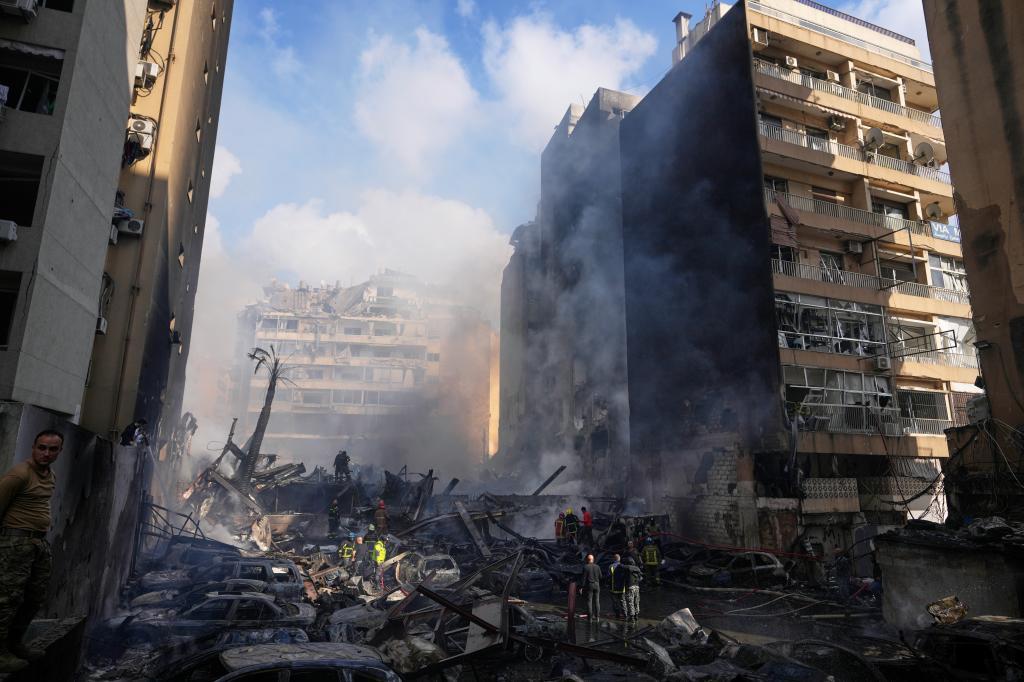
Meanwhile, the Israeli army has officially confirmed the execution of its "largest coordinated attack" to date, managing to simultaneously hit over a hundred command centers and military positions of the Shiite organization within a span of just ten minutes.
The massive offensive has primarily targeted the capital, Beirut, as well as the Bekaa Valley and various regions in the south of the country. Among the neutralized strategic targets are intelligence centers, naval and missile launch infrastructures, as well as assets of the Radwan Force and the 127th air unit, both elite bodies of the Shiite group. In response to this show of force, the Israeli Defense Minister, Israel Katz, has publicly threatened to kill the Hezbollah leader, Naim Qassem, emphasizing that the neighboring country had not suffered such a magnitude of aggression since the massive explosion of seekers in September 2024.
The preliminary casualty toll is devastating, with dozens of martyrs and hundreds of injured scattered throughout Lebanese territory. This emergency situation has compelled the Beirut Medical Syndicate to issue a desperate call to all physicians to report to hospitals to fulfill their humanitarian duty given the large number of affected individuals. The Ministry of Health has also urged the public to clear traffic routes in the capital to facilitate the passage of ambulances, while rescue teams race against time to extract survivors who are still trapped under the rubble.
On the diplomatic front, Lebanese Prime Minister, Nawaf Salam, deeply regretted Israel's escalation of violence against densely populated residential areas precisely as the recent agreement between Iran and the United States is being celebrated. Salam urged the international community to use all possible means to halt a war that has already claimed the lives of over 1,500 people and left 4,800 injured in Lebanese territory.