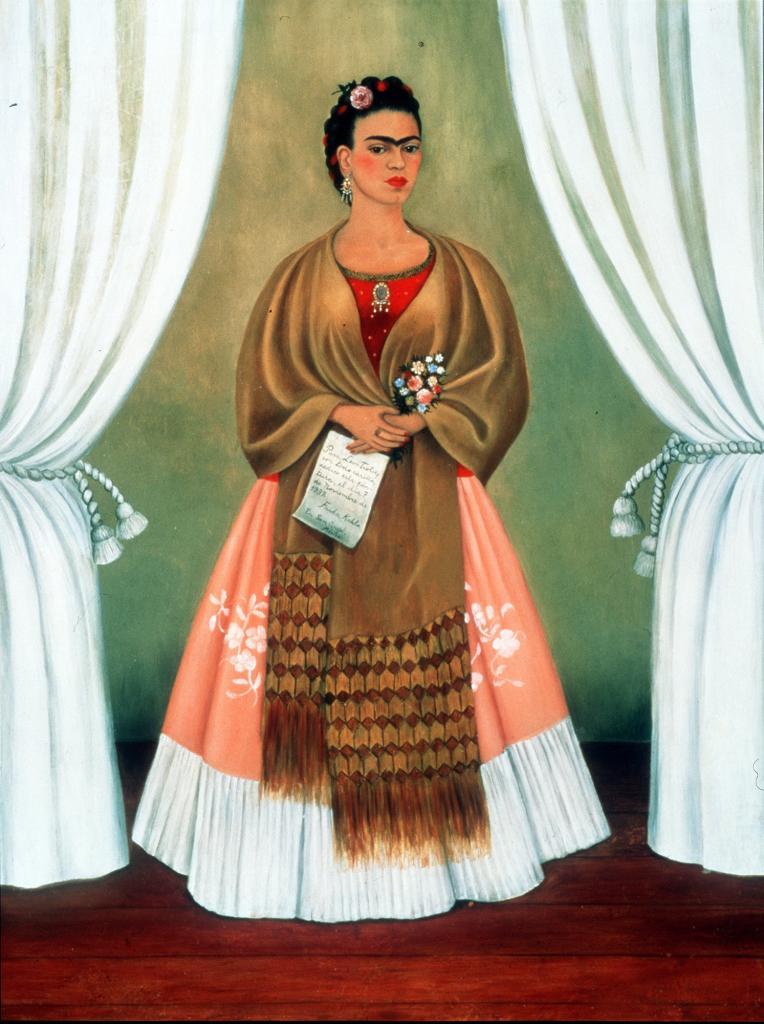
On January 21st, during a press conference, the officials of the Santander Foundation announced that the Gelman collection would be under their management following an agreement with the Zambrano family, the owners of the collection. The works of Diego Rivera, María Izquierdo, Rufino Tamayo, and especially Frida Kahlo would be the main attraction at Faro Santander, the cultural infrastructure that the bank will inaugurate this summer in the capital of Cantabria.
However, this agreement has sparked a national debate in Mexico, involving even the president, Claudia Sheinbaum. Over 400 art experts have already signed a letter demanding transparency from the government, opposing the removal of the works, and criticizing Santander as the final location to exhibit this collection. "Why does a foreign financial entity have to protect and promote this heritage instead of our government? This is the government's responsibility, which is also mandated by law. Can a bank have more power than our entire country?," states María Minera, an art critic and signatory of the letter. "I understand that since it's a collection, it shouldn't be expropriated as it would cause panic among collectors, but we should consider how these works can generate economy here. Symbolically, they belong to the Mexican people."
The main point of contention is Frida Kahlo's works, subject to a 1984 regulation detailing that the "exportation" of her works is "prohibited," except in "exceptional cases" where the National Institute of Fine Arts and Literature (Inbal) authorizes their "temporary export" for "the convenience of spreading national culture abroad." Currently, four of the painter's over 150 works are permanently exhibited in the Central American country. "It's as if Spain handed over all of Velázquez's work to a private foreign entity," adds historian Francisco Berzunza. He continues, "The Prado has a complete room dedicated to Velázquez as the foundational artist in Spanish art history, and Las Meninas have never left the Prado. Frida is not our foundational artist, but she is an analogue. Why is it easier to see her works outside of Mexico than within our country?"
The Gelman collection has been embroiled in controversy since 1998 when Natasha Gelman, the last owner, passed away. In her will, the American curator Robert Littman was designated as executor. After several legal processes in the early 2000s, in 2023, an agreement was reached for the sale to the Zambrano family. With them, the Santander Foundation reached an agreement to manage the works until 2030, with a return to Mexico in 2028 to comply with customs legislation, as reported by The Guardian. Although this agreement is extendable. "The big question that arises is what will happen after 2030. We don't know if Santander will take ownership of the collection and claim that the pieces are too fragile to travel, remaining there as their permanent home. To see Frida's work, we will have to travel to Spain because the Mexican government has not taken care of its people or its heritage," points out Ximena Apisdorf Soto, curator, cultural analyst, and signatory of the letter against the agreement.
In response to the controversy, Mexican President Claudia Sheinbaum had to address the accusations against her government since Inbal is the entity responsible for granting permits for the export of these works. "The cultural authorities will comply with the law and will defend the artistic heritage," she stated in a press conference, emphasizing, "How many times do we have to say that the Ministry of Culture is complying with the law?" However, the Mexican cultural sector insists on the application of the 1984 law. "This can be sold as a great thing, disguised as a way to protect heritage, but it's simply a financial transaction being allowed by the government," concludes María Minera.
During the presentation of the new Gelman Santander collection, the director of Faro Santander, Daniel Vega, emphasized that the permanent presence of the works in Spain was guaranteed by the "flexibility" of Mexican regulations. This statement has also raised suspicions among the letter signatories criticizing the agreement. "The origin of the popular outrage, I think, lies in that, especially when we talk about Frida Kahlo. Clearly, she is a cultural icon definitely comparable to the Sun Stone in the Museum of Anthropology," adds Berzunza. Minera concludes, "It's not flexible for anyone in Mexico except for Banco Santander."
In response to the generated controversy, the Santander Foundation released a statement defending that the agreement does not imply "in any case" the acquisition or permanent transfer of the collection outside of Mexico. "There is close communication and coordination with the National Institute of Fine Arts and Literature of the Ministry of Culture of Mexico, so that, at the appropriate time and with their authorization, the corresponding permits for the temporary export of the Artistic Monument works that are part of this collection are managed. Likewise, for the supervision of their conservation status during their exhibition abroad," the statement adds.