The office of the Pakistani Prime Minister, at the foot of the Margalla hills, a wavy and green range that marks the natural boundary of Islamabad and casts its shadow over the government district, is not usually the scene of grand gestures. However, in the early hours of Wednesday, while major Western capitals held their breath amid Donald Trump's threats to attack Iran and "wipe out an entire civilization," the figure of Shehbaz Sharif, 74, emerged with a tweet. The Pakistani leader "earnestly" asked the President of the United States to postpone the ultimatum by two weeks, while also requesting "Iranian brothers" to reopen the Strait of Hormuz during the same period as a "gesture of goodwill."
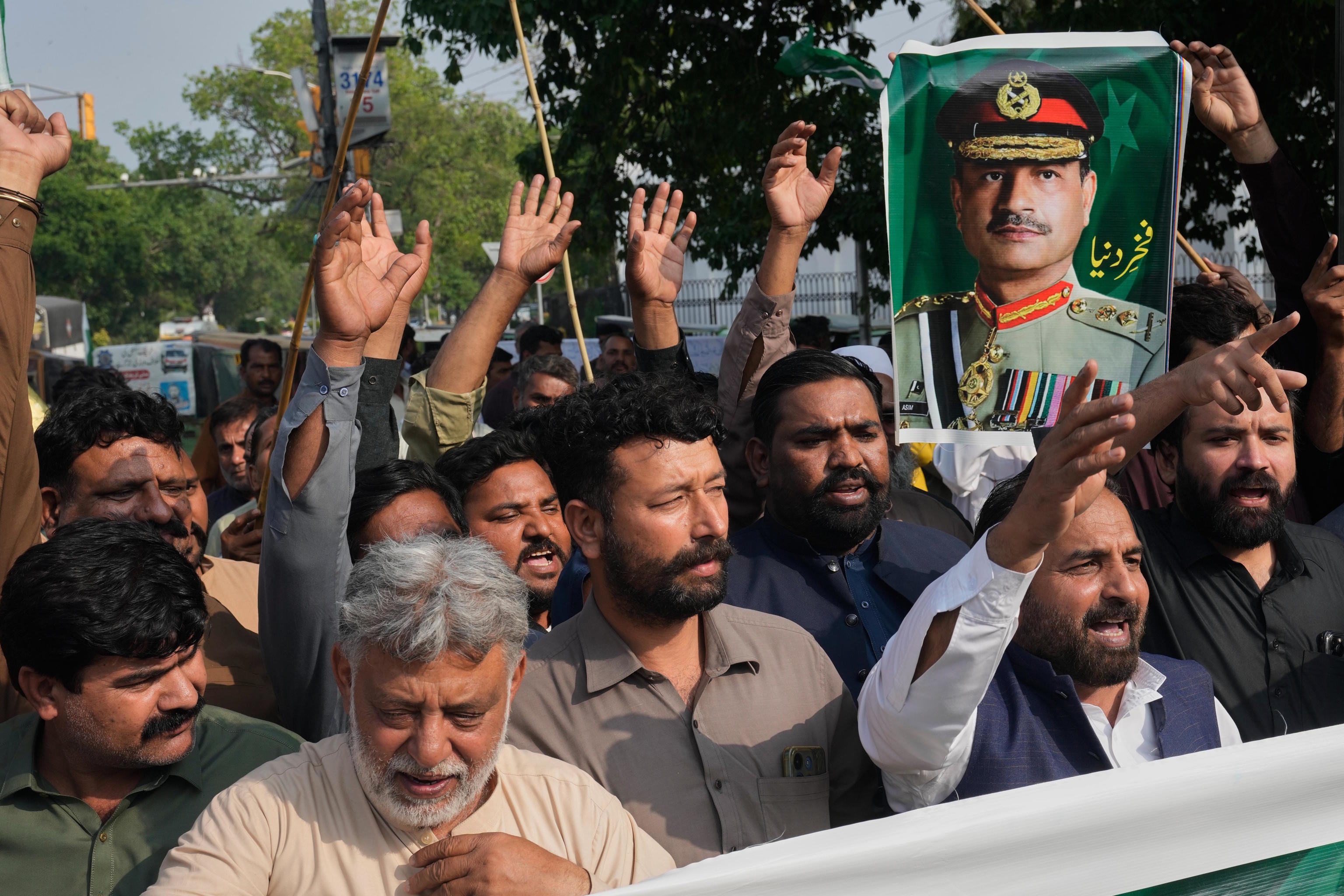
Less than an hour later, Trump announced the bilateral ceasefire, acknowledging Pakistan's central role in the mediation. The American stated that he had held discussions with Prime Minister Sharif and with the powerful Pakistani Army chief, General Asim Munir, who many now point to as the main architect - albeit in a more discreet public role - of the temporary truce.
This episode has catapulted Sharif and Munir to the center of the diplomatic stage, with the former acting as the voice of the initiative and the latter as its strategic brain.
It was the Prime Minister who later announced that Islamabad will host the first round of face-to-face negotiations on Friday to reach a peace agreement. But an even bigger surprise came later when Trump himself commented that China, which has long supported the sanctioned economy of the Iranian regime, had persuaded Tehran to negotiate. This has been acknowledged by Iranian officials themselves. The Asian superpower also committed to act as a guarantor for the U.S. to accept some of the 10 points proposed by the Islamic Republic to achieve a definitive end to the conflict.
In Beijing, there was silence regarding this last-minute intervention that pushed Iran to accept the ceasefire agreement. Meanwhile, from Islamabad, Sharif spent Wednesday posting messages on X thanking China and other relevant actors from the Middle East for their support in the mediation. International spotlights are now focusing for the first time on a leader who is the heir to one of Pakistan's most influential political dynasties and the younger brother of Nawaz Sharif, a three-time Prime Minister.
The current leader has built his reputation as an effective manager, especially during his time leading the Punjab region. Local analysts say his style is more bureaucratic than that of his predecessors, who had more charismatic (and authoritarian) profiles. However, the outbreak of war in the Middle East led to Sharif emerging as a bridge between the U.S. and Iran due to Islamabad's close relations with both countries.
In contrast, Munir's figure (58 years old) is a product of a historical trend in Pakistan: where the line between civilian and military governance is deliberately blurred, and where generals are often both arbitrators and political actors.
The general's strength on the global stage is that he has managed to establish a personal relationship with Trump. Dressed in a business suit rather than military uniform, he visited Washington with Sharif last year after praising the American leader's "bold and visionary" intervention in a brief confrontation between Pakistan and India in the divided Kashmir. Trump even referred to Munir as his "favorite field marshal."
According to some Washington officials who spoke to U.S. media, the general's good rapport with Trump was due to the fact that, when the Republican began his second term, Munir shared intelligence information and handed over a Taliban militant suspected of planning the 2021 attack at Kabul airport, a gesture that was interpreted in the U.S. as evidence of close cooperation in counterterrorism. Additionally, Munir publicly stated that Pakistan had nominated Trump for the Nobel Peace Prize for his role in mediating the conflict with India.
All this rapprochement was quite remarkable considering that, during his first term, Trump accused Islamabad of harboring terrorists - Osama bin Laden was located on Pakistani soil in 2011 - and the previous Biden Administration described Pakistan as one of the most dangerous countries in the world due to its nuclear ambitions. However, in recent months, the White House has pointed to Munir as a key interlocutor in the fight against terrorism.
The military officer has been identified as the "nighttime interlocutor" between senior U.S. officials - including Vice President JD Vance and Special Envoy Steve Witkoff - and Iranian Foreign Minister Abbas Araghchi, giving him a unique position to build bridges where others could not.
Munir, who was the head of Pakistan's main intelligence agency, was appointed as the top general in 2022 by Sharif. At the end of last year, a constitutional amendment created a new position that placed him above the three branches of the Armed Forces and granted him lifelong immunity, equating him in legal protection to the Prime Minister.
Officially, he was supposed to retire in 2027, but the new five-year term position effectively reset the command clock. And the title of field marshal he also holds opens the door for him to continue influencing even after formal retirement. In a country accustomed to alternating military dictatorships and authoritarian civilian governments, Munir holds a mix of arbitration and governance in his hands.
Sharif and Munir have spent the past few weeks activating an indirect channel at times when official communications were frozen. It has not been a typical negotiation, with delegations sitting face to face, but rather a choreography of measured messages and continuous coordination with regional actors such as Egypt and Turkey, who also played auxiliary roles in keeping dialogue paths open.