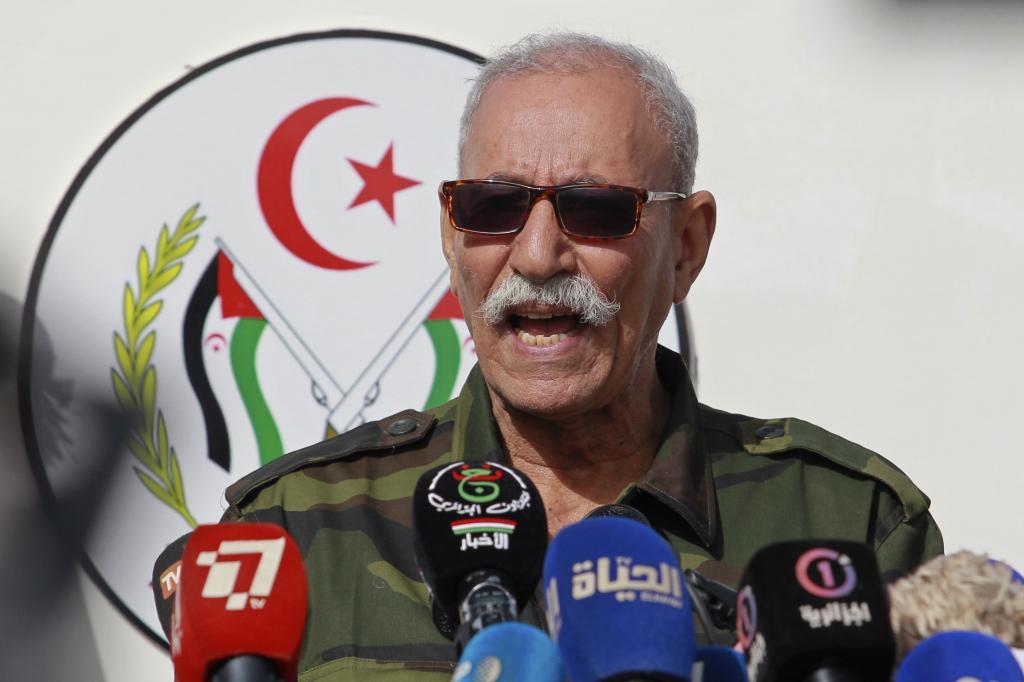
Batir Mohamed was 14 years old on the day of the first attack by the Polisario Front as a political force, on May 20, 1973. "Of the 17 who participated, only four survived," he tells EL MUNDO. Among them was a young Brahim Ghali, one of the founders of the liberation movement, who became a comrade in arms with Batir the following year. Now, Brahim Ghali is the president of the Polisario Front, and Mohamed, a veteran soldier from the early promotions of the Liberation Army. This Wednesday, he was in the Auserd camp with his veteran robe, a group of septuagenarian comrades, and four dromedaries. The celebrations of the 50th anniversary of the founding of the Sahrawi Arab Democratic Republic (SADR) took place there, bringing together thousands of Sahrawis.
From early in the morning, dozens of dilapidated Mercedes moved along the sandy roads of the camp while soldiers, brought from the liberated territories, assembled and prepared by units to parade. There was Hanna, 43, who works most of the year as a delivery driver in Alicante and is a sort of reservist who comes when mobilized: "It is my duty to help." Also Ahmed, a soldier born in 1990 from a family linked to the military: "Two of my uncles were killed by Moroccan forces," he confessed to EL MUNDO.
At ten in the morning, Brahim Ghali appeared on the makeshift platform of authorities, filled with Spanish delegations who attended the festivities. "This is an occasion to pay tribute to the souls of all the martyrs of the national cause," he began his speech. Because since that February 27, 1976, the Sahrawis have lived in a permanent conflict, with an open war with Morocco and without finding a solution for their land. The Sahrawi issue is one of the longest unresolved territorial conflicts in the world. But Ghali has extended a hand to the Moroccan neighbor: "The Sahrawi republic affirms its determination to strengthen and consolidate its relations with countries and peoples of the world, especially in its regional environment, including all its neighbors; among them, the king of Morocco, emphasizing that the Sahrawi people will not be a source of threat but a willing partner for peace and cooperation," he reiterated once again.
Auser (SADR), March 8, 2026. Military parade and commemorative events for the 50th anniversary of the proclamation of the SADR (Sahrawi Arab Democratic Republic).Photo: Antonio Heredia
In 1975, Spain promised the United Nations to hold a referendum on the independence of what was once its 53rd province. But the Green March promoted by Morocco led to the agreed and sudden abandonment of the territory. Since then, the Alaouite government has advanced in the occupation of the Western Sahara, which it now controls 80%. The stateless Sahrawis live in five refugee camps in Algeria. Additionally, on March 18, 2022, the government abandoned its traditional neutrality and supported the Moroccan autonomy plan as the most feasible solution to the issue.
At present, the Western Sahara is divided in two by a massive Moroccan defensive system, known as the Wall, over 2,700 kilometers long. The western zone, with access to the sea and important cities like El Aaiún, is controlled by Morocco; while the east is dominated by the Polisario Front in what they call liberated territories. The United Nations has a mission in the area, but with little influence despite its deployment in five bases on each side of the wall. Furthermore, the territory's administration remains in the hands of the Spanish government because it did not fulfill its decolonization obligations.
Ghali described the establishment of the SADR as "an urgent response to a comprehensive colonial conspiracy, in which Spain, the administering power, tried to evade its legal responsibility towards its colony through an illegal agreement, with the aim of depriving the Sahrawi people of their right to existence and self-determination, and paving the way for a new occupying force to seize their national territory," he stated, highly critical of Spain. But he also expressed optimism because Ghali congratulated himself that "in an unprecedented situation, the Sahrawi State has institutions that enable it to fully assume national management after the completion of its sovereignty," and he also stated that the State "has managed to affirm its existence, presence, and continuity despite the conditions of occupation, dispersion, and exile, achieving remarkable accomplishments on all fronts, even challenging for fully independent states."
Auser (SADR), March 8, 2026. Military parade and commemorative events for the 50th anniversary of the proclamation of the SADR (Sahrawi Arab Democratic Republic).Photo: Antonio Heredia
Although he boasted that "the Sahrawi State is a national, continental, and international reality, with Embassies and representations of the Polisario Front on all continents and playing its role as a founding member of the African Union, assuming responsibilities in promoting peace." His words clash with international reality. Because the diplomatic deployment that began with Hassan II to occupy the Sahara has been continued by Mohammed VI with success. In addition to Spain, many countries have embraced the Moroccan autonomy plan as the most feasible solution. The United States did so in 2020 in exchange for the Alawites establishing relations with Israel. And last October, the United Nations also embraced their proposal.
All of this did not overshadow the sense of optimism of the thousands of Sahrawis who yesterday crowded around the celebration site. Declared a holiday, the celebrations continued until the curfew began at night. There was a folklore exhibition and a traditional craft fair, with tents arranged in a circle reminiscent of those first tribes that were colonized by Spain and whose conflict has yet to be resolved 50 years later.