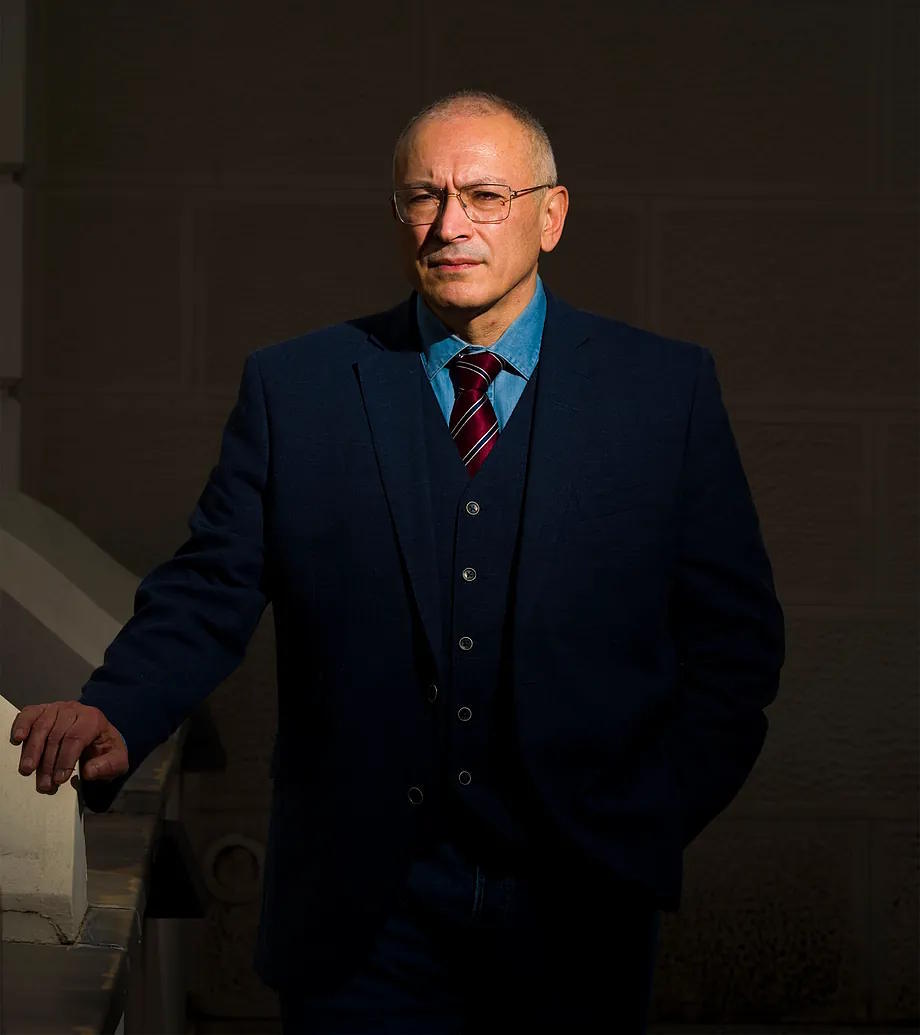
He was the most prominent of the oligarchs in post-communist Russia and the sixteenth richest person in the world while leading the Yukos oil company. But everything changed when Mikhail Khodorkovsky founded the Open Russia Foundation in 2001, aimed at strengthening civil society in Russia. His criticism of the corruption of Vladimir Putin's regime led him to prison and to lose a company that would eventually be bankrupted by the State. He spent nearly a decade in the fearsome camp number 13 of the Krasnokamensk prison in the former Chita province, in southeastern Siberia. Pardoned, he emigrated to London, where he lives and works as the founder of the NEST Centre, dedicated to the analysis of Russia and its surroundings.
This week, the former tycoon has been in Madrid as a guest of the Rafael del Pino Foundation, where he agreed to talk about the current situation in his country, the toughest experiences of his captivity, and a future beyond Putinism.
Putin is 73 years old. Who do you think will succeed him?
It is very difficult to know. Let's imagine a brick falling on his head. This is like the Russian joke where two bricks are walking on a roof. One says, "Hey, do you think it will rain today?" And the other calmly replies, "It doesn't matter... The important thing is to be a good person." I could mention several names, like Mishustin, but what is clear is that whoever it is, logic and Russian history show us that Putin's successor will be much weaker and more vulnerable than him. It is even possible that a kind of collective will end up governing the country, not a specific person.
Will Russia ever become a consolidated democracy?
I estimate it will take 20 years not for the arrival of democracy, but for its population to regain balance and stop seeing itself surrounded by enemies. In terms of democracy, more time will be needed. Russia is too large and has many very different communities. Much more democratic desire could be seen in the big cities than in the inland areas, where it is very difficult to think of a European-style system.
Should Europe get used to a Cold War with Russia?
Yes. Europe must realize that the only thing that can save it from a hot war is to have the ability to defend itself. Putin has become accustomed to solving his internal political problems through external aggressions. He has done so on four occasions. That is his modus operandi, and at his age, he will not change his way of acting.
Historically, the outcome of wars has shaped Russian politics, from a regime change when the result has been catastrophic to a consolidation of the same if it has been victorious. Does Putin's future depend on the war in Ukraine?
For now, he is winning the war. History shows us that if you win wars, the dictator stays in power. If Putin had thought he could lose it, he would not have started it. That is why it is very important that he does not feel capable of underestimating NATO and annexing, for example, the Estonian city of Narva.
Could prolonging the Ukrainian conflict be a strategy to create a war economy that allows Russia to reduce the technological gap with the West through the military industry?
I don't think so, the Russian military industry is deteriorating. There are delays. This deterioration is only compensated by supplies from China. The government's goal is to improve the Army's effectiveness. Let's not forget that in Europe now there are only two serious armies: the Russian and the Ukrainian.
Is the Kremlin concerned about the internal wear and tear that Donald Trump is experiencing?
It is clear that the Trump presidency has been very beneficial for him.
Do you see similarities between the Russia of the oligarchs you knew and the relationship of many Silicon Valley entrepreneurs with the White House?
I don't quite understand the influence of tech entrepreneurs on US politics, but I must say that the perception of Russian oligarchs has been a myth...
A myth?
A myth that we owe to Boris Berezovsky and that was later reinforced by the case of Boris Nemtsov...
Were the richest businessmen not part of the system?
Businessmen have never played a significant role in Russian political life. There is a saying in Russia that gold can buy everything, but the knife can take it all. State security forces have always had much more power than businessmen. I guarantee you that if it had been the other way around, Russia would not be at war.
As an expert in the oil industry, what impact do you expect the Iran war to have on the economy? Russia could be the big beneficiary.
Russia was exporting as much as it could. Increasing production significantly would not be possible because it could only be increased in wells with aquifers, which does not represent a very high increase. New wells would have to be opened.
Do you have new information about Russian support for European populist and separatist movements?
I am sure that in the coming years, Putin will carry out a hybrid war against Europe, and his goal remains to weaken institutions. He believes that if he destroys European unity, Russia will be the hegemonic power on the continent. He is interested in sowing discord and will take advantage of existing rifts. This was the case with the burning of Qurans, which incited the anger of the Muslim world against Sweden. In Spain, there are independent groups, which I consider marginal, that Putin sees as vulnerable points in the system. It would not hurt to investigate financial movements in this area.
Do you not think that the current internet censorship in Russia is a sign of weakness of the regime?
Of course. This control is a classic of authoritarian regimes. Putin is an experienced politician and, from my point of view, always uses a criterion based on limited reprisals. Those that are necessary to retain power. The problem is that as he ages and the regime weakens, he needs these reprisals to be increasingly forceful. In that sense, the FSB has not evolved much in terms of freedom of expression, it acts just like the KGB in the Soviet era.
What did you talk about in your last conversation with Putin?
About a possible merger of Yukos with Sibneft, Roman Abramovich's company [this oil company was eventually sold to Gazprom in 2005].
At that time, you were the richest man in the country. What strategic mistake do you consider crucial for your downfall in the eyes of the Kremlin?
I was a businessman, not a politician. In the late '90s, after the crisis we went through, I began to show more interest in public affairs, in how the system was being built. I got too involved and wanted to change things without realizing that Putin had already decided that systemic corruption would be the pillar of the regime. Had I known, my business career might have lasted longer. It's like the story of the frog: if it falls into a pot of boiling water, it jumps out; but if it falls into lukewarm water, it ends up boiling to death without being aware of it. What I don't know is what would have happened if I had fallen into the lukewarm water... Maybe today I would be on the other side of the fence. Would it have been better or worse for me? I think worse. My family now supports me, something that would not have happened if I had been on the other side.
Are you afraid of being assassinated?
To my relief, the State has not tried to kill me. If it had, the survival probability would be 10%. In prison, I was indeed attacked with a knife, but it was not ordered by the State, it was for another reason. It is true that people close to the regime did threaten me. Yevgeny Prigozhin, head of Wagner, put a price on my head, and Ramzan Kadyrov, the leader of Chechnya, called me an "enemy of Islam" for defending Charlie Hebdo and asked Putin for permission to cut off my head.
What is the memory that haunts you the most from your time in prison?
It was not a pleasant experience, but one of the things that impressed me the most was meeting some fantastic people, who did not come from my environment, but from rural Russia. I owe my life to some of them. As for negative experiences, I remember with horror the transfers to court, which could last many hours. They would put me in a metal box that was like a coffin that prevented me from moving. In summer, the temperature reached 50 degrees, and when you passed out, it was so strange that you couldn't fall to the ground. The guards were forbidden to take me out of that cubicle. I would lose consciousness over and over again.