He had never designed a winery. Extraordinary buildings, many. The Millennium Bridge in London, the dome of the Reichstag in Berlin, the Bilbao metro... But the world of wine production was new to Lord Norman Foster, the founder of Foster + Partners, the galactic architect with the Pritzker Prize. Vineyards, tanks, barrels. Family, roots, tradition. Would it work? It did.
Furthermore, Foster repeated. First in Ribera del Duero with Portia and then in Rioja Alavesa with Bodegas Faustino, which has just been awarded the title of European Winery of the Year, according to the Wine Star Awards by Wine Enthusiast. An international recognition of the enotourism vision of the fourth generation of the Martínez Zabala group, which, with Foster's help, has propelled the winery into the future. The award is "a great recognition of our more than 160 years of history, the hallmark of our generation," says Lourdes Martínez Zabala, CEO of the group. This is the winery of her childhood, her home, where she saw her grandfather Faustino build an empire. Because this is not just any winery.
In this triangle that unites the Basque Country, Navarra, and La Rioja where we are, in the town of Oyón, Bodegas Faustino hides nothing less than 60,000 barrels and nearly 9 million bottles. Its flagship is a highly prestigious and recognizable red wine: that dusty bottle with wire mesh and the famous portrait of a linen merchant painted by Rembrandt. Faustino I is the best-selling Rioja Gran Reserva in the world. "One out of every three bottles of Rioja Gran Reserva that we put out into the world is ours," emphasizes Lourdes.
Hiring a superstar architect entails risks. It's a gamble. Of course, harvesting and waiting for years and years to release that wine to the market is also an act of faith. Why did they want to build a winery with Norman Foster? "Back in 1990, my father built Bodegas Campillo with the idea of attracting the public. They thought he was crazy. No one had spent that much money on a winery, but he wanted to convey what was behind a bottle of wine." Lourdes explains that her father was convinced that money shouldn't be spent on advertising in magazines, but on bringing people to the winery. "Let them find out what a bottle of wine is, what's behind it, what's in the grape." So, except in Jerez, no one was opening wineries, and certainly it wasn't called wine tourism.
Julio Faustino's bet, Don Julio, paid off. And in 2003, when they planned to create a new winery in Ribera del Duero, they decided to tempt Foster + Partners. "We were looking for design but, above all, we were looking for functionality," points out Lourdes, who had seen the dome of the Reichstag in Berlin and was captivated. Seven years later, Portia was inaugurated in Gumiel de Izán (Burgos). The first winery in Foster's catalog is a flower with three petals. One for fermentation in steel tanks, another for aging in oak barrels, and the third for aging in bottles. Everything is controlled in the heart of the winery. The most innovative aspect is that we are facing the only winery with a walkable roof. Through it, trailers loaded with 20,000 kilos of grape boxes arrive, are deposited in the hopper, and fall by gravity into the tanks 14 meters below. Portia is simply brilliant.
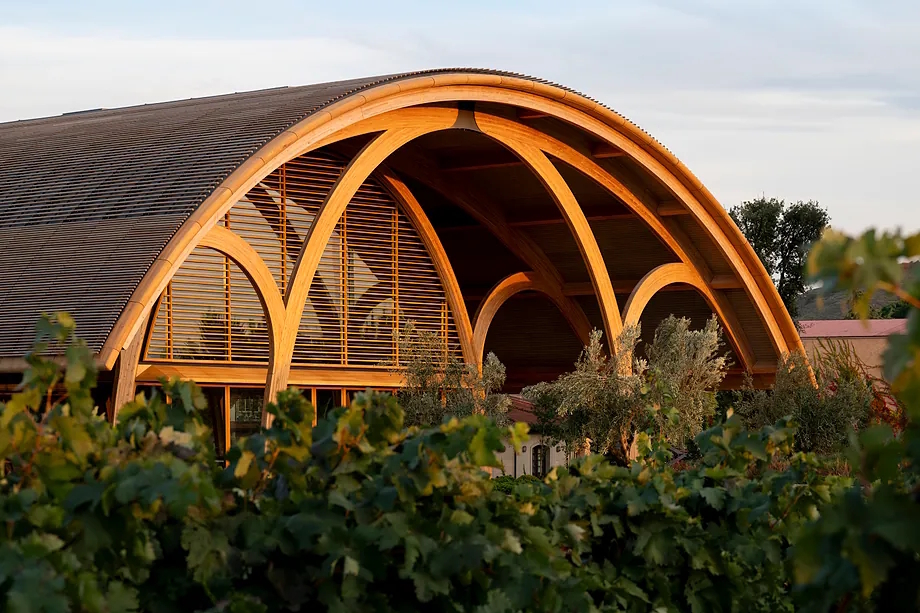
Not all wineries designed by renowned architects have met expectations. This one in Ribera del Duero did. With this precedent, the Martínez Zabala family and Lord Foster joined forces again to create The Legacy of Bodegas Faustino. That's the name of the spectacular visitor center of the winery in Oyón, inaugurated in the fall of 2024. "Profitability, well obviously we weren't looking for profitability," confesses Lourdes. "Some like airplanes, and we like wineries. Wine is our life, and we wanted to give it a beautiful place."
The Legacy of Bodegas Faustino
Larch wood dominates Norman Foster's design, a building that uses photovoltaic energy and is self-sufficient.
The center is the first thing visitors see when they arrive at the winery: a wooden building rises among vineyards as if it were an old European train station. However, it is fiercely contemporary. It is built with larch wood, a material that Foster knows well because he used it to build his own house in Switzerland. Over time and with the onslaught of rain, it takes on a grayish color. Design aside, we are facing the first enotourism project Planet 1.0, which means that the carbon footprint emitted during construction has been easily absorbed by the ecosystem. It also has the Energy Plus label. Lourdes explains: "The visitor center only consumes 30% of the energy it generates through its high-tech solar panels. The remaining 70% is poured into the other facilities. There are times when the winery is energy self-sufficient."
The other magic of the building is its transformative capacity. Any wine-related activity imaginable can be carried out there. "We wanted a space where we could do everything, even sing. In fact, it has excellent acoustics because the previous one is lined with fabric," says the CEO. Every detail is carefully thought out. The furniture, for example, fits inside each other to open up the space as if it were a theater, a cinema, or a bingo hall, to name a few of the activities that are paired here with wine. The wine bar, with an outdoor terrace, has become a must-visit for enjoying vermouth.
Needless to say, the visitor center has become the main protagonist of the winery, although the British architect also took care, years earlier, of revamping the entire winery complex. Since its inception in 1968, the winery had grown haphazardly, according to needs. "Faustino is the largest winery we have, and it is immense: we had 19,000 square meters of facade," explains Lourdes. "It made no sense. Foster played a key role in rationalizing all the spaces.
Visitors can see this during the tour of the facilities. The most surprising thing is that room with 60,000 barrels. A power that is understood in the museum where they talk about the 140 countries they export to, but also about the history of this family: that linen merchant, Eleuterio Martínez Arzok, Lourdes' great-grandfather and the first to buy vineyards and fall in love with wine in 1861. Of her grandfather, Don Faustino, the youngest of the five children and a pioneer who wanted to do as the French did: bottle all the production. And of her father, Don Julio, who in 1958 decided that what he had to do was to export, open up to the world, and borrowed that portrait from Rembrandt for Faustino 1...
In addition to the award for European Winery of the Year, this project has been recognized with the Best of Wine Tourism International 2026, awarded by the Great Wine Capitals Global Network (GWC), as one of the best wine tourism spaces in the world.