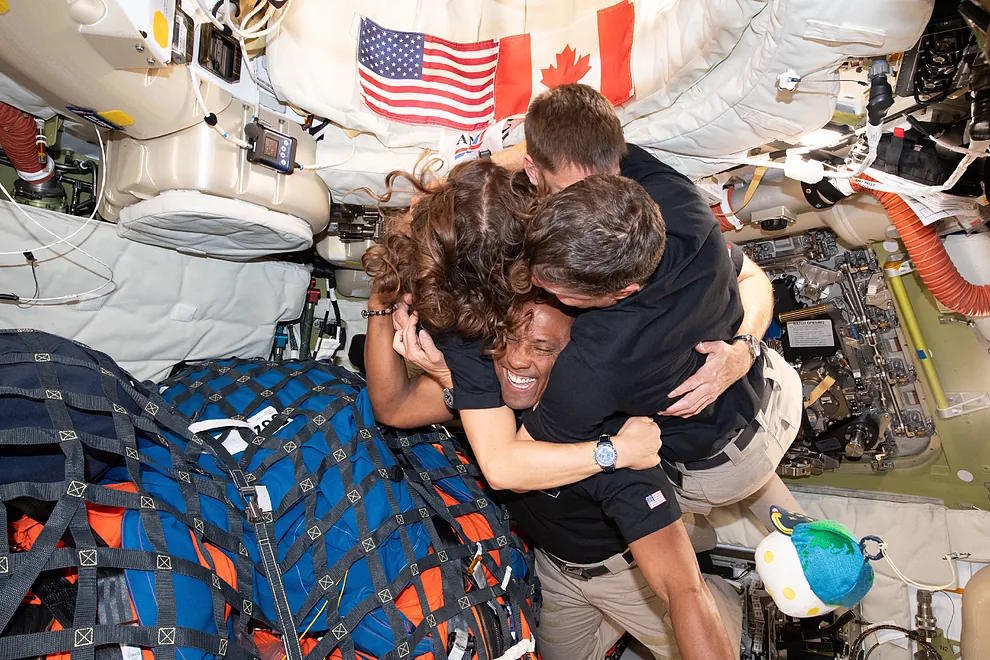
After traveling 700,000 kilometers through deep space, having flown over regions of the far side of the Moon never seen by the human eye, and having gone farther than any other Earthling in history, Reid Wiseman, Victor Glover, Christina Koch, and Jeremy Hansen are preparing to experience the most dangerous and risky phase of the entire Artemis 2 mission: returning to Earth.
The critical moment lasts only 14 minutes. Within them lies the collection of the most extreme risks of space exploration: hypersonic speeds, temperatures comparable to those of a star, and physical forces capable of crushing an astronaut against their seat.
All of this will happen between 1:53 and 2:07 in the early hours of Friday to Saturday in Spain. The time that will pass from when the Orion spacecraft enters the atmosphere until it splashes down in the Pacific.
After completing its trajectory around the Moon, the Orion does not ignite engines to return. It simply begins to fall. After leaving the gravitational influence of the Moon, the capsule entered a long fall towards our planet, with the heat shield pointing towards the sun, and guided by the compass of gravity and orbital mechanics.
Half an hour before splashdown, astronauts must be inside their pressurized suits and seated in their seats. The cabin has been reconfigured for descent, equipment has been stowed, panels secured, and systems prepared to withstand deceleration. At that moment, a final small trajectory correction burn is executed, which will adjust the exact point where the capsule enters the atmosphere to land at the desired point in the ocean.
With 20 minutes to go, the European service module (ESM), which has provided power, water, and propulsion throughout the journey to the Moon, separates from the capsule, will be lost in the atmosphere, and will be destroyed.
The critical 14-minute phase begins at 120 kilometers in altitude (commercial airplanes do not exceed 12). During descent, the spacecraft accelerates progressively until it reaches 40,000 kilometers per hour when it enters the Earth's atmosphere (those returning from the International Space Station stay at 28,000 km/h). At that speed, a flight from Madrid to New York would last ten minutes. At that speed, the spacecraft does not cut through the air but violently compresses it, creating a shockwave in front of the capsule that could raise the temperature to 2,760 degrees Celsius. The result is an incandescent plasma that completely envelops the spacecraft. Astronauts who experienced it describe how the black sky of space disappears, and the windows fill with liquid fire. A phenomenon that Charlie Duke, of Apollo 16, described as "entering a fireball." Frank Borman, of Apollo 8, reported seeing "tongues of orange fire," Michael Collins, of Apollo 11, saw them as red. And Gene Cernan, of Apollo 17, saw red, orange, and purple.
The entire survival of the crew now depends on a single system: the heat shield. A spacecraft falling from space must become a vehicle capable of surviving the fire. The Orion shield is made of Avcoat, an ablative material designed to burn slowly during reentry. By charring and shedding layer by layer, it carries away the extreme heat, preventing the interior of the capsule from melting.
This part of the system has received special attention since the Artemis I mission. On that unmanned flight, engineers discovered that gases generated during ablation could not escape correctly from the material, leading to a buildup of pressure and the appearance of cracks in the spacecraft.
Although after the incident NASA concluded that the system remained safe, it decided to modify the entry profile of Artemis II, eliminating the originally planned skip atmospheric maneuver. This maneuver involved the spacecraft not entering the atmosphere all at once but bouncing off the upper layers before reentering, like a stone skipping on water. In the end, NASA has opted for a direct reentry to try to reduce the time of extreme heat. The thermal shield's safety is literally the difference between returning home or losing the spacecraft and astronauts.
But the problems do not end there. While the shield slowly burns away, astronauts will feel another pressure: the brutal deceleration. During the most intense phase of reentry, forces can exceed several times Earth's gravity, pushing the crew against their seats as the capsule brakes violently. Jim Lovell, of Apollo 8 and 13, and the father of the iconic phrase, "Houston, we have a problem," described the G-forces as "as if a giant hand were pushing you against the seat." An 80 kg astronaut can feel a weight equivalent to over 500 kilos pressing against their body for a few seconds.
At the same time, something inevitable happens, complete silence. The plasma surrounding the spacecraft blocks communications with Earth for several minutes. From mission control in Houston, the capsule even disappears from radars, becoming uncommunicative just as it goes through its most critical moment. If something goes wrong, no one on Earth can help them. But if all goes as planned, communications will be restored in the last four minutes.
The plunge through Earth's atmosphere will reduce the spacecraft's speed to 500 km/h, and when it is about 7.5 kilometers in altitude, the spectacle of up to eleven parachutes will begin. First, three will open just to drag and remove the cover of the compartment for the two braking parachutes. Their function is not to stop the capsule but to stabilize it and reduce its speed to 210 kilometers per hour. When there are only two minutes left, and at about three kilometers in altitude, three pilot parachutes, small but very sturdy, will be deployed to extract the three main parachutes, white and orange for visibility, each about 35 meters in diameter, and together could cover a soccer field.
In a matter of minutes, the capsule goes from thousands of kilometers per hour to just 27, before splashing down in the Pacific at the speed of a leisurely drive through a residential neighborhood. To prevent rough weather, waves, or strong winds from capsizing the capsule, it has a righting system, known as CMUS, consisting of five bright orange helium bags located at the top, programmed to deploy even in calm weather conditions. The capsule must remain in a vertical position for the communication systems to work, providing a more comfortable wait for the astronauts before being rescued by the U.S. Navy amphibious assault ship USS John P. Murtha.
Divers will secure the capsule, install stability floats, and open the hatch. Only then, when the astronauts step out onto the rescue ship's deck, can it be said that the Artemis 2 mission has ended.